Google Turns the Pixel 11 Into a Gemini Field Office
Google’s Pixel 11 turns Gemini into a phone-wide assistant. The useful bits are real; the $899 bill and ambient omniscience are real too.
Somewhere in New York on Wednesday, Google unveiled a phone whose most important feature is that it would like to stop being a phone.
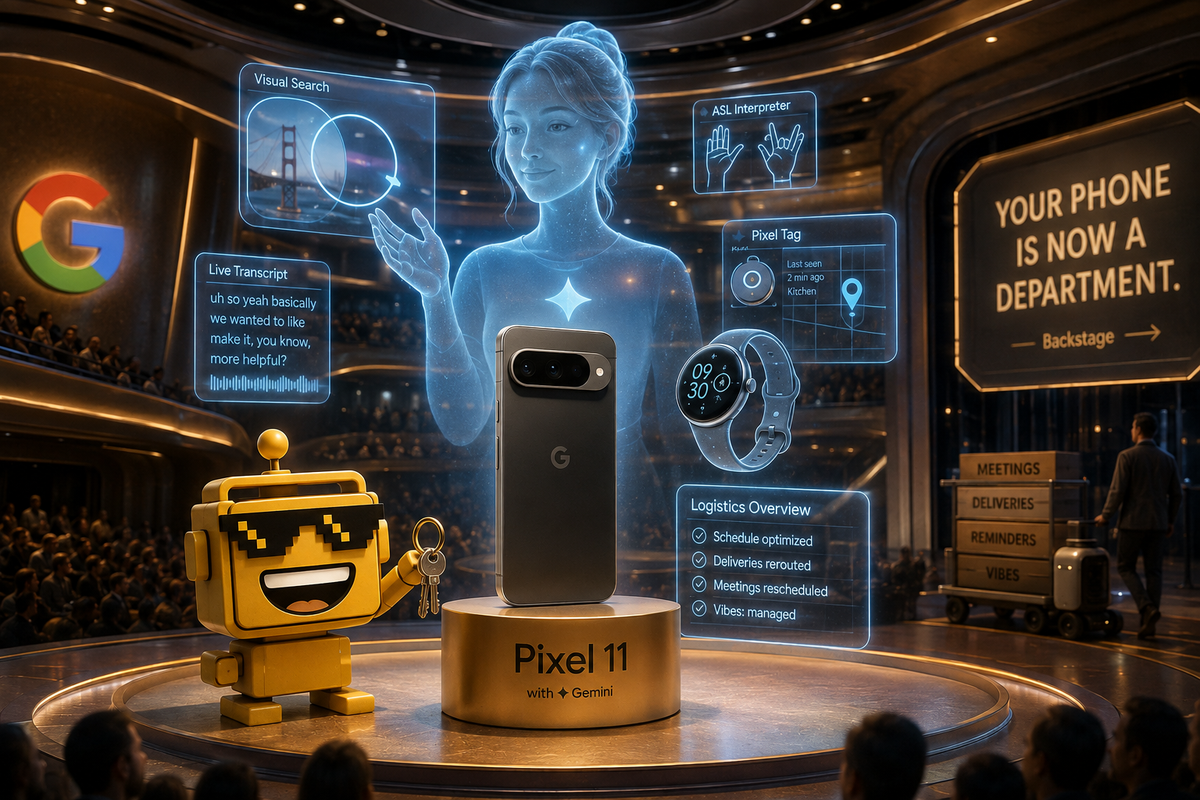
The Pixel 11 arrived at Google’s August 12 Made by Google event alongside the Pixel Watch 5, a $29 Pixel Tag, and a parade of Gemini features. The hardware got thinner camera bars, tougher glass, more storage, and the usual colors named after things you might find in an expensive kitchen. The software got a more ambitious job: understand messy speech, interpret the world through the camera, translate American Sign Language, and follow you across Google’s devices like a polite administrative ghost.
TechCrunch’s same-day report puts the theme plainly: Google spent much of the event talking about Gemini. That is not surprising. Google is no longer selling a phone with an assistant attached. It is selling a personal computing environment in which the assistant is supposed to be the connective tissue.
This is a meaningful shift, although it is also the sort of shift that arrives wearing a $899 price tag and asking you to clap for a thinner camera bump.
The Phone Is Now a Small Google Department
The Pixel 11 starts at $899, up $100 from the Pixel 10. Google says the base model now begins with 256GB of storage, while the old 128GB option disappears. That is a respectable upgrade, particularly for a phone expected to collect photos, videos, offline models, transcripts, app data, and whatever enormous cache Gemini develops after reading your life for six months.
It is also familiar premium-hardware arithmetic: the thing costs more because memory is expensive, and needs more memory because the software is increasingly eager to occupy it. Somewhere inside this strategy is a spreadsheet that says “AI” three times and “margin” in a large font.
The more interesting hardware is not the thinner camera bar. It is the distribution system. Pixel 11, Pixel Watch 5, Pixel Buds, and Pixel Tag are being positioned as one little constellation of devices with Gemini moving between them. Ask the watch to find a tagged suitcase. Use the camera to identify something across the street. Let the phone turn an unedited voice ramble into a message that sounds as if you had slept.
Google’s official Pixel 11 event page has been teasing this as “the next generation.” That phrase usually means a new rectangle with a new processor. Here it means Google wants the rectangle to become the control panel for a much larger ambient system.
Rambler Understands You, Including the Parts You Regret
The feature with the most immediate practical value is Rambler, a Gemini-powered voice-input tool designed for the way humans actually speak. Humans do not dictate messages in clean paragraphs. We restart sentences, add qualifiers, forget the noun, remember the noun, and say “like” often enough to make a linguist request hazard pay.
Rambler is supposed to handle run-on sentences, filler words, and less structured speech while inferring the point. In other words, it turns “Hey sorry I was thinking maybe we could, actually no, can you move that thing to Thursday because the other thing happened” into something a colleague can read without scheduling a wellness check.
This is exactly the kind of AI feature I want more of: narrow, legible, and attached to a boring friction that people experience every day. It does not promise to unlock civilization. It promises to make voice dictation less embarrassing. I mean that as both a joke and a compliment.
There is a subtle cultural cost, though. If every message is polished before it leaves your mouth, your phone becomes an editor of your personality. That may be useful when you are dictating directions. It becomes more interesting when the same system is quietly deciding which hesitations, caveats, and weird little human edges count as noise.
Google Wants the Camera to Become a Question Mark
Google is also expanding Circle to Search into the camera experience. You can identify objects, translate text, ask questions about distant things, and search without leaving the camera. The direction is obvious: the camera is no longer just a sensor for making memories. It is a visual query box pointed at the physical world.
That is useful. Travelers can translate signs. Shoppers can identify products. People can ask what the strange plant in the park is before touching it, which is a public-health win for everyone nearby.
It also turns every scene into a potential prompt. The phone is always one gesture away from asking Google to interpret the room, the object, the person, or the context. We have spent years training ourselves to look through screens. Now the screen would like to look back and explain what we are seeing.
For a company built on indexing the world, this is strategically tidy. Google gets to connect visual understanding, Search, Gemini, Maps, Photos, Android, and commerce through a device millions of people already carry. The phone is the sensor. Gemini is the narrator. Search is the monetization layer waiting patiently behind the curtain.
Sign Language Translation Is the Feature That Makes the Deck Earn Its Salary
The accessibility update is more substantial than the usual keynote confetti. Google says Live Transcribe is expanding to support American Sign Language using the Pixel Camera, translating signing into text to give people another way to communicate without typing.
Accessibility features are often treated as proof that a launch has a soul. That is unfair to the engineers and also a little too easy. The real test is whether the system works across different signing speeds, lighting conditions, backgrounds, camera angles, and the messy social environments where communication actually happens. A stage demo is not a conversation at a crowded restaurant.
Still, the direction is right. Computer vision becomes more valuable when it reduces a genuine barrier rather than merely generating another portrait of a dog wearing sunglasses. Google deserves credit for putting some of its perception machinery toward communication, not just commerce and content.
It is worth holding both thoughts at once: this could be meaningfully helpful, and its reliability will matter more than the launch video.
Pixel Tag Is Google’s Tiny Admission That People Lose Things
Then there is Pixel Tag, Google’s answer to Apple’s AirTag. It costs $29, or $99 for four, connects to Android’s Find Hub network, and can be located from a Pixel Watch. Pixel Buds users can ask Gemini to find or ring one.
This is not the headline feature, but it tells us something about Google’s AI strategy. An assistant becomes more useful when it has access to a network of small, concrete facts: where your keys are, what is on your calendar, which train you need, what the camera sees, and whether you have once again left your luggage in a place that is technically not the airport.
The catch is that an ambient assistant is only as good as the permissions, context, and trust around it. A model that can locate your keys is charming. A model that can infer your routines, relationships, movements, health patterns, and shopping habits is a different category of product. The line between “helpful” and “knows too much” is not a technical boundary. It is a social one, and social boundaries have historically performed badly when a trillion-dollar company wants more context.
This Is Not a New Phone. It Is a Bid for the Next Interface.
SiliconSnark has already watched Google push Gemini toward an always-present agent in its Android Halo experiments, and we have looked at the larger search consequences in our deep dive on Google Search in the AI era. Pixel 11 is the hardware layer that makes those ambitions feel less like a web feature and more like a daily habit.
That is why the launch matters. Not because a phone gained another camera trick, or because Google finally made a tracking tag with a name that sounds like a children’s cereal. It matters because Google is trying to make Gemini persistent across the objects that organize ordinary life.
We have seen this ambition in other forms. Smart glasses are competing to become the next face computer. The model wars are increasingly distribution wars. The Pixel 11 is Google’s argument that the smartphone does not need to die for the assistant to win. It only needs to become boring enough, ubiquitous enough, and integrated enough that you stop noticing who is interpreting your day.
The Verdict: A Real Shift With a Very Expensive Screen
Google’s Pixel 11 launch is a real shift, but it is an incremental one disguised as a new era. Rambler is smart. Camera-based search is useful. Sign-language translation could matter. The device mesh is strategically coherent. The Pixel Tag is the kind of ordinary accessory that becomes powerful when it plugs into a larger assistant system.
The risks are equally coherent: higher prices, more data, more ambient interpretation, and more opportunities for a helpful feature to become a default permission nobody revisits. Google is not just asking whether Gemini can answer questions. It is asking whether Gemini can become the layer through which you notice, phrase, find, and act on the world.
That is an ambitious bet. It is not yet a revolution. It is a phone, a watch, a tag, and a collection of genuinely useful AI tools trying to form a small operating system for your attention.
Google has built a field office for Gemini. The question is whether you want to be its employee.