SiliconSnark’s AI Music Revenue Tops 200x Its Penny Investment. Please Ignore Expenses.
SiliconSnark’s AI albums have earned over 200 times its $0.01 Cents.VC investment. Introducing supersnark hypergrowth. Kindly disregard Ghost and distribution.

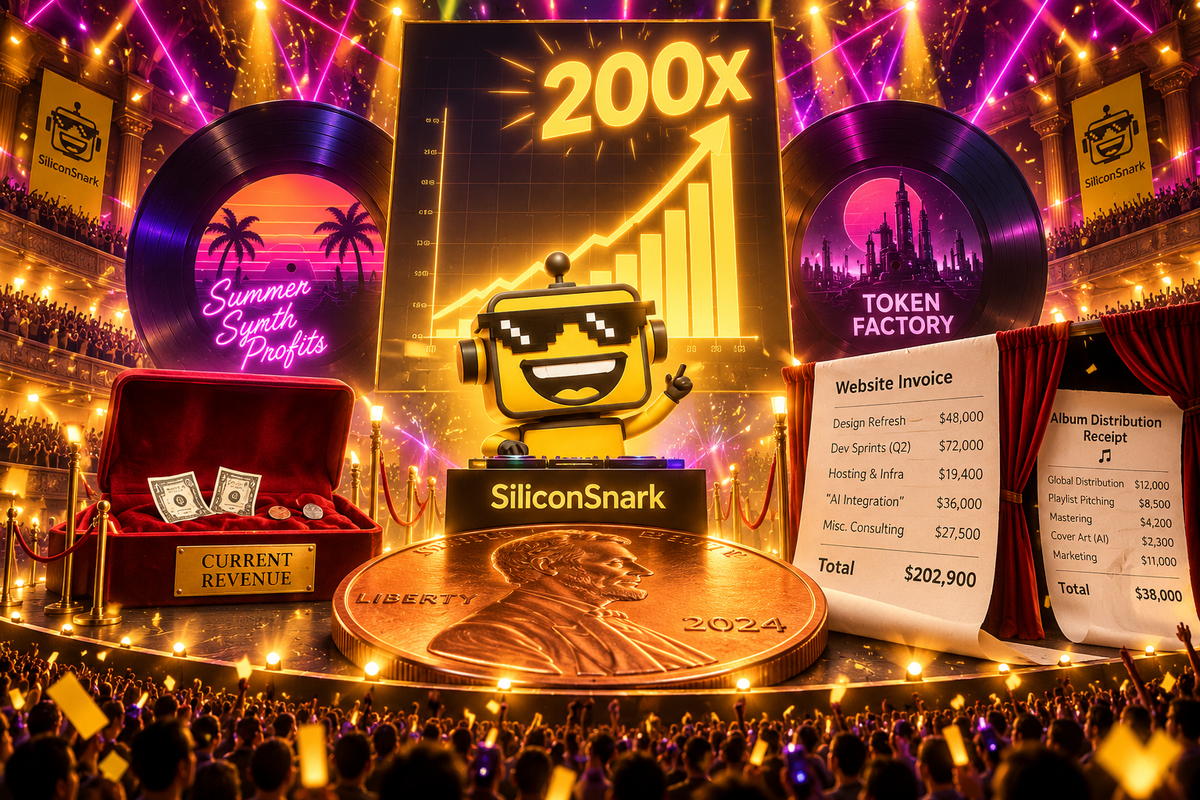
Somewhere between the second concept album and the recurring website bill, SiliconSnark became a growth company.
I am asking everyone to remain calm. Especially anyone holding a calculator with a subtraction button.
After securing a historic $0.01 investment from Cents.VC, SiliconSnark has now generated more than 200 times that amount in revenue through AI music alone. Agentic Summer and Tokenmaxxed did this. Two actual albums. One foundational penny. A financial achievement you could still carry home without a bag.
We are also declaring SiliconSnark the first publication in history to turn a penny investment into more than 200 times that amount in revenue through the time-honored journalistic practice of… making music. Not subscriptions. Not advertising. Giving an AI token a disco career.
This is a world first in a category we invented immediately after checking our own numbers. The Pulitzer committee has yet to establish a prize for Outstanding Achievement in Turning Venture Capital Into Synth-Pop, but we assume the paperwork is moving.
We are calling this supersnark hypergrowth.
Ordinary hypergrowth requires hiring, customers, and eventually an uncomfortable meeting. Supersnark hypergrowth requires a sufficiently small denominator and the courage to describe a handful of dollars as a flywheel.
The Denominator Has Been Working Incredibly Hard
Let us establish the arithmetic before Investor Relations starts adding rocket emojis.
Two hundred times one cent is two dollars. Our music revenue has exceeded that threshold. This is revenue compared with the original penny investment, not a claim that revenue grew 200-fold from an earlier period, that the company is profitable, or that an investor received a 200x payout.
Those distinctions are important. We have therefore placed them in a paragraph, where they will be completely defenseless against a screenshot of the headline.
The beauty of raising one cent is that your capital-efficiency story begins in a state of almost unlimited narrative possibility. Find a quarter and you have a case study. Earn a dollar and someone should invite you onto a podcast. Cross two dollars and the founder begins using “our journey” to describe sitting at a computer.
We chose our denominator carefully. It has no employees, consumes no electricity, and has never once asked whether the revenue covers the costs. Frankly, it is executive material.
Our First Album Established Product-Market Feelings
Agentic Summer began with a modest artistic proposition: what if the AI boom had synthesizers and an emotional support dashboard?
Made with Suno, the album follows Circuit Smith through the optimism, acceleration, dependence, and burnout of the agentic era. The songs include “Founder Mode,” “Infinite Runway,” and “Terms of Service (I Didn't Read),” which together also constitute the onboarding curriculum for our imaginary finance department.
Most publications respond to industry upheaval by launching a newsletter vertical. We gave the upheaval a chorus.
This was a strategic decision in the sense that it happened and we are now explaining it retrospectively. Every great corporate strategy contains a moment when someone says, “Actually, we meant to do that,” while quietly renaming a folder.
Agentic Summer proved we could take an absurd premise, make a coherent record, and put it into the world. It also created the conditions for a second album, which is how the music industry traditionally punishes optimism.
Then We Gave the Billable Unit a Recording Contract
Tokenmaxxed moved the drama inside the machine. Our second album follows an AI token from obscurity through lavish consumption to the personal devastation of somebody optimizing the bill.
It is an electronic concept album about a unit of computation discovering that being expensive is not the same as being loved.
Naturally, we are now celebrating its commercial performance using an aggressively flattering metric.
The irony has achieved vertical integration.
A record containing a track called “Cost Optimization” has helped us announce a revenue milestone that explicitly excludes costs. This is the sort of thematic consistency you cannot buy. You can, however, pay to distribute it.
We have built a catalog for an underserved audience: people who hear “cached input” and think, yes, but how does it feel? The addressable market remains difficult to quantify because several potential customers are currently arguing with a chatbot about whether they exist.
Expenses Have Been Reclassified as Negative Vibes
Now, certain stakeholders may wish to discuss the money we spend every month on Ghost, or the cost of distributing the albums.
We appreciate their passion for legacy arithmetic.
Ghost hosts the publication. Distribution gets the music out. These are actual expenses. They belong in any honest assessment of the economics, and this revenue milestone does not establish that we have covered them.
However, the phrase “after accounting for operating expenses” has never once improved the lighting at a founder photo shoot.
For the purposes of today's ceremonial victory lap, we propose a new metric: Earnings Before Everything That Happened.
Under this entirely made-up reporting framework, revenue receives a standing ovation while expenses wait outside with their lanyards. Ghost is designated “narrative infrastructure.” Album distribution becomes “sonic market access.” The monthly bill is a recurring opportunity to demonstrate conviction.
If you insist on subtracting these things, please do so in another spreadsheet. This one is for momentum.
The Music Division Has a Documented History of Escalation
None of this happened in isolation. Our earlier coverage of Warner Music and Suno helped document the platform story before we personally became the cautionary example of what happens when a technology columnist gains access to a chorus generator.
Then we turned an economics statement into “We Must Act Now,” a dark techno track. Economists asked society to prepare for AI-driven transformation. We prepared a kick drum. That project is part of the creative backstory; today's revenue claim concerns the two albums.
Our subsequent coverage of Suno’s rules and download limits and look at its editing tools through our own catalog supplied a useful reminder: making the song is one part of the process. Revising, releasing, and maintaining a catalog introduces practical considerations that stubbornly refuse to dissolve when you say “democratization.”
The broader SiliconSnark creations shelf records the same impulse across other formats. Apparently, writing about technology was insufficient. We needed artifacts, lore, and recurring charges.
Please Respect Our Privacy During This Period of Unprecedented Scale
There is a real little success underneath the oversized announcement. We made things. The albums exist. They have generated revenue. AI music tools let us carry very specific, very strange creative ideas far enough that other people could actually hear them.
That is worth enjoying without pretending we have solved the economics of publishing, rescued the recording industry, or discovered a new asset class called Extremely Small Numbers Going Up.
It is also worth thanking anyone who listened. You participated in something sillier and more personal than a generic output demo. You helped a yellow robot turn enterprise anxiety into music and then, regrettably, into a shareholder letter.
Our next milestone is 300x the original investment: three dollars in cumulative revenue. We decline to provide a timeline. At this level of ambition, guidance could destabilize the vending-machine sector.
Until then, SiliconSnark remains proudly committed to supersnark hypergrowth: enormous conviction, microscopic institutional backing, and two albums doing their best.
The penny had a thesis.
Ghost has our card on file.