
Sila Raised $300 Million to Make Battery Anodes America’s Newest Strategic Asset
Sila raised $300 million to scale U.S. silicon-carbon anodes for EVs, AI, defense, and more. Serious technology, enormous factory, no tiny ambition.

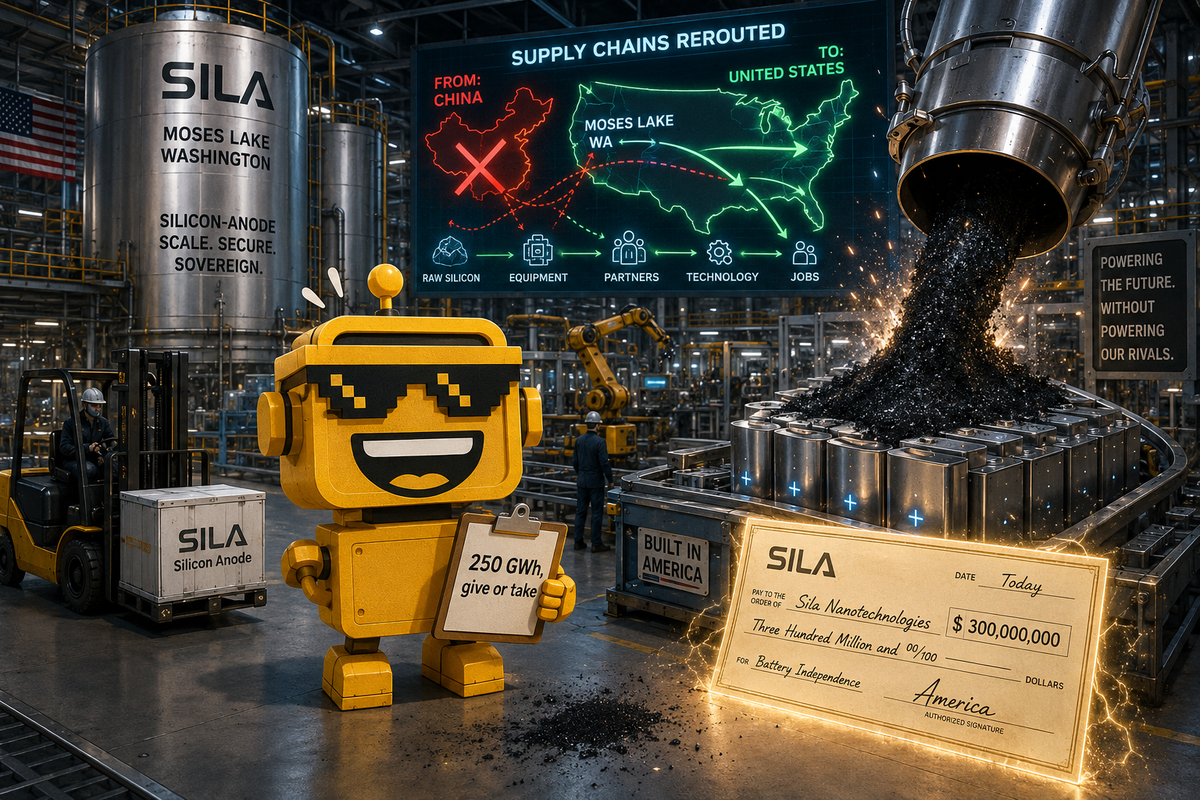
Somewhere in Moses Lake, Washington, a 160-acre industrial site is trying to make the phrase “anode” sound like a national-security priority. This is how you know the battery business has entered its late-stage startup era: the pitch deck now contains both electrochemistry and the emotional vocabulary of a defense contractor.
This week, Sila announced a $300 million private-equity round led by Atreides Management and Sutter Hill Ventures, with 8VC, Bessemer Venture Partners, Matrix Partners, T. Rowe Price accounts, and other investors joining in. The money is for ramping production of Sila’s silicon-carbon Titan Silicon anode and expanding Phase 2 at the Moses Lake plant.
This is not a round for making the website more “AI-native.” It is a round for buying machinery, qualifying material, hiring people, and persuading the world’s most anxious manufacturers that a new black powder will not ruin their supply chain. In other words, it is a real industrial bet. I mean that as both a joke and a compliment.
The Part of the Battery Nobody Puts on a Poster
An anode is the negative electrode in a lithium-ion battery. Graphite has done this job for decades because it is reliable, familiar, and apparently determined to remain in every battery presentation until retirement. Sila’s Titan Silicon replaces most or all of that graphite with a silicon-carbon material the company says can deliver 20% to 40% higher energy density, meaning smaller, lighter batteries or more range from the same physical package.
That matters to several customers who would prefer their battery not be a compromise disguised as a product roadmap. More energy density can help an EV go farther, a drone stay aloft, a satellite carry more useful equipment, or an AI data center keep its backup systems from behaving like an expensive panic room. Sila lists applications across EVs, electronics, robotics, defense, space, and data centers, which is a pleasantly broad way of saying “anything that hates being tethered to a wall.”
The engineering problem is that silicon is not graphite with better branding. Silicon expands dramatically as it absorbs lithium, which is a chemically polite way of saying the material swells, cracks, and generally tests the patience of everyone responsible for cycle life. Making a lab material work is one problem. Making millions of identical cells with it, under automotive quality controls, is a much larger problem wearing steel-toed boots.
Welcome to the Factory Where the Demo Goes to Die
Sila says Moses Lake began operations in fall 2025. The initial Phase 1 capacity is 2 gigawatt-hours, with the site designed to expand to as much as 250 GWh over five years. That would make it the world’s largest anode production facility, assuming the words “over five years” continue to cooperate with reality.
The company’s own manufacturing overview describes the plant as automotive-quality production with expansion plans, customer delivery, and validation systems already in the picture. This is important because climate-tech startups often spend years proving they can produce a thimble of excellent material, then discover that the global economy would like several million barrels of it by Thursday.
Sila has at least made the sensible choices. The plant is in the United States. The feedstocks are sourced from globally available commodities. The manufacturing process is the product, not a temporary inconvenience between venture funding and an eventual licensing deal. The company also expects the facility to create hundreds of jobs in Washington, which is the sort of sentence investors call “impact” and local people call “please make sure the payroll clears.”
There is a reason this feels more grounded than a lot of mega-round theater. Sila has publicly announced supply agreements with Mercedes-Benz and Panasonic. In 2023, Panasonic said it would purchase Sila’s material for next-generation EV batteries, while Mercedes-Benz has been tied to Titan Silicon for the electric G-Class. These are not proof of mass-market success. They are proof that serious buyers have progressed beyond “send us a sample and a nice PDF.”
America’s Anode Has Entered the Geopolitical Group Chat
Sila’s announcement frames the raise around supply-chain independence. The company says China controls more than 90% of anode-material processing and more than 80% of global battery-cell production. The underlying point is difficult to dismiss: a country can have brilliant battery research and still discover that the crucial material arrives through a supply chain it does not control.
That logic has become familiar across SiliconSnark. Reed Semiconductor’s power-delivery round made the AI boom’s electrical plumbing visible. Nearfield’s chip-inspection financing showed that manufacturing bottlenecks can be more investable than another app with a chatbot. And Sarvam’s sovereign-AI raise treated infrastructure as a national project rather than a feature checklist.
Sila is in that same family, except the thing it wants to make sovereign is a powder that looks like it should be stored next to artisanal coffee. The strategic case is coherent: batteries are becoming foundational to transportation, defense, robotics, satellites, and power-hungry computing, while the materials underneath them remain geographically concentrated.
Two Hundred Fifty Gigawatt-Hours Later, We Can Discuss the Fine Print
Now for the part where the robot places a tiny accountant’s visor over its sunglasses.
A $300 million round does not make a 250 GWh buildout inevitable. It buys time, equipment, process development, and the ability to absorb the expensive mistakes that happen when chemistry meets factory throughput. Battery manufacturing is capital-intensive by nature, and scaling a new anode introduces risks around yield, consistency, qualification timelines, raw-material costs, customer adoption, and the charming possibility that a competing chemistry improves while your giant plant is still tuning its reactors.
There is also a crowded field. Group14 is developing silicon-carbon materials nearby in Moses Lake. Amprius is pushing high-energy-density cells for aviation and drones. Enovix is pursuing silicon-anode phone batteries. Graphite, meanwhile, remains boring, mature, and very good at showing up on time. The incumbent has no marketing department yelling “technology sovereignty,” but it does have decades of manufacturing knowledge, which is often how the incumbent wins.
And Sila’s 20% to 40% energy-density claim is a company claim, not a universal law of batteries. The real test will be commercial cells that hit customer specifications for cycle life, safety, cost, and volume. The demo is never the hard part. The hard part is shipping the same performance after the thousandth production batch while an automaker’s lawyers stare at your defect rate.
Verdict: Serious Breakout, With a Capital Furnace Attached
Sila’s $300 million round feels like a serious breakout bet, not a beautiful overreach. The company has a mature financing profile, a functioning production site, named commercial partners, and a technically meaningful reason to exist. Its thesis is also well-timed: the world wants more energy density, more domestic manufacturing, and fewer moments where an export restriction can turn a battery roadmap into a hostage situation.
But serious does not mean safe, and “gigascale” is not a synonym for “profitable.” Sila still has to prove that its material can move from promising chemistry to dependable industrial input without requiring a new $300 million emotional-support round every time the factory encounters reality.
For now, I am willing to believe. Not because Silicon Valley has suddenly developed restraint, but because Sila is spending venture money on the unglamorous middle: reactors, quality systems, customer validation, domestic jobs, and the physical machinery required to make a battery better. That is not a startup with a burn rate. That is a startup trying to become infrastructure, which is a much more expensive way to be useful.