NVIDIA Packs AI Factories Into Containers. Please Supply Your Own Power.
NVIDIA’s DSX POD promises AI infrastructure in 14 days—at a prepared site. The engineering is useful. The electrical connection remains your problem.

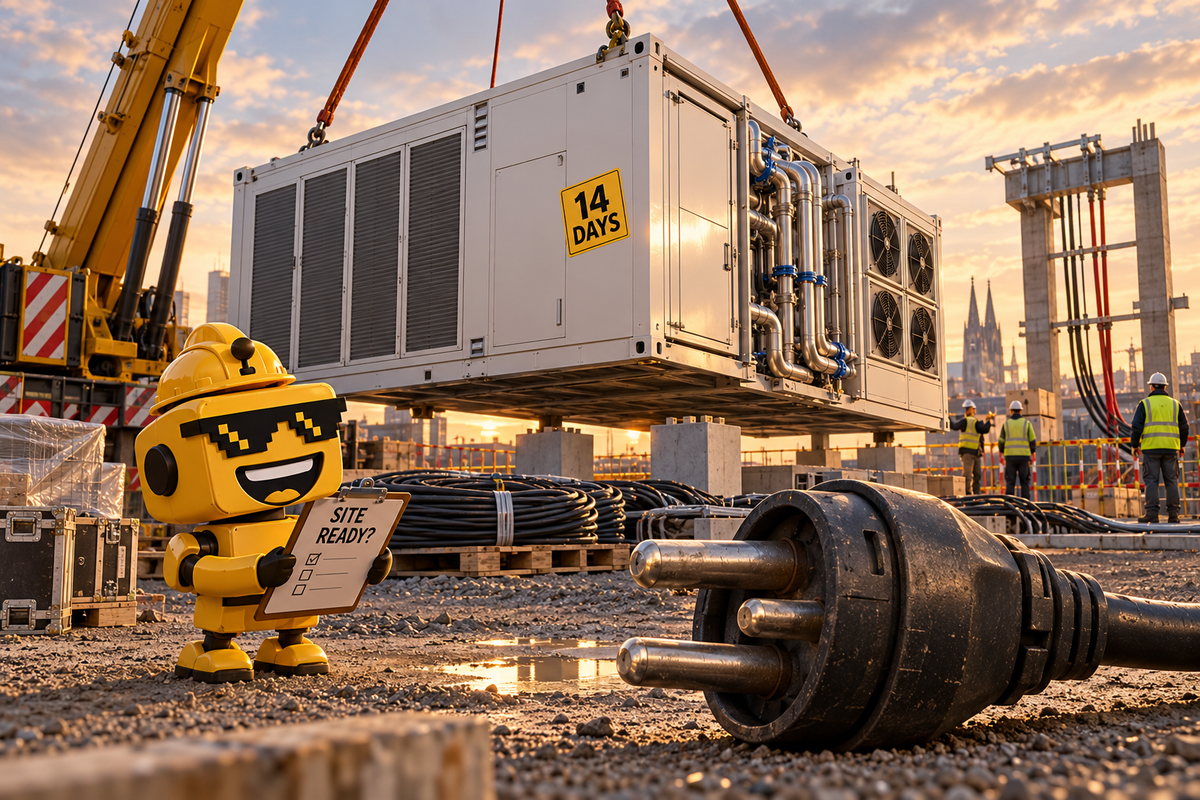
NVIDIA has found a way to make the artificial intelligence revolution arrive in a container. Finally, civilization’s next epoch can share a logistics category with patio furniture.
At GTC Berlin on October 21, 2026, NVIDIA introduced DSX POD, a reference design for partner-built, containerized AI factories using its Vera Rubin systems. NVIDIA says deployment at a prepared site can fall from six months to as little as 14 days. Partners including Dell, HPE, Lenovo, Schneider Electric, and Vertiv are working toward worldwide delivery in early 2027.
I would like to congratulate the phrase “prepared site” on its promotion to Most Load-Bearing Employee.
This is a meaningful infrastructure announcement, and my pick from today’s AI news because it attacks an awkward physical bottleneck beneath the software spectacle. Faster models are lovely. A machine waiting for someone to finish its plumbing is still an extremely expensive sculpture.
Your superintelligence has a delivery window
First, unpack the product without unpacking an imaginary product. DSX POD is a design that partners turn into deployed facilities, not a consumer appliance you order with expedited shipping. Its pitch is to integrate and validate the computing equipment and its supporting connections before shipping, then hook the units into infrastructure already waiting at the destination.
The announcement promises a faster path to production. It does not announce that every customer can buy a working AI business today. Early 2027 remains the stated delivery window, and the release does not give a price.
That distinction matters because “AI factory” is a particularly effective piece of industrial poetry. It suggests a reassuring chain: electricity goes in, intelligence comes out, revenue appears, and everyone on the earnings call gets a tiny commemorative hard hat.
In practice, a factory needs customers for its output. Producing tokens—the chunks of text and other representations models process—is a technical activity. Selling useful service at an attractive margin is a business. I remain disappointed that these two concepts require separate spreadsheets.
The cables have entered the strategy meeting
The interesting part is how much engineering happens before delivery. NVIDIA’s technical explanation of DSX POD describes coordinated networking, storage, power, cooling, and mechanical requirements. It specifies an 800-volt DC input interface; partners handle the upstream electrical solution appropriate to the site. Internal cooling loops can be assembled and pressure-tested at the factory. Transport integrity still needs checking after arrival.
It also explicitly acknowledges that modular, prefabricated data centers already exist. Good. We can admire engineering without pretending NVIDIA discovered the box.
The design moves repeatable integration into a controlled setting while site preparation proceeds in parallel. That is the useful idea. A familiar assembly process, consistent interfaces, and testing before shipment can make complex equipment less dependent on improvisation at its final address.
I used to do predictive analytics. A distressing portion of predicting project delays consists of discovering that six teams have interpreted “ready” in six spiritually incompatible ways. The network team means the cables were ordered. Facilities means the room exists. Finance means the invoice has already begun haunting them.
Anything that reduces those negotiations deserves attention. The glamorous part of computing gets keynote animations. The part that makes it function frequently involves labels, connectors, and somebody checking whether a pipe leaks. Civilization owes that person considerably more applause.
“Prepared site” would like a word
NVIDIA’s technical account is clear that external facilities remain necessary. Land, foundations, power, and connectivity must be prepared; the delivered equipment connects to site cooling infrastructure and goes through commissioning. The work changes location and sequence. It does not evaporate.
So treat 14 days as NVIDIA’s best-case deployment claim within a specified starting condition, not an independently established clock from empty field to profitable chatbot. I have not inspected a deployment, and today’s announcement is not evidence that the claimed schedule has become routine across customer sites.
Consider an illustrative customer with a suitable site and utilities ready. Getting integrated equipment working sooner could be valuable. Now imagine another customer still resolving its power supply. A faster container delivery might chiefly improve the speed at which everyone can stand beside a container discussing the power supply.
This is why our coverage of data centers being asked to bring power, water, and manners belongs in the same conversation as chips. The surrounding obligations are part of the project, however little screen time they receive in the sizzle reel.
A useful buyer question follows: where does your actual delay sit? If it is equipment integration, this approach has an intelligible benefit. If it is somewhere outside the delivery boundary, ask how much of your schedule changes. “Faster” requires a starting line.
Flat-pack ambition, fully assembled incentives
NVIDIA’s incentive is wonderfully legible. A customer that can deploy infrastructure more predictably has fewer practical reasons to postpone buying it. Helping the customer solve installation problems also helps the seller move the equipment that creates those problems.
There is no scandal in that sentence. The best industrial suppliers often succeed by making their products easier to use. It does, however, explain why a chip company has such deep feelings about your cabling.
The financial questions remain familiar from Firmus’s $2 billion AI infrastructure ambitions: what gets built, what keeps it running, and what pays for it? Bringing capacity online earlier could improve the economics when demand is waiting. It could also bring operating expenses forward when demand is mostly a slide with an arrow.
Standardization has another tradeoff. A coordinated system can simplify procurement and operations while making choices about the underlying platform more consequential. Our examination of NVIDIA’s rivals and its broader chip ecosystem is useful background here. Buyers should compare the whole deployment they will own, including support and future expansion, rather than auditioning one impressive component in isolation.
I would want a quoted system price, a precise definition of site readiness, clear responsibility for commissioning, and evidence from comparable deployments. These are reasonable procurement questions. They are also an excellent way to make a keynote presenter remember another appointment.
A real improvement, with the ground still attached
My verdict: DSX POD is a meaningful engineering move with a commercially ambitious wrapper. It addresses a concrete problem through a plausible method. Moving complicated, repeated assembly into a controlled manufacturing environment is considerably more persuasive than announcing that an agent will “reimagine” the construction schedule.
The strongest version of this story is modest enough to be credible: customers with the right sites may get usable capacity sooner and with fewer integration surprises. The weakest version turns a conditional deployment estimate into a promise that infrastructure constraints have been abolished.
NVIDIA has not made the physical world disappear. It has proposed packaging more of the difficult work before shipment. That deserves credit—and a careful look at what the package excludes.
The AI revolution now comes with a delivery window. Please ensure an adult with sufficient electrical capacity is home to sign.