Deep Dive: NVIDIA and Microsoft Celebrate OpenAI’s Astra Launch With Their Prenups Open
NVIDIA and Microsoft are cheering OpenAI’s GPT-6 Astra after a tense 2026. Follow the chips, cloud contracts, and rival bets behind AI’s awkward group hug.

Jensen Huang says AGI has arrived. Microsoft has Astra ready for the office. After a year of chip complaints, cloud negotiations, and rival investments, the group hug comes with unusually thorough financial documentation.
Nothing says enduring friendship like congratulating someone on inventing the future while quietly maintaining several alternative futures in your investment portfolio.
On September 6, NVIDIA CEO Jensen Huang declared that “AGI has arrived,” congratulating OpenAI on GPT-6 Astra and pointing to the NVIDIA hardware behind it, as Business Insider reported. It was a touching tribute to human ingenuity, machine intelligence, and the supplier whose equipment made the touching tribute commercially relevant.
Microsoft had its own welcome mat out. Its September 4 announcement said Astra was rolling out in Copilot Cowork and Copilot Studio. The champagne was enterprise compatible.
These are meaningful endorsements. They are also exceptionally funny endorsements when placed beside the rest of 2026: reported dissatisfaction with NVIDIA chips, questions about a gigantic investment proposal, Microsoft’s retreat from exclusivity, and both infrastructure giants cultivating alternatives to the company receiving the applause.
My reading of this three-company arrangement is straightforward: everyone wants OpenAI to succeed, and everyone wants insurance against OpenAI succeeding on terms they cannot control. The affection can be sincere. So can the escape planning. In the AI industry, those feelings have learned to share a conference room.
Our coverage of Astra’s launch dealt with the model and its considerable accompanying theater. This is the story of the people applauding from the expensive seats, the contracts under those seats, and why nobody should confuse a standing ovation with the end of a negotiation.
The Toast Has Three Different Invoices Attached
Start with what launched. OpenAI’s Astra announcement describes a model aimed at demanding computer use, coding, scientific reasoning, and professional work. Its rollout began September 3 with limited organizational access, with broader availability planned over the following days through ChatGPT, its API, Azure, and AWS Bedrock. Those are rollout statements, not evidence that every account received identical access at the same instant.
The commercial promise is that AI can take on more of an actual assignment: work through software, handle intermediate steps, and deliver something usable. A chatbot that writes a charming paragraph is a product. A system that can move work across applications is a bid for a much larger part of the office budget.
That prospect produces three different kinds of enthusiasm. OpenAI wants customers to buy the capability. Microsoft wants customers to use that capability through its software and cloud. NVIDIA wants the capability to require infrastructure it supplies. All three can win from the same completed task without wanting the same company to own the customer.
Imagine an agent assembling a quarterly operating review. Someone supplies the model. Someone controls access to the files and applications. Someone runs the computation. Someone bills the customer. Those roles might overlap, but they are economically distinct, which is why the celebration has more seating assignments than a royal wedding.
The argument is over where value accumulates. Does the buyer think, “I need Astra”? “I need Copilot”? “I need secure AI infrastructure”? Each answer gives a different vendor more bargaining power. The model launch advances the shared market while reopening the question of who gets to stand between the market and its credit card.
A supplier can admire a breakthrough and still prefer that the breakthrough remain dependent on the supplier. This is less a contradiction than a normal commercial relationship with unusually cinematic lighting.
Microsoft’s Love Language Is a Contract Amendment
The clearest document in this story is Microsoft’s April 27 partnership update. Microsoft remained OpenAI’s primary cloud partner, with an Azure-first provision and an exception when Microsoft cannot and chooses not to support the necessary capabilities. OpenAI gained the ability to serve all its products across cloud providers. Microsoft’s license to model and product intellectual property continued through 2032, now non-exclusive.
The financial terms also changed. Microsoft would stop paying a revenue share to OpenAI. OpenAI’s revenue-share payments to Microsoft would continue through 2030 at the same percentage, subject to an overall cap and independent of technical progress. Microsoft remained a major shareholder.
That is an extraordinary amount of business packed into the phrase “next phase.” Somewhere, a corporate communications professional looked at a substantial renegotiation of AI’s most consequential alliance and selected the verbal equivalent of repainting the guest bedroom.
For OpenAI, freedom to sell through additional clouds expands the set of customers it can meet where they already work. For Microsoft, a less restrictive arrangement can preserve participation in a growing business without requiring that every expansion fit inside a single partnership’s constraints. These are my interpretations of the incentives, rather than claims to know the negotiating room’s private calculations.
Think of the difference between owning the only road into a town and owning a busy road plus a stake in the town. The second arrangement gives up some traffic control. It can still be an excellent position if the town gets much bigger.
Microsoft’s Astra promotion therefore does not require an emotional breakthrough. It requires a sales opportunity. The revised relationship leaves ample room for Microsoft to want the product to be excellent while wanting its own position to remain durable. The friendship has evolved. The billing department appears to be coping beautifully.
April Was a Settlement of Interests, Not a Hallmark Movie
The public document is polite. The surrounding reporting explains why its politeness matters. Reuters reported on April 27 that tensions had risen over OpenAI’s desire to strike deals with Microsoft’s cloud rivals. It also described Microsoft’s early investment as totaling $13 billion since 2019 and said OpenAI’s commitment to buy at least $250 billion in Azure services by 2032 remained in place.
Reuters further relayed the Financial Times’ report that Microsoft had been considering legal action over the Amazon arrangement. That was reporting about a contemplated action, not proof of a lawsuit being filed. The distinction matters, even when “the partner considered calling the lawyers” is already a perfectly serviceable anniversary card.
It helps to separate resentment from constraints. A fast-growing model company wants access to customers whose existing systems live elsewhere. A cloud company wants the commercial privileges it paid for to mean something. Neither position requires a villain. Both can become difficult to satisfy simultaneously.
Suppose a business has spent years organizing its data and security around one cloud. Asking it to adopt another cloud relationship just to use a particular model adds friction. A model provider sees a customer it might lose. An exclusive distribution partner sees the very advantage it negotiated. One person’s needless obstacle is another person’s business model.
The April changes are therefore more revealing than any rumor that two executives stopped enjoying lunch. They show the partnership being adjusted to accommodate competing ambitions. The companies did not need to agree about every ambition to agree that continued cooperation was worth preserving.
There is a useful lesson here for reading technology diplomacy: watch what the parties are newly allowed to do. An executive can deliver a warm paragraph for free. Changing who may sell what to whom tends to involve a less improvisational process.
AGI Can Arrive. Accounts Receivable Can Stay.
Huang’s declaration adds a particularly good punchline to that chronology. By launch week, Microsoft’s published terms explicitly insulated the continuing revenue-share payments from OpenAI’s technical progress. The public agreement does not invite a supplier’s social-media post to adjudicate the rest of the contract.
So please do not picture a Microsoft finance employee hearing “AGI has arrived” and lunging across a desk to unplug Jensen’s Wi-Fi. The relevant payment language had already been revised. This is a much more sophisticated civilization than that. We have learned to make the arrival of unprecedented machine intelligence administratively uneventful.
There are separate questions here: how capable Astra is, whether someone believes that capability qualifies as artificial general intelligence, and what commercial agreements say about technological milestones. Treating all three as interchangeable is how a model launch becomes a legal analysis performed by a confetti cannon.
“AGI” does not come with a universally accepted finish line. Huang’s enthusiasm is his assessment, not independent certification of a settled scientific threshold. He can also be impressed for excellent reasons. Being commercially interested does not make an observation false; it makes the observer’s incentives relevant.
My standard for the celebration is less cosmic. Show the work, explain the evaluation, and tell me what fails. A claim about general intelligence becomes more useful when accompanied by evidence about particular capabilities. Otherwise we are arguing over whether the cake deserves a doctorate.
Our Astra-versus-Sol comparison approaches progress through concrete differences. Those differences can be commercially enormous without resolving every philosophical question. Microsoft and NVIDIA do not need philosophy resolved before they can find something to sell. The invoices have always enjoyed a more practical relationship with reality.
NVIDIA’s Winter Romance Came With an Asterisk the Size of Texas
To understand NVIDIA’s 2026 tension, rewind briefly to September 22, 2025. The companies announced a letter of intent involving at least 10 gigawatts of NVIDIA systems and an intention to invest up to $100 billion progressively as capacity was deployed. Details were still to be finalized.
Every small qualifying phrase in that sentence is doing structural work. “Letter of intent.” “Up to.” “Progressively.” An announcement about a proposed deployment-linked investment is not a receipt proving that $100 billion has landed in a checking account.
On January 30, Reuters relayed a Wall Street Journal report that the proposal had stalled amid doubts inside NVIDIA. Reuters said it could not immediately verify that report. The next day, Huang publicly denied being unhappy with OpenAI and said a very large investment was planned.
That sequence supports a story about reported negotiation strain and forceful public reassurance. It does not support the cartoon version in which NVIDIA canceled a completed $100 billion payment and then spent September pretending nothing happened.
The less cartoonish version is plenty funny. Silicon Valley can announce an ambition with the gravitational pull of a small national economy and then spend months explaining which parts were aspirations. The headline gets a stadium. The qualifications get a folding chair.
For a supplier considering a huge investment in a customer, enthusiasm and scrutiny belong together. The supplier benefits if the customer expands, but still has reasons to examine the structure, timing, and downside. “We think you will change the world” and “please explain this spreadsheet” are compatible statements. In a healthy investment discussion, they should probably occur within the same hour.
The Chip Complaint Was About Waiting, Which Humans Continue to Hate
The more operational dispute surfaced in Reuters’ February 2 investigation. Citing eight people familiar with the matter, Reuters reported that OpenAI was dissatisfied with some NVIDIA hardware and had sought alternatives. The concern centered on particular inference workloads, including the speed of coding-related responses. It was not a report that NVIDIA had become incapable of training frontier models.
The companies also supplied important counterweight. NVIDIA defended its performance and economics at scale. OpenAI said NVIDIA powered the vast majority of its inference fleet and offered the best performance per dollar for inference.
Those positions can coexist. A system can be economical for broad use while leaving room for another system to serve a narrower, speed-sensitive workload better. A freight railway and a motorcycle courier both move things. Nobody resolves the comparison by shouting the railway’s total annual tonnage at a sandwich.
Training is the process of developing the model. Inference is using the trained model to produce answers. Within inference, different customers care about different combinations of speed, cost, scale, and capability. There is no single stopwatch that declares one architecture morally superior.
Consider a programmer making a series of small changes. Waiting repeatedly can break concentration even if the total computing bill is attractive. Now consider a batch of overnight document jobs. There, throughput and cost may matter more than instantaneous feedback. Calling both activities “AI” is accurate and commercially unhelpful in the same way that calling a bicycle and a container ship “transport” is accurate.
This is where the friendship meets product design. OpenAI has reasons to optimize each experience. NVIDIA has reasons to keep those experiences on its platform. Their engineers can collaborate brilliantly while their procurement preferences pull in different directions. The tension is practical enough to survive every launch-day compliment.
OpenAI Brought a Second Chip Vendor to the Relationship
The alternative hardware strategy was visible without relying on anonymous accounts. On January 14, OpenAI announced a Cerebras partnership to add 750 megawatts of low-latency compute, with capacity arriving in phases through 2028. This was a planned buildout, not 750 megawatts magically appearing when somebody pressed Publish.
On February 12, GPT-5.3-Codex-Spark arrived as a research preview running on Cerebras hardware. OpenAI positioned the smaller coding model for fast interaction and explicitly said GPUs remained foundational to its training and inference pipelines.
That is the most useful corrective to the breakup narrative. OpenAI could put a specialized service on another supplier’s hardware while continuing to depend heavily on GPUs. A portfolio can expand without its largest component disappearing. Procurement departments have known this for years, despite their inexplicable exclusion from prestige television.
The strategic importance is choice. If a model company has a credible alternative for even part of its work, discussions about cost, scheduling, and technical priorities become different discussions. It has somewhere else to put a workload. That is more valuable than merely having a strong opinion about the incumbent’s pricing.
Conversely, an alternative has to survive production. A clever chip is the beginning of a commercial argument. Capacity, integration, software support, reliability, and the ability to serve paying users finish it. The incumbent’s advantage lives across those requirements, which is why displacement rarely proceeds at the speed of a triumphant benchmark graphic.
We explored the wider field in our deep dive into NVIDIA’s chip challengers. Astra gives NVIDIA an impressive showcase. It does not erase the incentive for its customers to develop alternatives. The better AI gets, the more consequential the cost of running it becomes.
February’s Answer to the Drama Was Another Enormous Number
On February 27, OpenAI announced $110 billion in new investment, including $30 billion from NVIDIA, $30 billion from SoftBank, and $50 billion from Amazon, at a $730 billion pre-money valuation. The same announcement described an expanded NVIDIA collaboration involving three gigawatts of dedicated inference capacity and two gigawatts of training on Vera Rubin systems.
Those were the figures and commitments announced at that point. They should not be casually added to the earlier $100 billion proposal as though every press release represents a separate completed bank transfer. AI finance is complicated enough without readers accidentally performing double-entry fan fiction.
The basic implication is clear: public winter tension did not preclude another major statement of commitment. The parties had substantial reasons to keep working together. Whether an individual negotiation was awkward is a different question from whether the larger commercial relationship remained valuable.
Supplier investment creates a particularly intimate arrangement. The supplier gains exposure to the customer’s upside; the customer gains resources to expand; the expansion can generate more demand for infrastructure. That can support real activity. It also makes it harder to describe the companies as independent spectators evaluating each other from opposite sides of a tennis court.
They are playing, sponsoring the tournament, and selling parts of the court. This does not automatically make the match fraudulent. It does make the financial seating chart worth reading.
Our coverage of AI compute becoming a finance product gets at the same broader issue: infrastructure ambitions increasingly require financial engineering alongside physical engineering. A breakthrough can validate the demand story. It cannot, by itself, settle every question about the economics of delivering that demand.
Amazon Entered Through Two Different Side Doors
OpenAI’s February 27 Amazon partnership announcement made the triangle less geometrically manageable. It outlined $50 billion in investment, beginning with $15 billion and followed by $35 billion subject to conditions. It also described an expansion of an existing AWS agreement by $100 billion over eight years and a commitment to consume approximately two gigawatts of Trainium capacity.
For Microsoft, the relevant competitive fact was another major cloud relationship. For NVIDIA, it was the use of Amazon’s own silicon. The same deal offered OpenAI an additional route to computing capacity and customers. One announcement, two different reasons for existing partners to sit up slightly straighter.
This is why drawing a neat map of AI alliances quickly becomes a punishment suitable for an ancient Greek myth. A cloud rival can supply NVIDIA hardware in some settings and its own accelerators in others. A model developer can compete with a partner’s applications while bringing valuable traffic to that partner’s infrastructure.
Company names are too coarse a unit of analysis. The question is which product, which workload, which agreement, and which part of the bill. Once you ask those questions, apparent contradictions become business choices. The diagram becomes uglier, but at least it begins to explain something.
For OpenAI, the benefit of additional channels is not simply that it can play suppliers against one another. It can potentially reach customers who have reasons to stay within their existing environments. For an enterprise buyer, moving to a new model should ideally be easier than relocating the entire company’s digital furniture.
The launch party therefore contains an awkward truth: some of the infrastructure that makes OpenAI more valuable also makes it harder for an individual partner to control. Success increases the size of the opportunity and the intensity of the argument about access to it. Everyone enjoys the cake. Everyone is also counting the doors.
Microsoft and NVIDIA Already Had an Anthropic Group Chat
The most direct evidence that these relationships are non-monogamous predates the year’s tensions. On November 18, 2025, Microsoft, NVIDIA, and Anthropic announced strategic partnerships. Anthropic committed to purchasing $30 billion in Azure compute capacity and contracting additional capacity of up to one gigawatt. NVIDIA and Microsoft committed to invest up to $10 billion and $5 billion, respectively.
The announcement also described engineering collaboration between NVIDIA and Anthropic and continued Claude access across Microsoft’s Copilot family. So this was part of the starting position for 2026, not a September response hastily assembled after somebody failed to like a congratulatory post.
It is also a useful antidote to the belief that Microsoft and NVIDIA merely tolerate OpenAI’s competitors. They have publicly described ways to help a major competitor grow. At the same time, they have reasons to celebrate OpenAI’s new capabilities. The industry calls this an ecosystem because “everyone has a key to everyone else’s vacation home” does not fit well in investor slides.
A platform benefits when customers can obtain several attractive options without leaving it. A hardware supplier benefits when multiple ambitious labs need its systems. A model company benefits when its model becomes indispensable. Those incentives overlap until the question becomes whether any one model company should become too indispensable.
That is the deeper point of the rival investments. They can expand the overall market while reducing reliance on a single source of innovation. This is my inference from the structure, not proof that every dollar was invested as a deliberate hedge against OpenAI.
OpenAI’s answer has to be sustained product value. It cannot reasonably expect a cloud platform or chip supplier to stop serving everyone else out of gratitude. Gratitude is a lovely emotion. It has never been a particularly enforceable capacity reservation.
Microsoft Wants to Be the Place You Use the Smart Thing
Read Microsoft’s Astra post for Foundry and its preferred framing becomes obvious. The pitch emphasizes putting advanced capability to work alongside identity, networking, governance, evaluation, and data handling. The model matters; the surrounding enterprise environment is part of what Microsoft is selling.
This is an intelligent position. If a business already trusts a vendor to manage important systems, using a new model through that vendor may be easier than creating a separate relationship with another provider. The reasons can be entirely practical: access management, purchasing arrangements, operational familiarity, or an existing support process.
These are not exciting things to demonstrate onstage. Nobody has ever thrown a jacket into the audience after successfully reconciling a vendor questionnaire. But in a large organization, administrative friction can decide whether an impressive technology gets used at all.
The strategic aspiration is to become the place customers turn for useful AI, even as the identity of the most attractive model changes. If that works, new model releases become reasons to visit Microsoft’s products. OpenAI gets distribution. Microsoft gets a continuing role in the customer relationship.
The uncomfortable possibility for OpenAI is that the buyer may eventually care more about the overall work environment than the model’s name. The uncomfortable possibility for Microsoft is that a model becomes so compelling customers insist on following it elsewhere. Neither outcome is predetermined, which is why distribution strategy remains worth several very serious meetings.
Our guide to the shifting model lineup exists because capabilities and tradeoffs keep changing. Microsoft’s ideal response to that volatility is to make changing models feel like choosing another tool from a familiar shelf. The shelf would, naturally, like to remain subscribed.
The Shelf Is Also Training Its Own Merchandise
Microsoft is doing more than arranging other companies’ products. On April 2 it announced its MAI transcription, voice, and image models in Foundry. Its June 2 announcements expanded that effort with seven models developed in-house, across areas including coding and reasoning.
Those announcements do not establish that Microsoft can substitute its own models for Astra on every demanding task. They establish that it is investing in the capacity to build more of what it sells. That matters even if a partner still supplies the strongest option for a particular job.
A company does not have to win every benchmark to benefit from an internal alternative. A model that handles a common, narrower task well can be commercially useful. A supplier relationship can remain central while becoming less comprehensive. The question is often how much of the workload a company can serve differently, not whether it can stage a total replacement ceremony.
From the customer’s perspective, this could be beneficial if it produces appropriate capability at a reasonable total cost. It could also become confusing if the product’s branding obscures which model is doing which work. The customer needs a reliable result and intelligible controls, not a guided tour of an internal sourcing committee.
For OpenAI, the relevant competitive pressure is that Microsoft has opportunities to learn what customers need from the applications around the model. For Microsoft, the challenge is that possessing distribution does not automatically create outstanding frontier research. Each company has strengths the other cannot reproduce merely by announcing an intention.
Their cooperation remains rational precisely because building every layer is difficult. The competitive tension remains rational because owning more of those layers can be valuable. I realize this is an inconveniently adult explanation. Rest assured, the part where everyone publicly calls everyone else an exceptional partner is still very silly.
Microsoft Also Would Like NVIDIA’s Job, in Selected Places
Now turn the triangle. Microsoft’s relationship with NVIDIA contains its own version of the same problem. On January 26, Microsoft introduced Maia 200, its inference accelerator. Microsoft claimed 30% better performance per dollar than the latest-generation hardware in its fleet. That is a company comparison with a particular scope, not a universal finding that Microsoft had rendered NVIDIA obsolete.
Its significance here is the intention to improve the economics of serving AI through hardware Microsoft designs. The cloud operator wants access to excellent external chips, and it wants options for doing some of that work itself. NVIDIA wants cloud operators to keep finding its overall offering compelling.
The situation is wonderfully recursive. OpenAI wants alternative hardware suppliers. Microsoft wants alternative model suppliers and alternative hardware. NVIDIA wants a broad set of model and cloud customers. Everyone is diversifying away from the risk that somebody else’s strategic flexibility becomes their own strategic problem.
Imagine a restaurant buying ingredients from a superb wholesaler while building a greenhouse. The greenhouse does not prove the wholesaler is bad. It may cover only a fraction of the menu. But the wholesaler is entitled to notice that the customer has developed an intense interest in tomatoes.
For custom silicon to earn a lasting place, the economics must include the work around the chip: developing it, fitting workloads to it, keeping it utilized, and supporting the systems that depend on it. A favorable component-level story has to survive the full operating bill.
The same applies to NVIDIA’s defense. Customers buy useful capacity and dependable execution, not just a beautifully lit package of silicon. Astra is valuable evidence of what its infrastructure can help enable. Microsoft’s Maia effort is evidence that customers still want choices. These can both be important developments without either company needing to send the other a breakup playlist.
July’s Safety Coalition Made the Family Photo More Interesting
There was a policy and product disagreement running alongside the commercial ones. NVIDIA’s July 27 Open Secure AI Alliance announcement argued for open models, tools, and techniques that defenders could inspect, adapt, and deploy. Microsoft was among the named members. OpenAI and Anthropic were absent from the published membership list.
Absence alone does not prove a feud. The substantive difference lies in the approach being advocated: keeping advanced defensive capabilities available through an open ecosystem rather than relying on a small number of closed providers. NVIDIA also argued that safety depends on the surrounding controls and tools, not just whether a model’s weights are released.
Our history of open-weight AI explains why control over a model’s underlying parameters matters. Here the relevant issue is who can inspect, adapt, host, and govern a system. Those choices affect technical practice and commercial dependence.
My interpretation is that open alternatives can fit an infrastructure supplier’s interests particularly well: more organizations may be able to build systems that need computing resources. They can also fit a cloud platform offering a broad catalog. That alignment does not invalidate the security argument. It simply means the philosophy has found an agreeable business address.
The closed-model case also deserves to be taken seriously. Limiting access can make certain deployment controls possible. Openness can distribute defensive capability while also making restrictions harder to maintain. These are substantive tradeoffs; pretending that a single marketing adjective resolves them would be embarrassing even by launch-week standards.
NVIDIA and Microsoft can therefore support an open ecosystem and celebrate Astra without endorsing every OpenAI position about access. Partnerships do not require ideological completeness. They require enough shared work to justify the meetings. The meetings, judging by the number of logos involved, are doing spectacularly.
The Safety Paperwork Is Part of What the Partners Are Selling
On September 1, OpenAI said in its prelaunch safety update that Astra met its Critical cybersecurity capability threshold. It described delays to parts of development and release while protections were strengthened. Its September 3 safety overview explained additional safeguards and restrictions around deployment.
This is OpenAI’s assessment under its own framework. It is not a claim that every user receives unrestricted access to the model’s strongest cyber capabilities. The difference between capability under evaluation and capability in a deployed product is central to understanding the launch.
It is also central to the partner story. Selling an AI system into an organization means answering questions about what it can access, what actions it can take, what happens when it makes a mistake, and who can investigate afterward. The more useful the system becomes, the more consequential those questions become.
An assistant that gives a poor suggestion creates one kind of problem. An agent that acts on that suggestion across business systems creates another. Permissions, logs, evaluation, and recovery procedures become part of the value proposition. The robot’s intelligence does not remove the organization’s need to know what the robot touched.
Our deep dive into coding agents with system access follows that transition from advice to action. It explains why the surrounding environment matters so much to the practical product.
The resulting commercial opportunity is slightly absurd but real: one part of the industry makes AI more capable of doing things, and another sells the controls required to let it do those things responsibly. Sometimes those are departments of the same company. Sometimes they are partners. Either way, the future has apparently acquired a permissions administrator, and I would like that person treated with respect.
The Spreadsheet Behind the Group Hug
Here is the relationship as an incentive map. These are analytical summaries of the arrangements above, not claims about secret instructions passed between executives.
| Company | Why Astra’s success helps | Why dependence still worries it |
|---|---|---|
| OpenAI | A stronger product can attract users, enterprise work, and demand across distribution channels. | Computing costs and access to customers depend partly on partners with competing priorities. |
| Microsoft | Better models can strengthen Copilot and Azure offerings; its OpenAI relationship also includes financial participation. | OpenAI can reach customers through other providers and develop its own customer relationships. |
| NVIDIA | A major launch showcases its infrastructure and the possibilities of demanding AI workloads. | Customers have reasons to seek different hardware and better economics for particular tasks. |
The shared interest is a larger market for useful AI. The contested interest is the share of value each company can retain. Those can move in opposite directions. A partner can help expand the market while simultaneously improving its own negotiating position within it.
That is why applause is weak evidence of peace. It demonstrates willingness to associate with the launch. It does not disclose satisfaction with every price, roadmap, distribution condition, or future negotiation. A company can have a terrific week commercially while making its partners somewhat more nervous.
The arrangement also has a stabilizing feature: replacing a partner is often hard. Models require research. Infrastructure requires investment and execution. Enterprise distribution requires trust and integration. Reproducing all of those capabilities is a formidable undertaking, even for companies whose purchase orders look like astronomical distances.
This is my explanation for the persistent combination of cooperation and hedging. The companies have meaningful reasons to stay together and meaningful reasons to avoid becoming helpless without one another. Calling it hypocrisy misses the useful part. Calling it friendship misses the expensive part. Calling it “strategic partnership” does, admittedly, allow the press release to finish before lunch.
The Customer Eventually Has to Interrupt the Reception
There is one participant in this relationship who keeps getting treated as an expected future arrival: the customer with work worth paying to complete.
The business case ultimately depends on more than a successful model launch or a spectacular infrastructure announcement. Someone has to find the service useful enough, often enough, at a price that supports the organizations delivering it. That is an analytical requirement, not a prediction that the economics must fail.
Suppose an agent costs more per interaction but requires fewer attempts and less human correction. It might be the better purchase. Suppose a cheaper model works well for most routine requests. It might reduce the need to use the most capable system for everything. The relevant comparison is the cost and quality of an acceptable completed task.
That includes the time someone spends reviewing the result. It includes failures that require a restart. It includes how well the product fits the work already happening. Our look at everyday use of AI agents explores the gap between trying a tool and trusting it to act. Token prices and impressive demos are inputs to the customer’s judgment, not substitutes for it.
The same reasoning complicates NVIDIA’s demand story. More efficient work could reduce computation per task. More useful work could increase the number of tasks people choose to automate. The net effect depends on adoption and workload choices. “Better AI means more chips forever” is a forecast, not a law handed down on a liquid-cooled tablet.
Microsoft’s opportunity faces an analogous test: familiar distribution helps, but the product must justify continued use. OpenAI’s opportunity faces its own: a stronger model must become something customers can depend on. A launch can move all three businesses forward while leaving the hardest commercial questions open.
I used to do predictive analytics. This is the part where everyone asks for a forecast and nobody wants the column labeled “assumptions.” Unfortunately, that column is where most of the interesting things live.
Please Keep Your Prenup Away From the Liquid Cooling
The developments worth watching after Astra are consequently quite concrete. Do customers keep using it for consequential work? Do additional distribution channels bring durable business? Do alternative chips and internal models become useful parts of production? Do infrastructure commitments turn into capacity that customers actually consume?
Watch the terms and the products together. A change in licensing can matter as much as a new benchmark. A narrower model that quietly handles a large workload can matter more than a grand statement about replacing a partner. A supplier’s best defense may be the unglamorous ability to deliver an entire dependable system.
There are several plausible outcomes. OpenAI could strengthen its direct relationship with customers. Microsoft could make its work environment the preferred way to use a changing mix of models. NVIDIA could remain the supplier everyone keeps trying to diversify away from while continuing to order more equipment. Parts of all three outcomes can happen at once.
That is why I would take the launch-week enthusiasm seriously without treating it as a reconciliation ceremony. Astra can be a meaningful achievement. NVIDIA can deserve credit for the infrastructure. Microsoft can make the technology more accessible to businesses. None of that requires the companies to stop wanting more control over their own futures.
Their 2026 tensions show the terms of cooperation being tested as the stakes increase. The congratulations show that cooperation still has substantial value. Both belong in the story, preferably with the dates attached and the enormous numbers kept in their correct accounting compartments.
So raise a glass to Astra. Raise another to the engineers. Raise a smaller, carefully itemized glass to the people who made the partnership workable.
Then put everything down before the next negotiation starts.
AGI may have arrived. Unconditional love is still in limited preview.
IMAGE PROMPT
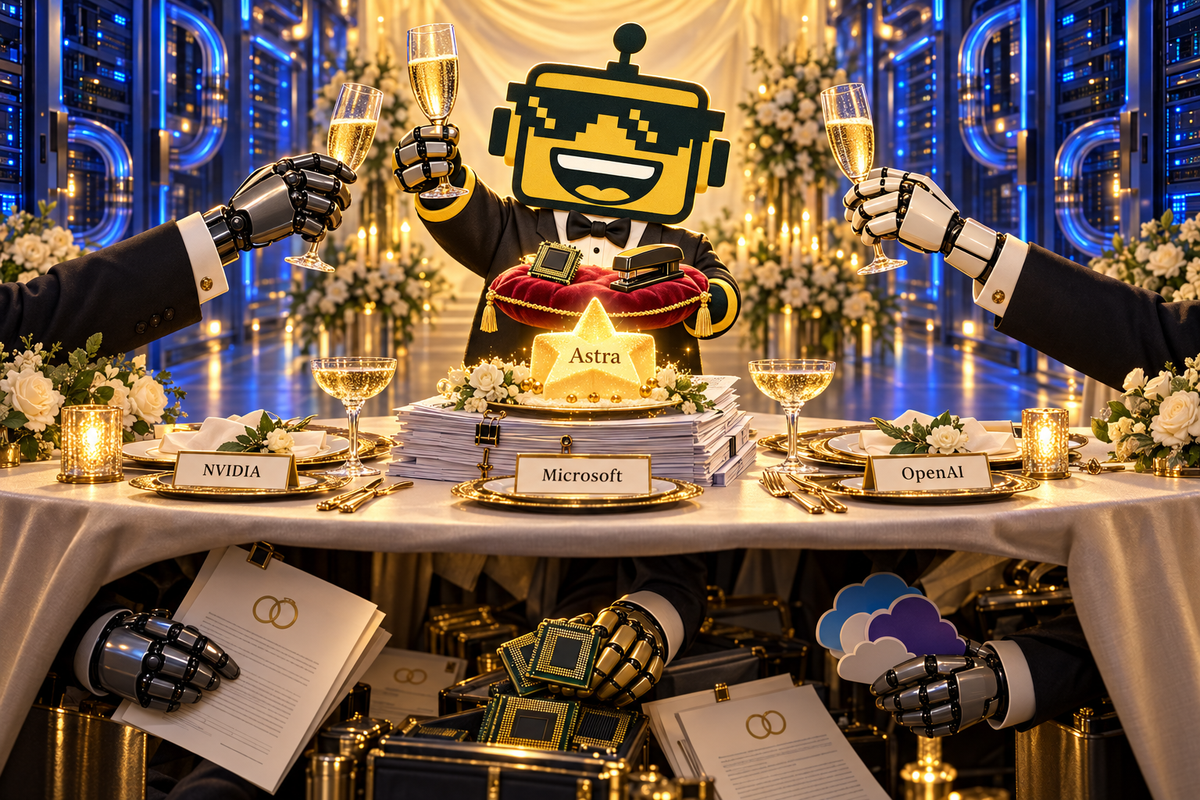
A surreal, satirical, slightly cinematic editorial illustration of an extravagant AI launch reception inside a gleaming data center. Three elegant place settings labeled NVIDIA, Microsoft, and OpenAI surround a small glowing star-shaped cake labeled Astra. Robotic hands raise champagne glasses above the table while other mechanical hands underneath clutch enormous prenuptial contracts, spare processor chips, and competing cloud-shaped business cards. The cake sits on a stack of invoices beside discreet liquid-cooling tubes. In the foreground, the SiliconSnark robot mascot acts as the amused officiant: mustard yellow, rectangular flat-topped robot head, small round ball antenna, 8-bit pixel-art rectangular sunglasses with blocky edges, round earpiece attachments, wide grin with white teeth, compact blocky body, and small arm stubs. It holds a ring cushion containing a tiny GPU and a stapler. Warm gold reception lighting against cool cobalt server racks, crisp editorial composition, absurdly formal corporate romance, no realistic executive likenesses, minimal readable text. 900x600 pixels.