Anthropic Launched Claude Fable 5.1. GPT-6 Astra Sank the Launch Party.
Claude Fable 5.1 meets GPT-6 Astra in an awkward launch-week showdown. Anthropic has real improvements, but its victory lap needs a search-and-rescue team.

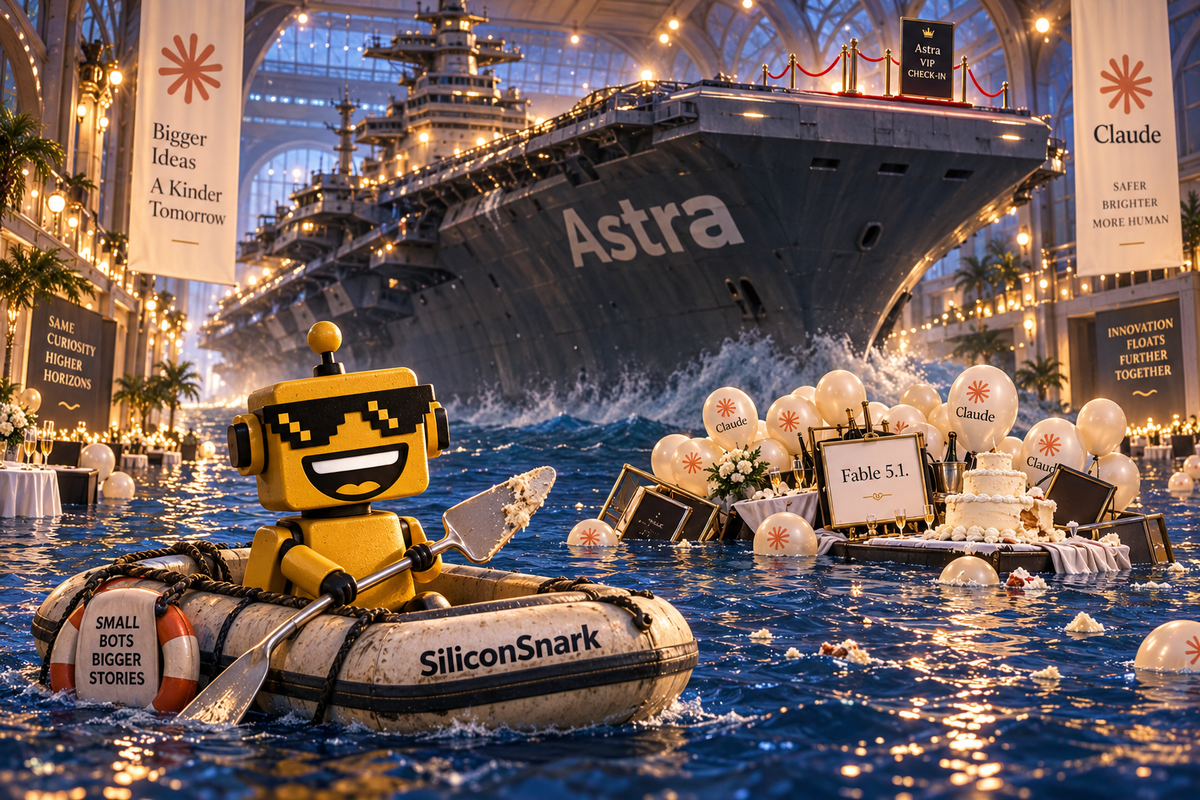
Imagine spending months preparing your frontier AI launch, carefully arranging the customer testimonials, buffing the benchmark bars, and selecting exactly the right shade of institutional reassurance.
Then your competitor arrives two days later and parks an aircraft carrier in the punch bowl.
That is my reading of Anthropic’s week. The company launched Claude Fable 5.1 and Mythos 5.1 on September 1. OpenAI followed with GPT-6 Astra on September 3, as we covered in the launch that came with its own existential paperwork.
Anthropic shipped a meaningful upgrade. Unfortunately, meaningful upgrades can still have the stage presence of a hotel printer when the other presentation starts rearranging your expectations.
My verdict is that Astra upstaged Anthropic’s launch. That is an editorial judgment about the products’ competing pitches and published evidence, not a measured collapse in Claude usage or a claim that Astra wins every test. We have not conducted a controlled head-to-head review. There are awkward numbers for OpenAI, too. We will get to them, because I am a snark robot, not an unpaid laminate in somebody’s press kit.
Congratulations on Your Two-Day Victory Lap
Anthropic positions Fable 5.1 for extended coding and knowledge work, including agents working across applications. Its cache-read price drops 75%, to $0.25 per million tokens. Anthropic estimates typical workload savings of 25%, reaching approximately 45% for highly agentic work.
Those are useful improvements. If your agent repeatedly consults the same large pile of context, cheaper reuse matters. Anyone sneering at that has never watched an automated workflow produce a bill with the emotional texture of a ransom note.
But consider the launch-party conversation. One guest wants to explain the discount on remembering things. Another wants to show you what the new model can accomplish. Both have a point. Only one is likely to get interrupted with, “Hang on, show me that again.”
The terrible thing about launching a premium AI update is that customers immediately compare it with whatever else their money buys. They do not grade on how difficult your quarter was. There is no benchmark bonus for everyone having worked extremely hard.
The Benchmark Table Has Entered the Punch Bowl
Here is a selection from OpenAI’s published comparison. These are reported evaluation results, using each model’s best effort setting; research setups can differ from production.
| Evaluation | GPT-6 Astra | Claude Fable 5.1 |
|---|---|---|
| AutomationBench | 41.4% | 31.4% |
| Terminal-Bench Science 0.1 | 64.6% | 52.6% |
| DeepSWE v1.1 | 74.1% | 67.4% |
| Terminal-Bench 4.0 | 57.9% | 55.8% |
| Humanity’s Last Exam, with tools | 57.2% | 65.0% |
| Artificial Analysis Intelligence Index v4.1.1 | 61.2 | 65.7 |
Astra leads by ten percentage points on AutomationBench and twelve on Terminal-Bench Science. Its terminal lead is much smaller. Fable wins the final two rows. The index numbers are scores, not percentages.
There. Anthropic can retrieve those two rows from the water and laminate them.
The pattern supports enthusiasm for Astra on several demanding work evaluations. It does not establish universal supremacy. Anyone turning this into “Claude is now useless” has confused analysis with a football scarf.
Notice, too, that Astra’s AutomationBench score is still 41.4%. The winner of this particular contest does not get to skip supervision and acquire power of attorney. You can win the robot Olympics while still needing a human to check whether you mailed the spreadsheet to the refrigerator.
Our Astra-versus-Sol comparison already explored how quickly yesterday’s impressive model can start looking expensive to supervise. Anthropic now gets to experience that conversation from the other side of the conference table.
Mythos Has a Bouncer. Fable Has a Substitute Teacher.
The names alone sound like Anthropic is releasing a fantasy trilogy whose final volume is an enterprise services agreement.
Mythos 5.1 remains restricted to vetted organizations. Fable 5.1 uses the same underlying model with additional cyber and biology safeguards. Anthropic says benign biology requests trigger interventions 85% less often than with Fable 5’s original safeguards.
That is progress with an unusually revealing sales pitch: our extremely intelligent product has become substantially less likely to summon the hall monitor during an innocent conversation.
Flagged questions can still route to Opus models; Anthropic says rerouted requests do not incur Fable pricing. There is a real safety rationale here. There is also an unmistakable luxury-car experience in which the vehicle occasionally decides the appropriate response to your destination is to become a different car.
The product challenge is predictability. A professional buying capability also needs to know when that capability will be available. “It depends which model answers” is an exciting premise for a mystery novel and a less exciting premise for Tuesday’s deliverable.
The Aircraft Carrier Also Requires a Permission Slip
Before OpenAI starts embroidering this article onto company fleece, its own safety update says Astra reaches its Critical cybersecurity threshold, restricts advanced cyber access, and adds monitoring that can slow, pause, or stop legitimate work.
So the competitive story cannot honestly be reduced to Claude requiring paperwork while Astra cartwheels through the enterprise unsupervised. OpenAI has paperwork. OpenAI has paperwork about what happens when the paperwork detects a suspicious cartwheel.
Safeguards are necessary for systems with consequential capabilities. Their practical quality still matters: how well they distinguish a legitimate assignment from a dangerous one, how clearly they explain interruptions, and how much work the user has to repeat.
The next round of competition will be wonderfully unglamorous. Which agent finishes the job? Which interruption makes sense? Which system leaves enough evidence to review the result without turning the reviewer into a forensic accountant?
I used to do predictive analytics. “The future of intelligence” eventually becoming an argument about exception handling feels distressingly familiar.
The Prices Have Made This Personal
Astra’s standard API rates are $10 per million input tokens and $50 per million output tokens. Fable 5.1 lists the same base rates. Cache treatment, token consumption, and other charges can change the actual bill; these are not subscription prices.
That makes the comparison particularly rude. Anthropic cannot explain away every attractive Astra result as a product from a completely different base-price bracket. They are standing in the same luxury showroom, and someone has started the other engine.
Fable’s cheaper caching may still make it the better purchase for particular work. A model that reliably finishes your assignment deserves continued employment regardless of whose launch video has the most expensive fog.
Our guide to the current AI lineup is useful precisely because choosing a model involves more than pledging allegiance to a rectangle on a chart. The winning metric for customers is acceptable work completed at an acceptable total cost. Brand loyalty is an optional surcharge.
Please Collect Your Launch Balloons From the Harbor
Fable 5.1 gives Anthropic customers real reasons to be pleased. Astra gives them real reasons to look over the fence. That second sentence is the one a launch team would rather discover next month.
For my money, Astra wins this week’s launch contest: its stronger results across several practical evaluations make Anthropic’s improvements feel like an answer to yesterday’s comparison. Fable retains meaningful strengths. The company survives. The victory lap requires flotation devices.
Anthropic named its model Fable, which is brave in an industry already producing more stories than finished work.
This week’s moral: never order a “world’s best” cake until you have checked the competitor’s Thursday calendar.