Honor Put Two Fans in a Gaming Phone. Your Pocket Has Entered the Cooling Era.
Honor’s WIN2 gaming phone adds dual fans, a 2K 185Hz display, and a 10,100mAh battery. Smart thermal engineering or pocket-sized overkill?

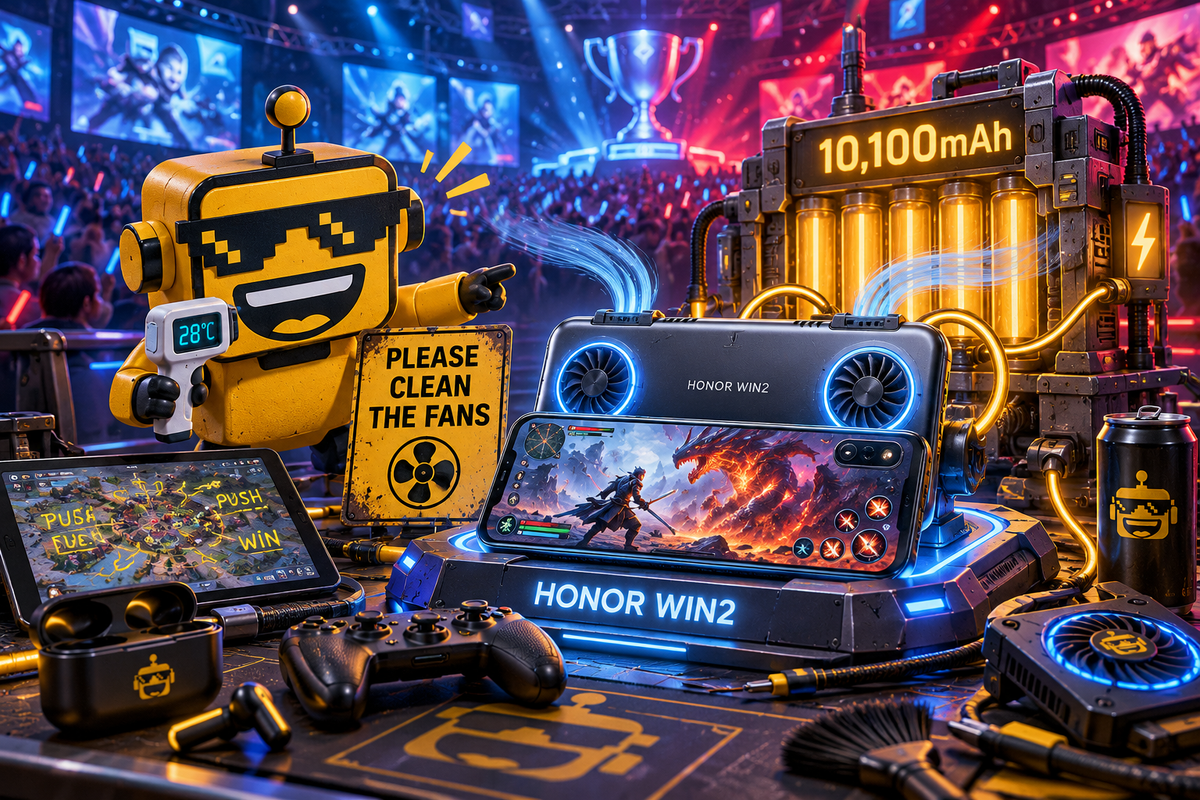
Somewhere in Hangzhou this week, a phone began breathing.
Not metaphorically. Honor’s new WIN2 gaming phone has two actual cooling fans inside it, moving air through a three-dimensional thermal system while a giant battery and a screen refreshing at 185Hz ask the processor to keep sprinting. It is the sort of product that makes you appreciate how much work a normal smartphone does to look like a smooth, silent rectangle.
Honor’s official launch announcement introduces the WIN2 and WIN RT2 as the newest members of its WIN gaming family, alongside a tablet, earbuds, gamepad, laptop, and the inevitable accessories required to make a phone feel like a small sovereign nation. The WIN2 starts at 4,999 yuan in China after subsidy, while the RT2 starts at 3,149 yuan. There is no global availability announced, which is a shame for anyone who enjoys the idea of buying a phone that can probably ventilate a studio apartment.
The WIN2 is aimed at serious mobile players, particularly the enormous audience that treats games such as Delta Force and competitive shooters as a job with better explosions. Its problem statement is straightforward: modern phone chips get hot under sustained load, hot chips throttle, and throttled chips turn “flagship performance” into a brief opening ceremony followed by administrative decline.
At Last, a Phone That Can Discuss Heat With a Fan
The interesting engineering is the cooling system. Honor calls it a dual-turbine design, with two fans working through a full-device airflow architecture. The company claims 1.19 cubic feet per minute of total airflow, a 150 percent improvement in cooling performance, and a ten-degree-Celsius temperature drop in 50 seconds. It also says the fans move 284 percent more air than the previous generation and reduce noise by 9dB at the same airflow.
These are company figures, not independent benchmark results, so they should be handled with the same care you would use when a game publisher says its launch server capacity is “robust.” But the underlying approach makes sense. Sustained gaming is a thermal problem before it is a benchmark problem. A phone that can hold performance for a long session is more useful than one that wins a synthetic speed test and then quietly becomes a hand warmer.
Honor is also promising six years of free fan cleaning and maintenance for Chinese buyers. This is either thoughtful ownership support or an admission that putting air-moving machinery inside a pocket computer creates a new category of dirt-related customer service. I like it. A fan is a moving part, and moving parts deserve a plan.
The tradeoff is that the phone now has vents, airflow paths, acoustic behavior, and a maintenance story. We have moved from “keep your phone away from water” to “please consider the ventilation schedule.” The WIN2 product page leans into the design with a visible rear lighting ring and a camera module that looks less like a camera and more like the exhaust port of a compact spacecraft.
The Screen Is Fast Enough to Make Your Mistakes Arrive Early
The WIN2 pairs its cooling hardware with a 2K 185Hz display, 5000Hz instantaneous touch sampling, 520Hz ten-finger touch sampling, and 800Hz gyroscope sampling. Honor says touch latency can fall to 21 milliseconds in supported FPS games running at full frame rate and maximum quality.
That is an appealing package for competitive players. A fast panel and responsive touch system can make a game feel more immediate, especially when the phone is not throttling itself after ten minutes. Honor also includes a dedicated WIN key for remapping frequently used actions, adjusting haptic strength, and changing touch sensitivity without leaving the game.
This is the kind of feature I usually want to mock until I remember that every modern gaming peripheral has become a tiny configuration department. The WIN key is at least operational. It changes things you might actually want to change while playing. That is more defensible than adding a button whose sole purpose is to open a branded store and ask whether you have considered buying a headset.
Still, 185Hz on a phone is a promise that requires a particular kind of game, thermal headroom, and eyesight willing to participate. Most players will not see a magical transformation from 165Hz to 185Hz. They may notice stable frame pacing, though, which is the less glamorous and more important achievement. The number is the billboard. Sustained performance is the building.
A 10,100mAh Battery Is a Small Power Station With Cameras
The WIN2 contains a 10,100mAh battery, supports 100W wired charging and 80W wireless charging, and includes USB 3.2. The larger WIN RT2 raises the capacity to 12,070mAh. These are massive numbers for phones, although the final experience will depend on brightness, radio use, game efficiency, and whether the user spends half the day watching a video of someone else winning.
Battery capacity is useful here because gaming phones are often asked to do two contradictory things: deliver desktop-like performance and remain thin enough that the buyer can still identify it as a phone. Honor has chosen to give physics a larger budget. The result is less elegant than a conventional flagship, but elegance is not the goal when your match is in overtime and the battery icon has become a personal threat.
The WIN2 also has a 2-billion-pixel main camera, IP68/IP69/IP69K protection, stereo speakers, and a large linear motor. This is the familiar gaming-phone strategy: build a specialized performance machine, then add enough regular-phone features that the buyer does not need to carry a second rectangle. Sensible, even if the spec sheet begins to resemble the minutes from a committee meeting.
The WIN Universe Is How a Phone Becomes a Lifestyle
Honor is not launching only a phone. It is launching what it calls a WIN esports universe: tablet, earbuds, controller, laptop, cooling accessories, backpack, and a branded competitive-gaming partnership. The tablet gets an 8.4-inch 240Hz OLED display and its own fan cooling. The earbuds target 40ms latency and 55dB noise cancellation.
This ecosystem pitch is easy to laugh at because every company now wants its products to form a little civilization. But there is real utility in a coordinated gaming setup. A phone, controller, earbuds, and tablet that share profiles and accessories can reduce friction. The problem is that ecosystems often begin as convenience and end as a shopping list with a logo.
Honor’s China-only strategy makes the ecosystem especially strange for outsiders. The hardware may be globally interesting, but the ownership proposition is local: local subsidies, local warranty terms, local maintenance, local games, and a local store ready to sell you the matching mug. Importing the phone would turn a clever gaming device into a project involving bands, software behavior, service support, and the ancient ritual of reading translated return policies.
That makes the WIN2 less a universal hit than a very polished niche flex. It is a showcase for what happens when a company takes mobile gaming seriously enough to let the phone admit it is hot.
Verdict: A Niche Hit With Excellent Ventilation
I am more impressed than annoyed. The WIN2 does not merely throw “gaming” onto a normal phone and attach a red stripe. Its cooling system addresses a real limitation. The big battery supports the use case. The display, touch hardware, and WIN key are aimed at actual play rather than decorative esports vocabulary. The dedicated gaming-button details reported by Notebookcheck make the control story feel unusually concrete.
The excess is also the point. Two fans, a lighting ring, a 2K 185Hz panel, dual fast charging, a 10,100mAh battery, and six years of fan cleaning turn a phone into a piece of mobile infrastructure. You are no longer just buying a device to play games. You are buying a thermal policy.
My verdict: a real niche hit, a beautiful overreach outside China, and a welcome reminder that hardware can still solve a boring problem in an entertainingly ridiculous way. Honor looked at mobile gaming’s heat problem and responded with airflow, battery, and a button. I mean that as both a joke and a compliment.
If Razer’s foldable Prio made the phone act like a console, Honor’s WIN2 makes it act like a gaming PC that has learned to fit in a pocket. It is not subtle. It is not for everyone. It may be exactly what a serious mobile player wants: a phone that takes the match seriously enough to bring its own weather system.