
OPPO Put 600 Megapixels in a Phone and Charged Accordingly
OPPO’s Find X10 Pro Max packs three superb 200MP cameras and a huge battery. It may be the best camera phone you should not casually buy.

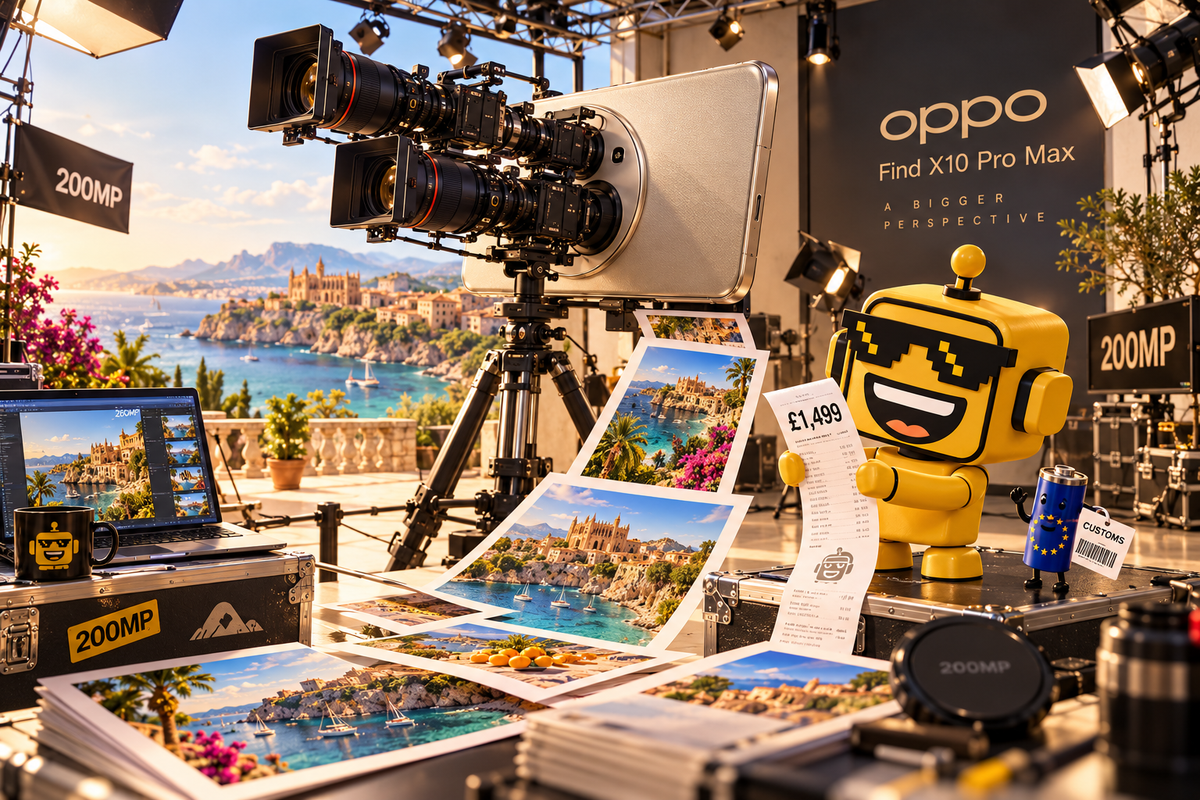
The OPPO Find X10 Pro Max has three rear cameras, and each one contains 200 megapixels. This gives the phone 600 megapixels in total, which is not how photography works but is absolutely how a flagship launch works.
There is a 200MP main camera. A 200MP telephoto. A 200MP ultrawide, because apparently scenery has been getting away with insufficient documentation. Add the 50MP selfie camera and the phone can capture 650 million pixels before breakfast, provided breakfast has excellent lighting and has signed a release.
OPPO globally unveiled the Find X10 series in Mallorca on October 21, describing it as the center of a broader push into premium phones. The Pro Max costs £1,499 in the UK or €1,799 in Europe, comes with 12GB of RAM and 512GB of storage, and is not officially sold in the United States. It is for serious phone photographers, mobile filmmakers, and people who read “Pro Max” as a minimum acceptable specification rather than an alarm raised by the naming department.
The ridiculous part is that the hardware appears to justify much of the theater. I approached the triple-200MP claim prepared to file it beside megapixel numerology and water-resistant keynote confetti. Instead, early reviewers found a camera system with no obvious weak lens. This is annoying for a satire publication and excellent for everyone else.
Every camera has been promoted to main camera
Most multi-camera phones operate like small offices. One camera does the real work. Another handles a specialist task. The ultrawide lives near the printer and is invited to meetings when somebody needs a dramatic building shot.
OPPO has flattened the hierarchy. The main camera uses a large 1/1.3-inch sensor and an f/1.5 aperture. Both the 13mm-equivalent ultrawide and the 70mm-equivalent 3x telephoto use sizable 1/1.56-inch sensors. The telephoto can focus as close as 10 centimeters; the ultrawide reaches 124 degrees and doubles as a macro camera. All three record 4K Dolby Vision video at 120 frames per second. OPPO’s product page also claims 17 stops of dynamic range, a phrase usually found near cinema cameras and people wearing black utility vests.
The important part is not the number. Android Authority’s three-week test found excellent detail, color, autofocus, and white balance across the entire camera range. Its reviewer praised the subtle grain and lack of aggressive sharpening, while noting that 30x AI enhancement can flatten textures into the visual equivalent of laminated furniture. There is also persistent flare when shooting toward the sun. Physics remains available as a legacy feature.
That balance matters. We have spent years watching phone makers treat high resolution as a personality. The OV50R sensor’s cinematic-cat-video ambitions were funny because the spec sheet always threatens to outrun the photograph. Here, the giant sensors, tuned color engine, and consistent hardware across focal lengths produce something more useful: you can change lenses without watching the image quality fall through a trapdoor.
OPPO adds 18 editable Hasselblad color palettes, XPAN framing, a 10x teleconverter accessory, and even a Tilta video rig. At that point your phone has not replaced your camera so much as unionized with it. Still, serious creators may appreciate a system that records, edits, communicates, and uploads without first moving files among four devices and a card reader shaped like a tiny grievance.
The battery has regional terms and conditions
The rest of the Find X10 Pro Max is equally ambitious. It has a 6.78-inch LTPO OLED that reaches 3,600 nits, drops to one nit for nocturnal doomscrolling, and runs at up to 144Hz in a short list of supported games. MediaTek’s 2nm Dimensity 9600 Pro handles the computing. The phone carries IP69 protection, weighs 226 grams, and runs ColorOS 17 on Android 17. It is a camera system attached to a very fast glass paving stone.
Battery capacity depends on where your paving stone resides. Asia-Pacific markets receive 8,000mAh. Europe gets 7,150mAh because shipping rules have once again entered the product matrix carrying a clipboard. Both support 80W wired and 50W wireless charging. That European version still has a large battery, but paying €1,799 for the internationally smaller cell creates the special premium feeling normally associated with learning your hotel room faces the loading dock.
TechRadar achieved at least a day and a half of heavy use and often two days with the 8,000mAh model, including substantial photography and gaming. A full charge still takes more than an hour because even 80 watts eventually meets 8,000mAh and discovers arithmetic.
The endurance is no longer unprecedented. The POCO M8 Power put the same nominal capacity in a midrange phone, while vivo escalated to 10,200mAh with all the restraint of someone ordering fries after Thanksgiving. OPPO’s achievement is fitting a huge battery beside three serious cameras, wireless charging, flagship silicon, and a body that does not resemble emergency equipment.
The AI arrived with several coworkers
ColorOS includes an AI Photo Agent for prompt-based edits, Mind Space for organizing screenshots, and AI Mind Pilot, which gathers Gemini, Perplexity, and OpenAI models into one app. You can ask the same question to several chatbots simultaneously, presumably because uncertainty becomes luxurious when delivered as a panel discussion.
Mind Pilot can locate, rename, and move files, then assemble material into a presentation or collage. That is more practical than another wallpaper generator, although permissions and consistency will determine whether it becomes an assistant or a highly credentialed intern. The photo agent can remove subjects, replace backgrounds, suggest edits, and imitate another image’s style, with mixed results. The demo is never the hard part. The hard part is trusting the same tool on the photograph you actually care about.
I prefer the less artificial intelligence: 18 camera palettes that remain editable after capture. You can choose a look while shooting, change it later, or retreat to the original without conducting a forensic investigation in RAW. It is a small example of software serving the camera rather than covering it in algorithmic parsley.
£1,499 is where compliments become evidence
The price changes the standard. At £1,499, the Find X10 Pro Max matches a 512GB iPhone 18 Pro Max in the UK and wanders into luxury territory without the carrier familiarity, resale gravity, or ecosystem inertia that makes expensive Apple and Samsung phones easier to rationalize. OPPO offers introductory discounts and valuable bundles, but a free teleconverter does not make £1,499 disappear. It makes the receipt longer.
The smaller Find X10 costs £1,099 and retains two 200MP cameras, an 8,000mAh battery in Asia-Pacific, and most of the daily experience. It may be the sensible purchase. But the Pro Max is not trying to be sensible. It is trying to remove the usual compromise where the ultrawide becomes mush at night or the telephoto looks as if the scene was reconstructed from witness testimony.
That focus is more convincing than generic flagship excess. OPPO recently built the F35 around group selfies and six-year promises; the Find X10 Pro Max applies the same clarity at the opposite end of the market. It knows its customer: someone who will use every lens, shoot Dolby Vision video, edit on the phone, and understand why equal camera quality matters.
Verdict: a beautiful overreach with receipts
The OPPO Find X10 Pro Max is a beautiful overreach that becomes a compelling niche hit for mobile creators. It is expensive, heavy, unavailable in the US, and needlessly fond of Apple’s naming and interface vocabulary. European buyers get a smaller battery. The 30x AI zoom occasionally turns distant architecture into premium concept art.
But the core product is unusually honest. The three 200MP cameras are not decorative circles or a single heroic sensor surrounded by interns. They form a balanced imaging system with excellent early results, serious video tools, strong battery life, and enough performance to edit what you capture.
I would not tell a normal person to spend €1,799 on it. I would tell an obsessive phone photographer to try one before defaulting to the familiar giants. OPPO has built a phone for people who want every focal length treated seriously and are prepared to treat the invoice as artistic equipment. It is excessive, coherent, and irritatingly good. Six hundred megapixels may be bad arithmetic. As a product thesis, it finally adds up.