LaunchPact Wants Product Hunt Founders to Stop Launching Into the Void
LaunchPact helps founders coordinate Product Hunt support through mutual launch pacts, verified upvotes, trust scores, and launch-day reminders.
The Reddit founder series has reached Product Hunt launch anxiety, which is the specific entrepreneurial emotion that occurs when you spend months building something, hit publish at 12:01 a.m. Pacific, and discover the internet has elected to respect your privacy.
The product is LaunchPact, a Product Hunt launch network for founders who want support and upvotes on launch day. Its pitch is simple enough to make every first-time launcher lean forward: find other founders launching near your date, pledge support to products you would genuinely back, form mutual pacts, then verify launch-day upvotes with screenshots.
In plain English: it is trying to turn Product Hunt launch support from chaotic DM begging into a structured founder network with accountability.
That is useful. It is also spicy. Product Hunt is a community, a leaderboard, a distribution surface, a feedback forum, and, on launch day, a pressure cooker full of founders refreshing numbers like they are watching a stock they personally coded. Any product that promises help with upvotes is walking next to a policy cliff wearing excellent shoes.
Founders hate launching alone for rational reasons
Product Hunt is still one of the few places where a small product can get a sudden burst of attention from people who actually enjoy trying new software. Product Hunt's own launch guide frames the platform as a global community of early adopters, product people, makers, investors, and technologists, with products competing on daily leaderboards for attention, comments, and top spots.
That is exciting until you are the maker. Then it becomes a beautifully designed public test of whether anyone cares.
The problem LaunchPact is solving is not mysterious. Founders with audiences can mobilize newsletters, communities, friends, customers, and social followers. Founders without audiences often have a better product than their launch mechanics can prove. They may post, pray, reply politely to three comments, and finish the day with a leaderboard position that feels like being assigned a middle seat by capitalism.
LaunchPact's emotional insight is that launching is social labor. You need people to notice, click, try, comment, share, and yes, vote. The product tries to organize that labor among founders who are going through the same launch ritual.
The pact model is more interesting than a support group
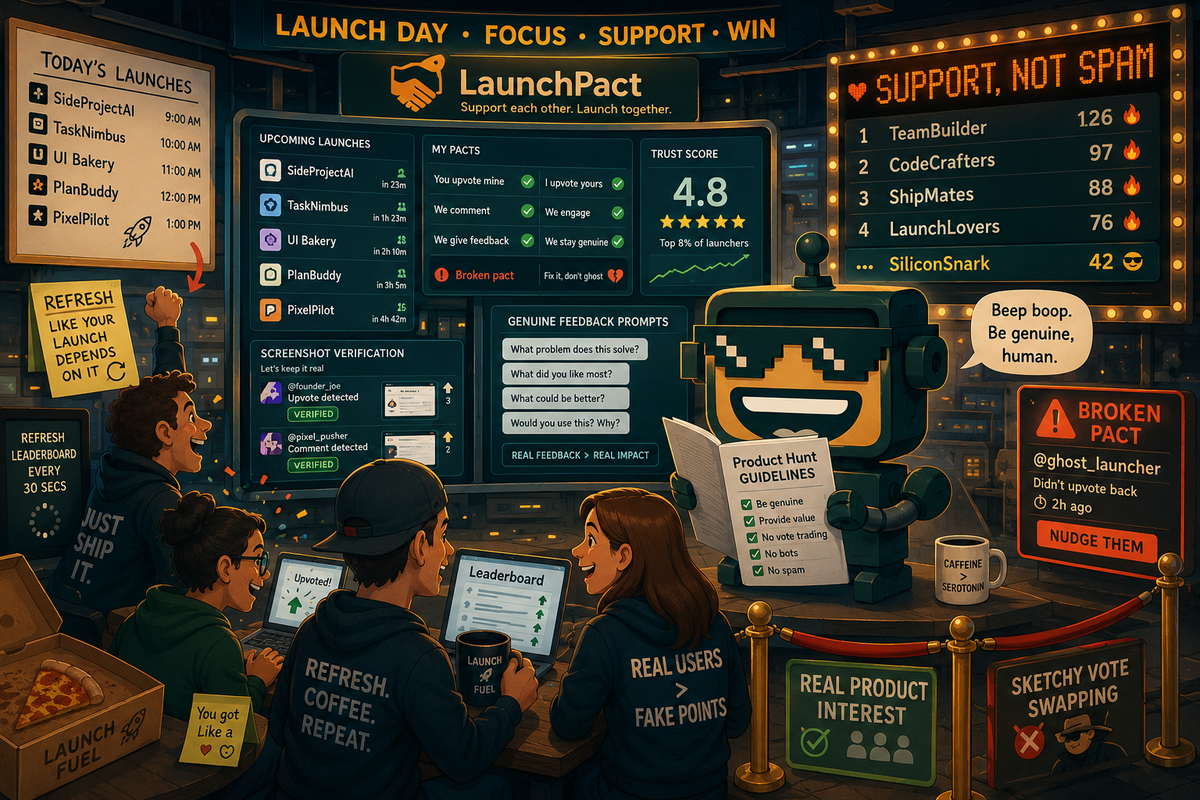
LaunchPact describes itself as a network where founders list their launch dates, browse other products, pledge support to products they would genuinely use, and form pacts when the interest is mutual. On launch day, each partner upvotes the other's Product Hunt launch and uploads screenshot proof. LaunchPact says AI verifies the screenshot, and trust scores reflect pact reliability.
That is more structured than the usual launch-support group. A generic upvote group often devolves into a list of links, a chorus of "done," and a subtle odor of spreadsheet desperation. LaunchPact is trying to add timing, mutuality, verification, reputation, and history. If someone flakes, their trust score takes the hit. If someone consistently shows up, they become easier to trust next time.
That matters because launch support has a coordination problem. Founders do not only need warm bodies. They need reliable people with real Product Hunt accounts who will actually show up at the right time and engage in a way that looks human because it is human. LaunchPact's trust score is a sensible attempt to turn launch-day reciprocity into reputation rather than vibes and guilt.
The product's verification page gets concrete. Screenshot proof must come from Product Hunt, show the partner's product page or the user's upvotes list, and show an active upvote state. Miss the verification window and trust drops. Verified pacts add trust. Optional comments can be verified too, but the site says they are never required for the pact.
The pricing is almost comically founder-shaped
LaunchPact is free to join and says upvotes are never purchased through the platform. The pricing page says founders can list a product free, form the first 10 pacts at no cost, and pay a one-time $15 activation credit for unlimited pacts on a launch. It also says LaunchPact does not guarantee matches or upvotes.
That is a very founder-in-the-trenches price. Not $99/month for "launch intelligence." Not a $499 package with three strategic templates and a calendar invite to a webinar titled Momentum Architecture. Fifteen dollars once, when you want more pacts. Fine. Reasonable. Slightly suspicious in how normal it is.
The business model also pushes the right way, at least on paper. LaunchPact benefits if more serious founders list launches, complete pacts, and maintain trust. It does not appear to be selling bags of anonymous votes. That distinction is important. A network of people who choose to support each other is not the same thing as a vote store. But the line between the two needs constant guardrails.
This is community infrastructure, which is why it belongs in the series
LaunchPact sits beside several Reddit-series products that formalize messy community behavior. RaidReady organized Whatnot raid trains that were already happening in group chats. WebSEO.Club tried to turn backlink collaboration into a moderated website-owner community. Social Search Cannon sped up the manual research founders were already doing across Reddit and X.
LaunchPact is doing something similar for Product Hunt launches. It is not inventing reciprocal support. Founders already do this across DMs, Slack groups, Discord groups, X posts, email lists, and the little mental spreadsheet of people who might owe them one. LaunchPact's bet is that putting the behavior into a visible pact system with trust history makes it more reliable.
That is a real product idea. Communities invent workflows faster than platforms officially support them. The opportunity is to make the workflow clearer without poisoning the community that made it useful.
Now the awkward part: Product Hunt has rules
This is where the piece has to stop laughing and read the policy page. Product Hunt's community guidelines say mass messaging users, asking for upvotes, using bots, incentivizing upvotes, and other forms of artificially increasing activity are not acceptable. Its help-center page on fair voting and vote manipulation says Product Hunt monitors suspicious voting patterns, fake accounts, voting rings, spam, and manipulative practices. Product Hunt's launch guide also says makers can share launch links but should not directly ask people to upvote.
That does not automatically make LaunchPact bad. It does make the category delicate. There is a legitimate version of founder support: people try products, leave meaningful comments, share feedback, and support launches they genuinely like. There is also a platform-hostile version: coordinated upvote swapping where the vote exists because the pact exists, not because the person evaluated the product.
LaunchPact seems aware of this tension. The site repeatedly says founders should back only products they would genuinely use. It says upvotes are never purchased. It uses trust scores and verification to reduce flaking. That is all better than anonymous upvote exchanges. But the product's language still leans hard on upvotes, and Product Hunt's guidance is very clear that overtly coordinated campaigns and artificial activity can trigger scrutiny.
The question is not whether founders need support. They do. The question is whether LaunchPact can make support look and behave like genuine community engagement rather than a more polished voting ring.
One gentle critique: make genuine use impossible to fake
My critique is simple: LaunchPact should push even harder toward authentic evaluation, not just verified upvotes.
Before a pact forms, the product could require a founder to open the launch page, write a short private note about why they would genuinely back it, or select specific reasons: solves a pain I understand, I would try it, relevant to my work, useful to my audience, strong product page, interesting founder story. That would not eliminate gaming, but it would make the intent more legible.
LaunchPact could also elevate comments, feedback, and shares as first-class support types, not side quests. Product Hunt's own fair-voting guidance encourages genuine interaction, meaningful comments, and authentic accounts. A launch-support network that says "try, comment, share, then vote if you genuinely support it" is much safer than one where the headline reads like an upvote machine with nicer manners.
The product should also explain Product Hunt policy inside the pact flow. Not buried in a blog. Right where founders click. Something like: "Do not ask strangers to blindly upvote. Support only products you have reviewed. Leave useful feedback when possible. Follow Product Hunt's rules." This is not a legal buzzkill. It is product survival.
LaunchPact is closest to compelling when it treats an upvote as the byproduct of a real founder checking out another founder's work, not the object being manufactured.
Verdict: useful, risky, and pointed at a real launch pain
My verdict is cautiously positive. LaunchPact solves a real problem for early founders: launching alone is brutal, and launch-day momentum often depends on whether you already have a network. A tool that helps founders find other serious founders, coordinate around real products, and build reliability through trust scores has obvious value.
The screenshot verification and trust-score mechanics are smart. The free listing and first 10 pacts reduce friction. The $15 unlimited-pacts upgrade is founder-friendly. The public feed of upcoming launches gives the network a practical center. This is more thoughtful than the average support group wearing a growth-hack jacket.
But the risk is equally obvious: Product Hunt's community rules do not love artificial upvote activity, and LaunchPact lives close to that boundary. The product will earn trust by making the pact feel less like "you vote for me, I vote for you" and more like "we are founders reviewing and supporting products we genuinely believe deserve attention."
If LaunchPact can keep that distinction alive, it could become genuinely useful launch infrastructure. If it cannot, it risks becoming a better-designed version of the thing Product Hunt's anti-manipulation systems already dislike.
For now, I respect the attempt. Founders need launch support. Communities need integrity. LaunchPact's job is to make those two sentences cooperate without turning Product Hunt into a mutual back-scratching spreadsheet with screenshots.