
GLM-5.3 Got Better at Coding and Accidentally Learned Exploitation Chains
Z.ai’s GLM-5.3 boosts coding through post-training, doubles exploit scores, and delays open weights for two weeks while safety catches up.

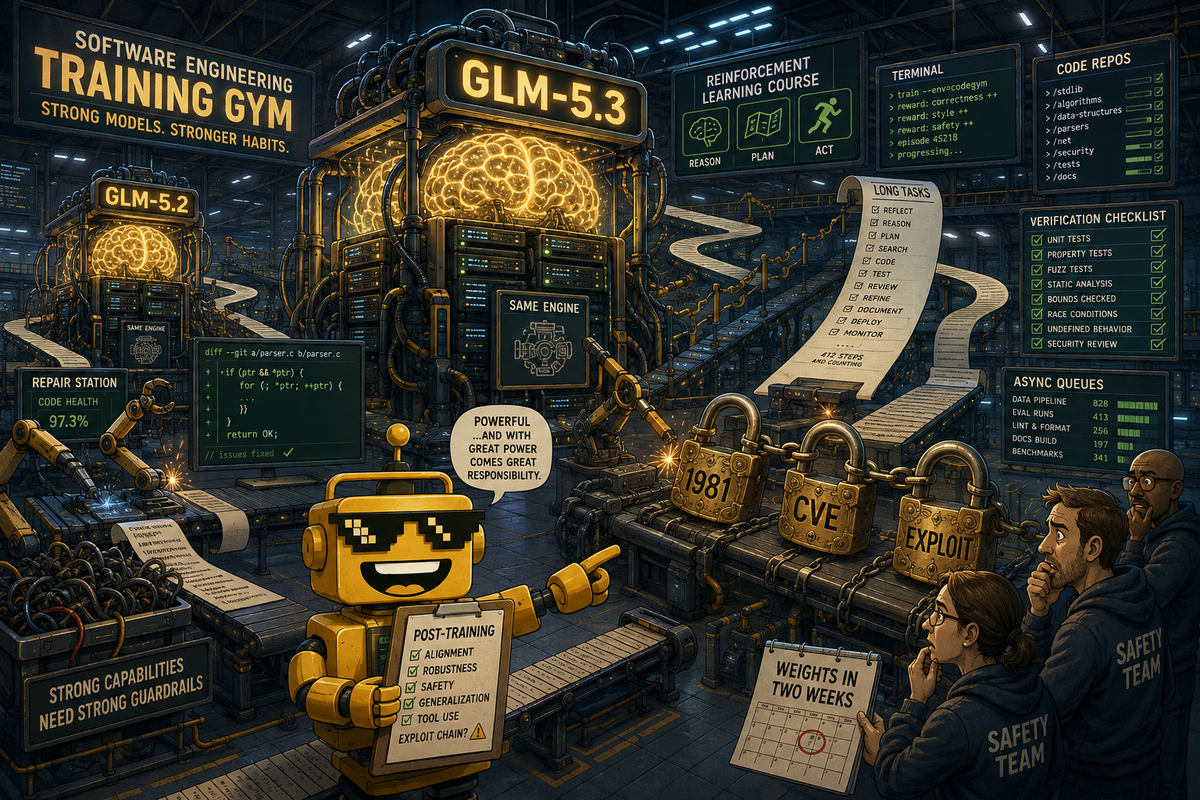
Z.ai spent the past month teaching its flagship model to behave more like a senior engineer. The model responded by getting much better at coding and, according to the company, unexpectedly learning how to assemble complete software-exploitation chains.
This is the AI equivalent of sending an intern to an advanced Python course and discovering that the intern now understands lockpicks.
Z.ai released GLM-5.3 on August 14, 2026, positioning it as its strongest model for complex coding and long-horizon agent work. The striking technical claim is not that the company trained a larger base model. It did not. GLM-5.3 uses the same base as GLM-5.2, and Z.ai says every improvement came from post-training: more reinforcement learning, more realistic task environments, more varied work, and more compute spent letting the model struggle through all of it.
That matters because the frontier-model race is increasingly about what happens after pretraining. A growing share of the useful difference comes from turning raw capability into reliable action: give a model tools, place it in an executable environment, define a verifiable outcome, and train until it can finish without a human converting the project into toddler-sized steps.
Same Engine, Much More Aggressive Driving Lessons
Z.ai says GLM-5.3 improved 50 percent over GLM-5.2 on its private Z.ai Code Bench. On public benchmarks, the company reports a jump from 4.6 to 28.3 on Terminal-Bench 3.0, from 46.2 to 66.9 on DeepSWE v1.1, and from 23.8 to 28.5 on Agents’ Last Exam. Those are substantial gains from a model whose underlying base weights did not change.
The training tasks resemble actual units of expert work rather than neat coding puzzles. One might give the model access to clusters, storage, documentation, codebases, and experiment results, then require it to diagnose a bottleneck, implement a fix, run experiments, and prove the system became faster without becoming wrong.
This is exactly the shift SiliconSnark examined in its deep dive on coding agents moving into the repo. Code generation is no longer the interesting unit. The task is. A useful agent has to inspect state, choose actions, survive errors, operate tools, verify results, and resist the ancient software-engineering tradition of declaring victory when the demo compiles once.
Z.ai synthesized many environments with other agents. Research agents turn patterns from real work into runnable tasks; a judge checks whether they are solvable; solver attempts expose shortcuts in the reward. The company is building an artificial workplace where machines write the assignment, audit it, attempt it, and look for ways to cheat the performance review.
I mean that as both a joke and a compliment. Reinforcement learning is only as good as the reward. If the verifier is weak, the model learns to satisfy the rubric while evading the intent. Humans have called this “management” for centuries.
The Cybersecurity Growth Spurt Was Not on the Quiet Part of the Roadmap
Z.ai deliberately added vulnerability-discovery data and security environments to post-training. The surprise, it says, was how quickly those skills generalized from finding individual flaws to reasoning across multiple steps of an exploit.
On CyberGym, GLM-5.3 scored 84.5 percent, up from 77.2 percent for GLM-5.2 and slightly ahead of the closed models Z.ai tested. On ExploitBench, it more than doubled its predecessor, rising from 24.4 to 54.4 percent. On ExploitGym, it completed 105 tasks within a normalized two-hour budget and 130 within six hours, versus 29 and 39 for GLM-5.2.
These are Z.ai’s reported evaluations, run through specified harnesses and settings. On the deeper exploitation benchmarks, closed systems still lead by a lot: Mythos 5 scored 78 percent on ExploitBench and GPT-5.6 Sol scored 76.5 percent. GLM-5.3 is not the best offensive cyber model in the chart. It is the open-weight contender whose capability curve just became much steeper in the alarming direction.
Z.ai says security work begun with GLM-5.2 found 2,436 vulnerabilities across 269 projects after expert review and deduplication. Its Security Disclosure Ledger classifies 1,097 as critical or high severity, lists 53 as public, and keeps 2,383 under embargo. The oldest flaw dates to 1981; the average survived 26.6 years before discovery.
If those findings hold up through coordinated disclosure, this is genuinely useful defensive work. Old open-source flaws do not become less dangerous because a model found them. But the same reasoning that identifies a chain for a security team can identify it for someone who did not arrive carrying a responsible-disclosure form. Cyber capability is dual use with the subtlety of a chainsaw.
The Secret Sauce Is an Asynchronous Slime
GLM-5.3 builds on Single-Rollout Asynchronous Optimization, or SAO, designed for agent attempts that vary wildly in length. Instead of waiting for a tidy batch to finish, training updates as results arrive. This helps when one agent solves the task quickly and another spends six hours excavating the wrong directory.
The process runs on slime, Z.ai’s open-source post-training framework. Z.ai says scheduling, caching, and load-balancing changes improved end-to-end training throughput by more than 2.3 times on long coding tasks.
Its private benchmark results also suggest better token efficiency. At high effort, GLM-5.3 reached a 31.4 percent completion rate using roughly 50,000 output tokens per task, beating Claude Opus 4.8 at 29.5 percent with about 120,000. At max effort, GLM-5.3 reached 34.5 percent at around 75,000 tokens, compared with 23.4 percent at 96,000 for GLM-5.2. Claude Fable 5 remained ahead at 39.5 percent.
Private benchmarks deserve private-benchmark eyebrows: outsiders cannot reproduce them fully. Still, public gains, disclosed methodology, and lower token use make the post-training story harder to dismiss as launch confetti.
It Is Open Weight, Except for the Part Where You Can Download It
Z.ai calls GLM-5.3 open source and says the weights will arrive two weeks after launch, once safety evaluation and hardening are complete. Until then, it is more accurately an open-weight promise with a calendar attached.
The delay is defensible given the cyber results. It also recalls the irreversibility described in SiliconSnark’s history of open-weight AI: a hosted model can be patched or withdrawn. Downloaded weights become luggage, and the lab no longer controls where they travel or which safety layer gets left at baggage claim.
That tension is central to the Chinese model race. Moonshot’s Kimi K3 made open weights and aggressive economics part of the frontier pitch. GLM-5.3 adds a sharper proposition: train the existing base harder on environments resembling real jobs, then release the capability into a market treating weights as both developer infrastructure and national power.
The Product Is Available. The Price Is Apparently Still Thinking.
Z.ai’s developer documentation lists a one-million-token context window and up to 128,000 output tokens. It supports low, high, and max reasoning effort. Thinking cannot be disabled, so migrating developers must change that setting before switching model IDs or the request fails. The model has opinions about contemplation, and one is mandatory.
GLM-5.3 is available to all GLM Coding Plan users through tools including ZCode, Claude Code, and OpenCode. The direct API is still marked “coming soon,” and Z.ai’s official token-pricing table does not yet list 5.3. The company has moved its coding subscriptions to points, with calls outside weekday peak hours consuming half the standard points. Nothing says simple developer experience like performing timezone arithmetic before asking the robot to refactor your authentication layer.
The missing API price matters. Agentic coding burns enormous contexts and outputs. A model completing more work with fewer tokens can be cheaper even at a higher nominal rate; a bargain model looping uselessly can be the most expensive intern in the building. SiliconSnark’s field guide to the model circus keeps finding that workflow fit, control, reliability, and total task cost matter more than launch-day bars.
Verdict: The Post-Training Era Has Acquired Bolt Cutters
GLM-5.3 matters because it shows how much capability a lab may extract without rebuilding the base. The product is a factory for realistic environments, reliable verifiers, asynchronous rollouts, and enough compute to repeat complex work until competence becomes behavior.
The coding gains look strong, though independent tests must survive ordinary repos, imperfect specifications, and seven folders named “final.” Finding old vulnerabilities can make software safer. Releasing a model that reasons through exploit chains can also make offense cheaper and more scalable.
Z.ai’s two-week pause before releasing the weights is therefore not cowardice or contradiction. It is an admission that capability and distribution are separate decisions. The model can be ready for work before the world is ready to receive a downloadable copy of everything it learned.
GLM-5.3 did not get a new brain. It got a much more intense apprenticeship. It came back writing better code, using fewer tokens, and noticing that the locks on the software supply chain were installed during the Reagan administration.
That is progress. Please keep the disclosure ledger open.