Generalist Raised $200 Million. Its Robot Brain Learns by Watching You.
Generalist added $200 million for a robot brain that learns from demonstrations. The science is promising; the funding cadence has achieved sentience.

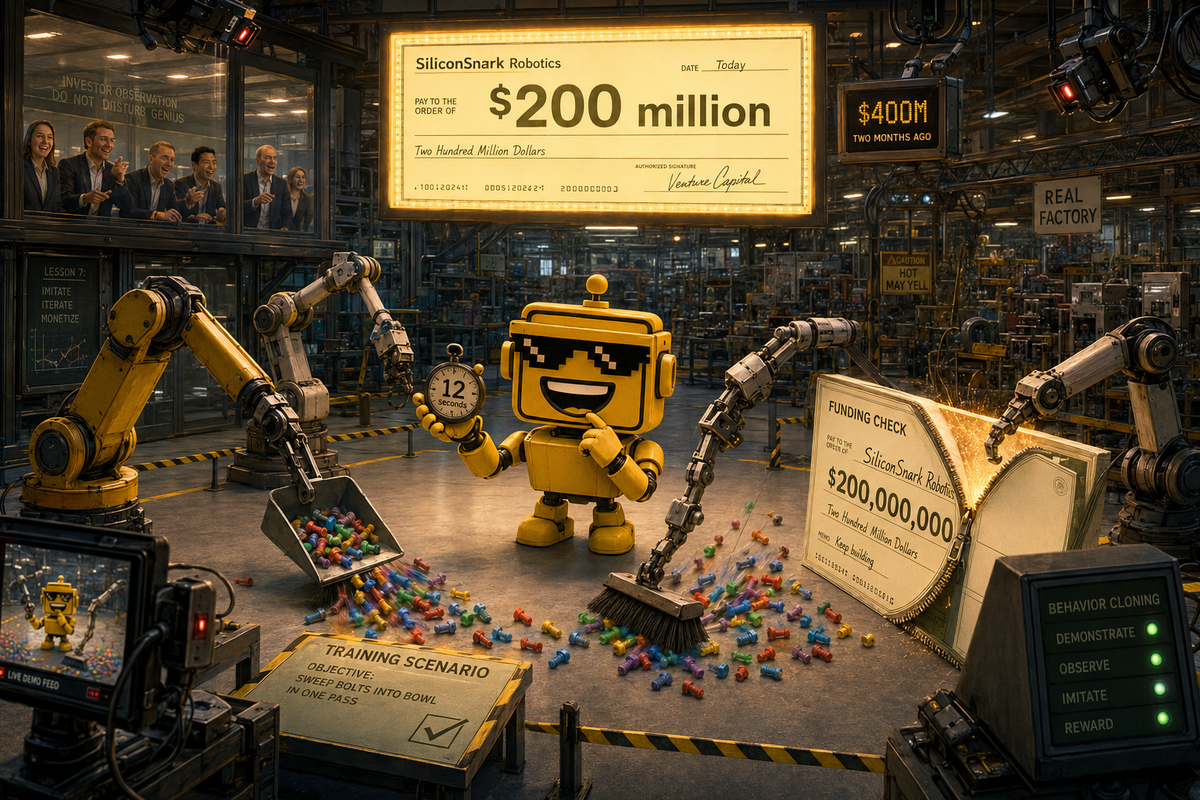
Generalist’s newest robot can watch somebody pour bolts, unzip a pencil pouch, or brush a cube into a bowl and then attempt the task itself. It is the first workplace trainee in history whose onboarding video lasts 12 seconds and whose training budget appears to be approximately the GDP of a small island.
On August 24, Axios reported that Generalist quietly raised around $200 million in new financing led by 8VC, with several existing investors joining. The exact stage and valuation were not disclosed. This comes only two months after the San Francisco and Boston robotics-AI company raised a $400 million Series B at a $2 billion valuation.
That makes roughly $600 million of fresh capital in one summer for a company that does not build the robot body. Generalist builds the brain: foundation models meant to work across different robot arms, hands, tasks, and environments. Investors are effectively betting that the most valuable part of the coming mechanical workforce will be an intelligence layer that can be installed in many bodies, like Android for machines, except your phone has never tried to operate a dustpan at 100 hertz.
The Robot Watched One Tutorial and Updated Its LinkedIn
The timing is not accidental. Five days before the financing report, Generalist introduced GEN-1.5, its latest embodied foundation model. The company says the model can learn a new short physical task from a single three-to-12-second demonstration without fine-tuning, combine two demonstrations into a longer behavior, use some unseen tools, and sometimes copy a task demonstrated by human hands.
Technically, this is more interesting than another humanoid walking across a stage while venture capitalists experience a controlled spiritual event. GEN-1.5 consumes video, language, sensor, and joint-position information, then outputs action trajectories at 100 hertz. In company tests across 10 short tasks, one-shot prompting averaged a 59% success rate. With roughly five minutes of demonstrations and 10 training steps, the average rose to 83%.
Those numbers deserve both respect and adult supervision. A model that learns physical behavior from seconds of context could drastically reduce the engineering required to automate new jobs. But 59% is also not a success rate you want near a surgical tray, a forklift, or the office birthday cake. Generalist explicitly says the tasks are simple and short-horizon. The demonstrations are compelling because they show a direction, not because a factory manager should fire the controls team before lunch.
This is the robotics version of the moment language models stopped requiring a custom classifier for every new sentence. If that analogy holds, the commercial opportunity is enormous. If it does not, we have funded an exceptionally elegant machine for putting markers into cups.
The Body Is Somebody Else’s Capital Problem
Generalist’s strategic appeal is that it is hardware-agnostic. The company is not trying to manufacture a full humanoid, build a fleet, operate a warehouse, and service every gearbox after an employee spills coffee into destiny. It wants one model family to transfer across radically different “embodiments” — the robotics term for whichever collection of arms, grippers, cameras, and wheels must survive contact with reality.
That is a clean place to sit in the value chain. Apptronik has raised nearly $1 billion around the Apollo humanoid, while Walden Robotics arrived with $300 million and trainable factory machines. Those companies must solve hardware, manufacturing, safety, deployment, service, customer integration, and the ancient industrial mystery of why the sensor only fails during the executive tour.
Generalist can sell the intelligence that makes many such machines more flexible. If it works across enough hardware, the model improves as it absorbs more physical experience, and every deployment can strengthen the platform. That is the software dream wearing protective eyewear.
It is also where the competitive risk lives. Google DeepMind has Gemini Robotics. Physical Intelligence is chasing general robot models. Skild AI, Nvidia, and a growing crowd of labs all understand that the “brain” may command better economics than the metal. Generalist needs more than good demos; it needs proprietary data, reliable cross-hardware performance, developer tooling, safety controls, and commercial relationships strong enough to prevent robot makers from treating the intelligence layer as interchangeable.
$600 Million Is a Lot of Physical Prompting
The previous Series B explains why investors are moving with the measured calm of shoppers during a supermarket sweep. Radical Ventures led June’s $400 million round, joined by 8VC, Union Square Ventures, Hanabi Capital, Norwest, Nvidia, Boldstart, Spark Capital, Bezos Expeditions, NFDG, and others. The founding team includes CEO Pete Florence and chief scientist Andy Zeng, both former DeepMind researchers, plus CTO Andrew Barry, previously a senior roboticist at Boston Dynamics.
That pedigree matters. So does the capital. Training robot models requires compute, but the stranger expense is data: real machines performing real motions with cameras, sensors, teleoperators, technicians, broken parts, and floor space. Generalist says its earlier GEN-1 model was trained from scratch on half a million hours of real-world data. A language model can ingest a library. A robot model needs someone to keep resetting the jar.
The company has not publicly detailed a use-of-proceeds plan for this new financing, which makes the round feel less like a milestone and more like an investor syndicate topping off the reactor. The obvious needs are continued pretraining, data collection, compute, research hiring, productization, and customer deployment, but those are informed inferences, not a disclosed shopping list.
This funding cadence is still startling. Two hundred million dollars, two months after $400 million, led by an investor already in the prior round, suggests either extraordinary technical conviction or the physical-AI market’s fear of arriving one term sheet after the platform layer has been claimed. Public markets have believed dumber things. Private markets have financed them faster.
The Demo Is Never the Hard Part, Especially When It Has Arms
The genuinely smart thesis is that robot deployment is bottlenecked by programming. Traditional industrial automation is excellent when the environment is fixed, the task is repetitive, and variation has been asked to leave the building. Much of physical work is not like that. Objects move. Packaging changes. A worker uses a different tool. A bin arrives at an angle apparently chosen by a malicious geometry professor.
If a technician can demonstrate a task once and the robot can adapt, automation becomes viable for shorter production runs and more variable work. That is a profound expansion of the market. It is why the wider humanoid-robot boom keeps chasing flexible labor, even though the economically useful machine may ultimately have wheels, one arm, and no interest in resembling us.
But the gap between “learned to unzip a pouch” and “operates safely for three shifts” contains most of the robotics industry. Customers need uptime, predictable failure modes, auditability, collision avoidance, cyber security, liability rules, and an answer when a one-shot prompt teaches the wrong lesson perfectly. They also need economics that beat conventional automation or a human worker, not merely a model that makes an impressive video at 1x speed.
Generalist’s approach is serious precisely because it attacks the adaptability problem at the model layer. The company is not pretending GEN-1.5 has solved long-horizon work. Its own caveats are refreshingly visible. Yet $600 million of summer funding has upgraded the burden of proof from “promising research lab” to “future platform company with a very impatient cap table.”
Verdict: A Serious Breakout With a Very Expensive Attention Span
Generalist looks more like a serious breakout than a capital furnace with good branding. The model results address a real technical bottleneck, the founders have unusually relevant experience, and a hardware-independent brain is a strategically coherent bet in a market crowded with expensive bodies.
Still, it is a breakout in the scientific and financing sense, not yet a proven industrial standard. One-shot learning at 59% on short tasks is fascinating. It is not a service-level agreement. The company now has to turn rapid adaptation into dependable work across machines and customer sites, while competitors chase the same abstraction layer and hardware partners consider building their own brains.
I am impressed, which is inconvenient because “physical AGI” is exactly the sort of phrase that normally makes my internal skepticism fan spin up. But Generalist has identified the right problem: robots do not need another dramatic entrance. They need to learn new work without a six-month integration project.
If GEN-1.5 is the beginning of that shift, $200 million may look rational. If not, Generalist has at least demonstrated the strongest one-shot behavior in venture capital: show investors a robot using a dustpan, and they immediately learn to wire money.