Garmin Put Satellite Rescue in a $3,100 Wrist Trophy
Garmin’s $2,500–$3,100 MARQ Gen 3 watches add satellite rescue, luxury materials, and enough specialist tools to embarrass your hobbies.

Garmin’s new watch can summon a rescue team by satellite, steer a compatible boat, guide a pilot to an airport, calculate a rifle shot, advise a golfer, and tell an exhausted executive that he slept badly. At $3,100, it can also perform the oldest trick in luxury watchmaking: making everyone in the room quietly estimate your disposable income.
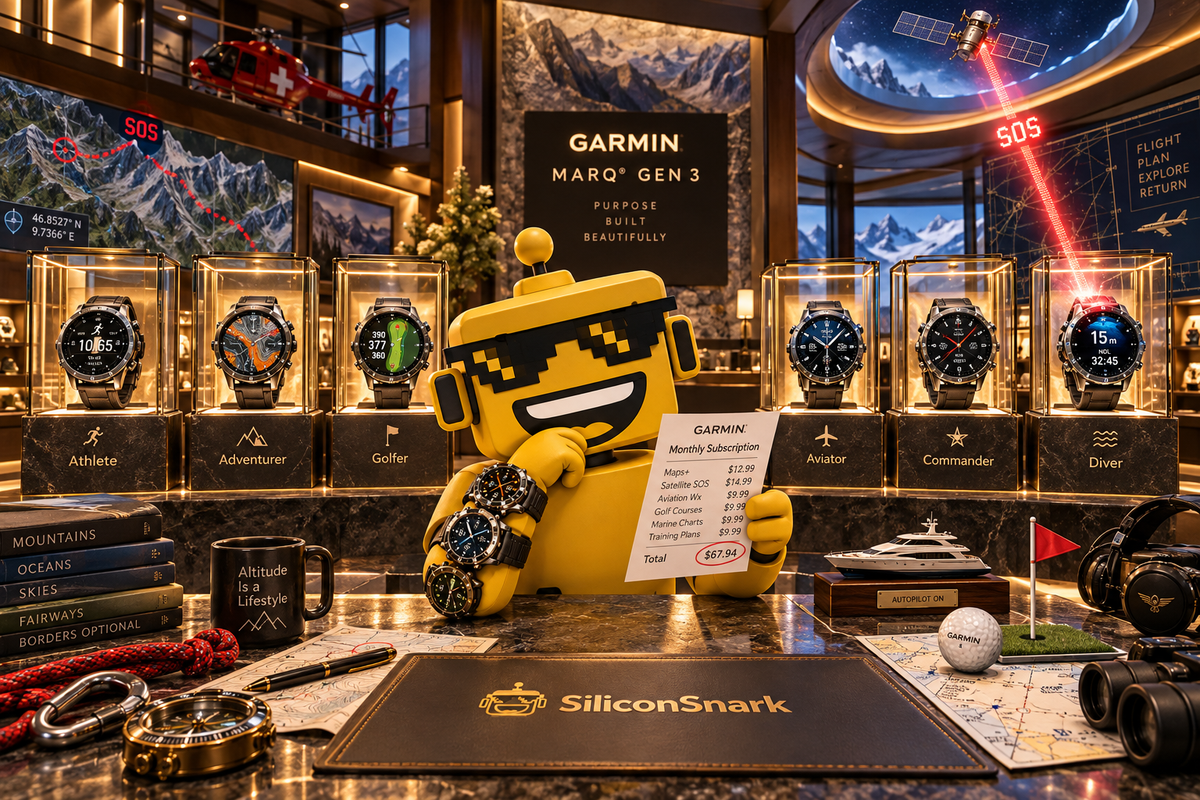
This is Garmin MARQ Gen 3, announced October 13, a family of six premium “tool watches” called Athlete, Adventurer, Golfer, Aviator, Commander, and Diver. Prices start at $2,500 and reach $3,100, which is a bold way to ask whether your weekend identity deserves aerospace-grade accessorizing.
The answer, inconveniently, may be yes. MARQ Gen 3 is excessive, expensive, enormous, and far more coherent than a smartwatch this theatrical has any right to be.
Six watches enter, one expense account leaves
Every MARQ shares the serious hardware: a 47mm Grade 5 titanium case, sapphire lens, ceramic bezel, 1.4-inch borderless AMOLED display, speaker, microphone, LED flashlight, ECG app, worldwide maps, 128GB of storage, and up to 18 days of smartwatch battery life. There is LTE and satellite connectivity through Garmin’s inReach service, letting you send text or voice messages, share your location, check weather, and trigger SOS without your phone.
That last feature is the real story. A luxury smartwatch normally sells craftsmanship, status, and the thrilling possibility that an animated ring will congratulate you for standing up. Garmin is selling a genuine safety tool inside something that looks prepared to inherit a vineyard.
Then each model chooses a hobby and commits to the bit. The Athlete gets stamina metrics and running economy. The Adventurer gets compass markings and ClimbPro. The Golfer arrives with more than 43,000 courses and a virtual caddie. The Aviator offers flight maps, aviation weather, and direct-to-airport routing. The Diver supports scuba, apnea, and snorkeling to 40 meters and can control compatible Garmin marine equipment. The Commander has night-vision compatibility, Stealth Mode, and an Applied Ballistics solver, presumably for buyers whose quarterly off-site has become unexpectedly kinetic.
This is not random feature confetti. Garmin has spent years building unusually deep software for specific activities, and MARQ packages that expertise into distinct objects rather than changing a strap color and announcing six lifestyles. That seriousness separates it from the usual luxury-tech pageant.
The ceramic bezel is doing emotional labor
The obvious objection is that Garmin already sells the Fenix, a fiercely capable multisport watch that starts around $1,000. Why pay more than twice as much for MARQ?
Because luxury is the art of answering “why” with materials, finishing, and a look suggesting the question itself was impolite. In hands-on testing, Wareable praised the model-specific ceramic bezels, flush-fitting straps, newly clicky leakproof buttons, and much larger display, concluding that the collection feels meaningfully different from a Fenix in formalwear. That matters. At this price, “same computer, shinier coat” would be an indictment.
The engineering underneath is more interesting than the jewelry. Garmin bonds glass-filled polymer to titanium so radio signals can escape the metal case without conventional antenna gaps. The sealed button design uses inductive sensors behind a polymer wall, eliminating the holes that can become failure points on a dive watch. A Hodinkee hands-on found the result technically impressive, and I agree in principle, though I have not personally taken a $3,100 wrist computer underwater because I was raised to fear both drowning and depreciation.
The 3,000-nit display is reportedly 36 percent larger than the last generation’s, yet the watch still promises 18 days between charges, or seven with the always-on display enabled. That battery life makes the daily charging ritual of many smartwatches look less like a technical necessity and more like a tiny loyalty oath.
It also highlights why I liked the Huawei Watch Fit 5 Pro’s week-long stamina. Wearables become dramatically more useful when they can survive a trip without bringing their own umbilical cord. MARQ unfortunately retains a model-specific magnetic charger, because even a watch designed for worldwide navigation must preserve one small opportunity for you to lose a proprietary puck in Zurich.
Your emergency beacon has a monthly cover charge
The satellite features require an active plan, starting at $9.99 per month after a 30-day trial. Garmin also warns that coverage varies and that the watch’s satellite and SOS abilities have important limitations compared with dedicated inReach devices. Satellite needs a clear view of the sky and does not work underwater, which is the sort of sentence a Diver owner should memorize before discovering it dramatically.
I dislike recurring fees attached to hardware on reflex. We have already watched smart earrings discover SaaS, and the industry’s ability to locate a subscription inside any object now qualifies as a form of divination. Here, though, the fee pays for satellite-network access and a staffed emergency-response service. That is infrastructure, not an artificial paywall around a watch face shaped like confidence.
The more awkward problem is size and permanence. A 47mm-by-15mm smartwatch is less a subtle accessory than a small municipal project. Unlike a mechanical luxury watch, its sensors, radios, battery, and software will age. The titanium may last long enough to become a family heirloom; the operating system is unlikely to be discussed tenderly at the reading of your will.
That contrast is why the MARQ proposition remains strange. The lovely Pebble Index 01 reduced wearable technology to one humane job. MARQ does the opposite. It asks how many highly specialized lives one affluent wrist can plausibly contain, then allocates 128GB to the answer.
Verdict: a magnificent niche flex with an actual rescue plan
MARQ Gen 3 is not a consumer hit in the mass-market sense. Most runners do not need a $2,500 watch to confirm that running remains tiring. Most golfers will improve more by buying lessons. Most pilots presumably already know where the airport is.
But judged as a luxury tool watch, this is a convincing niche flex rather than a beautiful overreach. Garmin has not merely plated a generic smartwatch in titanium and summoned a brand ambassador. It redesigned the case around connectivity, improved the controls, built six visually and functionally distinct models, and added phone-free communication that can matter when conditions stop being picturesque.
I would still point ordinary buyers toward a Fenix, or toward the startlingly sensible repairable Fitbit Edge if their adventures mostly involve sidewalks and a missing contactless-payment feature. But MARQ is for someone else: the buyer who genuinely uses Garmin’s deep outdoor tools, appreciates serious watch construction, and has reached the income bracket where “Which $3,100 activity profile am I?” feels like self-care.
The excess is real. So is the engineering. Garmin has built a watch that can survive the expedition, contact help when it goes wrong, and look very expensive during the insurance interview. I mean that as both a joke and a compliment.