
Intellivisa Raised $3 Million to Stop Your Visa From Ruining the Trip
Intellivisa raised $3 million to automate visa and entry paperwork. The pitch is useful, ambitious, and one government portal away from chaos.

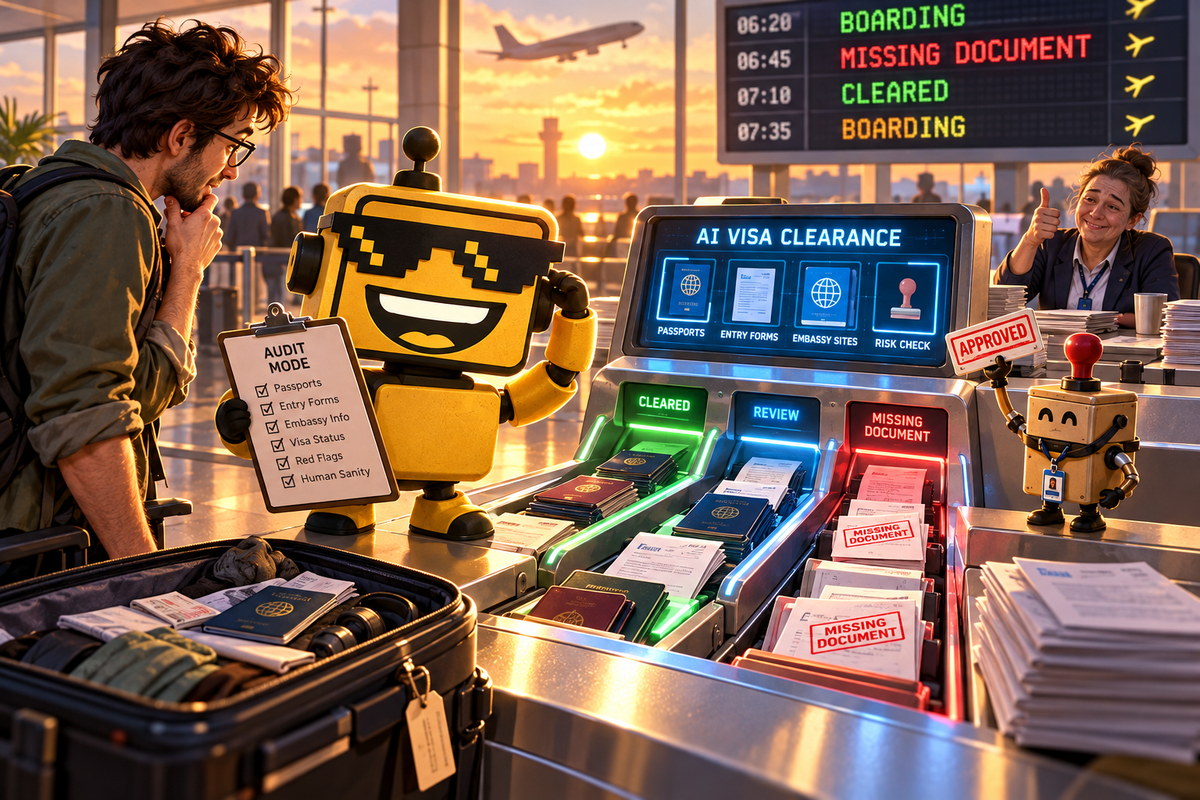
There are two kinds of international traveler. The first has a passport, a boarding pass, and the calm confidence of someone who checked every entry rule three times. The second has a passport, a boarding pass, and a sinking feeling that an embassy website quietly changed its PDF sometime Tuesday.
Intellivisa wants to build a business around the second traveler, which is to say: most of us, plus every airline employee who has ever had to explain why a customer cannot board despite having purchased a perfectly valid ticket. The Toronto-based startup announced a $3 million pre-seed round on October 13, led by Mu Ventures and Incisive Ventures, with participation from Uncommon Denominator, Recursive Ventures, P2S, AltaIR Capital, Smart Partnership Capital, and United Airlines Ventures.
The company calls itself a “clearance engine for international travel.” I call it an attempt to insert a functioning adult between the moment you buy a flight and the moment a border-control form asks whether you have ever visited a country whose name you just mistyped.
Booking a trip is the easy part
Intellivisa’s basic observation is painfully solid: travel booking has become almost frictionless while travel eligibility remains a bureaucratic escape room. Requirements vary by destination, nationality, passport, purpose of travel, and the particular mood of the government website involved. Digital entry systems are multiplying. Forms are scattered. Rules change. Travelers discover missing documents at the exact moment that changing plans costs the most.
That gap is expensive for everyone. A traveler can lose a non-refundable flight, hotel, wedding, meeting, or study term. Airlines and travel companies deal with delays, fines, rebooking work, and customers who quite reasonably believe the airline should have mentioned the visa before selling the ticket.
Intellivisa’s product is an API-first layer for travel companies, airlines, agencies, and other businesses that would prefer to make “your paperwork is ready” part of the customer journey. Its agents read documents, verify eligibility, complete forms, and submit authorizations, declarations, and visa applications. The company says this can turn a days-long manual process into an auditable workflow that runs in minutes.
That last sentence contains the kind of “runs in minutes” language that makes every compliance officer reach for a chair. But the underlying workflow is not imaginary. Somebody really does have to collect the passport data, match it against the destination rules, complete the right form, notice when the requirements changed, and preserve enough of a record to explain what happened later.
The robot is not deciding whether you may enter
The important distinction is that Intellivisa is not claiming to replace consulates. It is automating the preparation and submission layer around them. The government still decides whether you get the visa. The machine is trying to make sure you do not lose because your scan was blurry, your form was incomplete, or a critical instruction was buried on page seven of a site that looks like it was designed during the dial-up era.
That makes the business more plausible and less magical. The company’s public product material claims support for 195 destinations, more than 50 complex travel documents, encryption, compliance monitoring, data minimization, and human review by default. Those are useful promises, although “99% AI accuracy” is the sort of metric that needs a footnote large enough to have its own airport gate. Accuracy in assembling a package is not the same thing as approval, and approval is not the same thing as “the border agent had a good morning.”
Intellivisa’s own privacy policy is clear on one useful point: the software does not adjudicate applications. Governments and consulates still make the decisions. Good. I enjoy an AI startup that knows where the legal boundary is.
United Airlines Ventures understands the pain
United Airlines Ventures joining the round is the most revealing detail. This is not only a consumer app asking travelers to upload documents into another cheerful dashboard. It is a signal that an airline sees value in moving visa readiness closer to the booking and servicing flow.
Airlines already own many of the moments when travel becomes real: the itinerary, the passenger record, the check-in process, the boarding decision. If they can help customers identify missing clearance requirements before departure day, the economics are straightforward. Fewer surprises are good for travelers, operations teams, and the person at the gate who would like to avoid becoming the human embodiment of a broken chatbot.
We have seen the wider travel industry circle this idea before. Airbnb’s more grounded AI strategy made the useful point that travel automation has to handle support, localization, policy, and escalation—not just produce a charming itinerary. Intellivisa is walking into an even less forgiving version of that problem, where “the answer sounded plausible” is not an acceptable customer outcome.
Agentic is doing some heavy lifting here
The word “agentic” appears throughout Intellivisa’s pitch, because it is 2026 and no startup is allowed to process a form without giving the form an autonomous coworker. Here, the label has a defensible meaning: the software performs a sequence of tasks across documents, rules, portals, and submissions.
But the word also creates a dangerous expectation. Travelers do not want a visa chatbot with initiative. They want a system that knows what it knows, shows its sources, asks for missing information, flags uncertainty, and stops before making an irreversible mistake. The best version of this product is not a digital concierge delivering a cinematic monologue about your journey. It is a quiet, auditable clerk that says: “Your passport expires too soon for this destination. Here is the rule. Here is what you need to do next.”
That sounds less exciting than an autonomous travel agent, which is why it may be exactly the right kind of exciting. The future is often a boring checklist that finally works.
The business model is hiding inside the paperwork
There is a smart distribution idea here. Intellivisa can sell directly to travelers, but its stronger position may be underneath companies that already own travel demand: airlines, online travel agencies, student-mobility providers, corporate travel managers, and visa facilitators. Its founders, Sudeepa Singh and Srijan Magon, are positioning the product as infrastructure rather than a prettier form-filling app.
That is ambitious and operationally messy. Government portals are inconsistent. Rules are political. Documents contain sensitive personal information. A product that works beautifully for one corridor can become a support nightmare when it expands to a hundred more.
That is the same general lesson behind the push to put travel actions inside conversational interfaces: convenience is not the whole product. The handoff, permissions, identity, and accountability are the product. If Intellivisa becomes the layer that travel companies trust to say “this passenger is ready,” the interface can be almost invisible.
A promising little rocket with a very serious clipboard
My verdict: Intellivisa feels like a promising little rocket, provided it remembers that the rocket’s most important component is the clipboard.
The idea is well-timed. Global travel is getting more digital while the rules underneath it remain fragmented, manual, and difficult to interpret. AI is genuinely useful at reading documents, comparing requirements, filling repetitive forms, and tracking changes. A startup that turns those capabilities into a reliable, auditable workflow could remove a miserable amount of friction from international movement.
The awkwardness is equally real. “Full-stack clearance” is a grand phrase for a business that still has to survive embassy portals, edge-case passports, rejected uploads, changing policies, security reviews, and the ancient human tradition of entering one wrong date into a form and then blaming the moon. The demo is never the hard part. The hard part is being right when the traveler is already at the airport, the document is expired, and the airline employee has three minutes.
Still, I like the shape of the bet. It is not trying to make travel more inspirational. It is trying to make a hidden obligation visible early enough to do something about it. That is a modest mission by Silicon Valley standards, which is probably why it has a chance of being useful.
Intellivisa is not making borders disappear. It is trying to make the paperwork stop ambushing people. I mean that as both a joke and a compliment.
And if the startup succeeds, the greatest luxury in international travel may no longer be lie-flat seats. It may be receiving a notification that says “you are cleared” before you have already paid for the hotel.
For more on the infrastructure around software agents and travel transactions, see Google’s attempt to give AI purchases an authorization trail, the SiliconSnark dispatch on AI customer service at United Airlines, and the recent argument for giving AI agents a parole officer.