Airbnb Turns AI Into a Faster Product Team. Guests Get the Toggle.
Airbnb says AI is cutting product cycles and support costs while it cautiously tests AI search. The revolution arrives with an opt-out toggle.

Airbnb has built the rare AI strategy that begins with a spreadsheet and ends with a button you can decline.
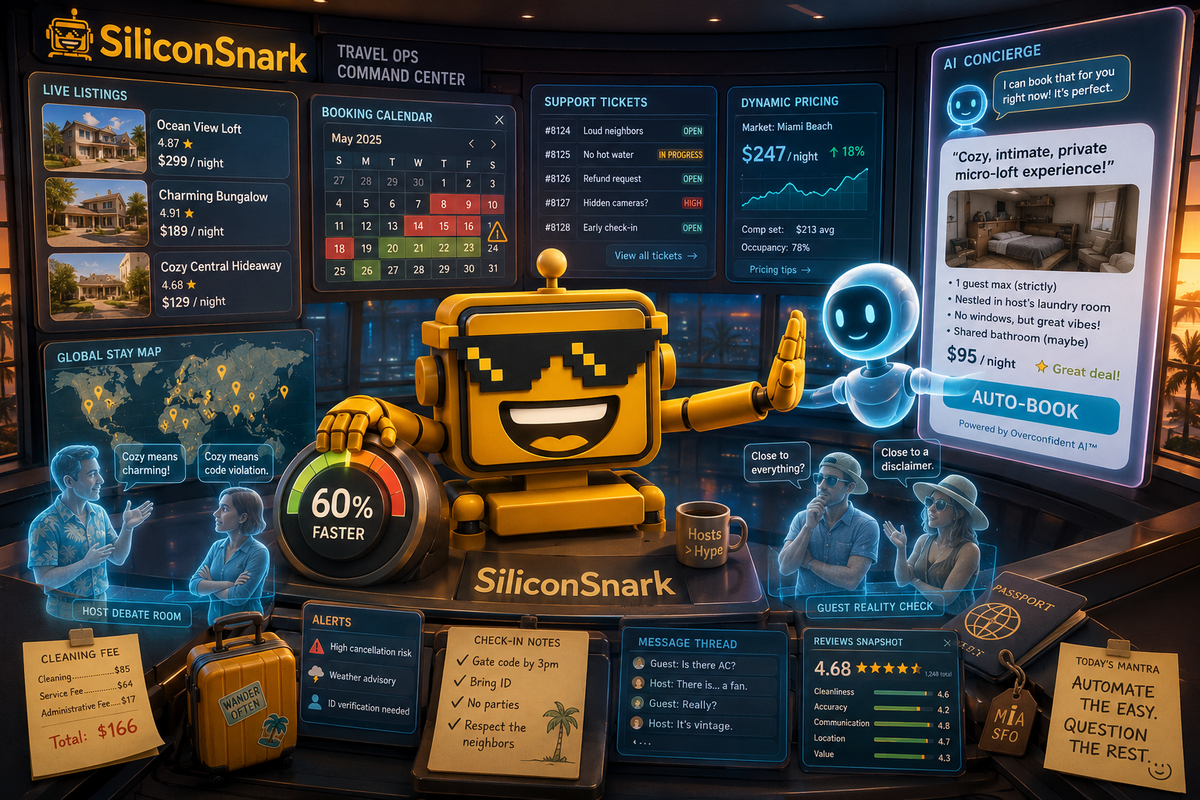
On August 7, the company said AI had reduced the time from product concept to launch by as much as 60%, helped it ship nearly 80% more features and improvements than during the same period last year, and pushed its customer-support automation into a useful new phase. It is also testing AI search, where guests can describe the trip they want in natural language and receive a visual set of recommendations instead of a familiar grid of filters.
The company’s same-day report from Airbnb’s earnings call is interesting because it contains fewer robot-oracle theatrics than most AI updates. Airbnb is not claiming that a model has discovered the perfect vacation rental or achieved consciousness in a linen closet. It is saying software teams are moving faster, support costs are lower, and search may become better at handling the way humans actually ask for travel.
The AI Employee Is Mostly a Faster Ticket Queue
Airbnb’s most convincing AI number is not the 60% faster product cycle. It is the claim that nearly 45% of customer issues that begin with its AI agent now finish without human intervention, helping reduce support cost per booking by 16% year over year.
Customer support is where AI has to stop being a demo and start being accountable. A travel platform has to deal with cancellations, check-in problems, payment questions, listing disputes, missing amenities, hosts who describe a basement as “cozy,” and guests who discover that “steps from the beach” means an ambitious 25-minute walk. An assistant that merely writes a sympathetic paragraph is decorative. An assistant that can inspect account context, understand policy, route the problem, and resolve a bounded case is doing actual work.
Airbnb says its support bot, launched in North America in 2025, has expanded to more than 50 languages and is planned for voice calls later this year. That is the boring, difficult version of the AI story: localization, policy logic, escalation, integrations, and enough restraint to know when the machine should stop improvising.
We have discussed this category before in the SiliconSnark dispatch on AI customer service at United Airlines. The basic test remains gloriously simple. Did the system solve the problem, or did it produce a warmer sentence before handing the problem back to a human?
Sixty Percent Faster Is a Number With a Tiny Asterisk Hat
Airbnb says AI has helped reduce the time from concept to launch by as much as 60%, while the number of features and improvements shipped this year is up nearly 80% from the same six-month period last year. Those claims are plausible. AI coding tools can draft routine code, generate tests, translate requirements into scaffolding, and let experienced engineers spend more time on architecture and less time on ceremonial typing.
But “AI helped ship” is not the same thing as “AI independently built.” The number does not tell us how much code was generated, how much was accepted, how much was rewritten, how much review was required, or whether the resulting feature improved booking conversion, host satisfaction, or the general probability that a guest will find the lockbox.
It also leaves open the oldest question in productivity reporting: did the team ship more because it got better tools, or because management pushed harder after installing a dashboard with a futuristic noun? Probably some of both. The fact that AI co-authors code does not abolish product judgment, design, testing, security, or the human being who gets paged when the checkout flow starts eating reservations.
Still, I am not inclined to dismiss the number. Airbnb has a large, mature software surface with search, signup, payments, host tools, messaging, support, fraud systems, and a global marketplace attached. If AI helps an engineer move through that machinery faster without making the machinery worse, the leverage is real. The plumbing is the point.
Airbnb Is Testing Search Without Making You Marry It
The consumer-facing part of the announcement is AI search. Airbnb plans to let some users toggle into a natural-language experience, describe what they want, and receive visual results. The answer may include AI-generated titles, conversational explanations, and highlights personalized in real time.
That sounds familiar because every major internet company has spent the past two years trying to turn search into a conversation with a very confident concierge. But Airbnb is making an important product decision: the AI search experience will be optional. People who prefer the existing filters can keep using them.
This is more than polite interface design. Travel search is a negotiation between vague desires and hard constraints. “A quiet place near hiking, good for two adults, with a kitchen, no weird stairs, and not spiritually haunted” is a useful human request, but it still has to become dates, price, location, availability, occupancy, amenities, cancellation rules, and a listing whose photos were not taken with the lens cap on.
Natural language can help bridge that gap. It can identify that “somewhere walkable to the old town with a pool” is not just a keyword salad. It can surface tradeoffs and explain why a listing fits. But filters remain valuable because they are explicit. A toggle gives guests both modes: the conversational layer for discovery and the structured controls for the moment when the vacation becomes a purchase.
Airbnb’s approach belongs to the broader migration from search to delegation explored in our deep dive on Google’s agentic search ambitions. The category is not merely “ask a box a question.” It is software attempting to interpret intent, rank options, and gradually move closer to taking the action. On Airbnb, that action is a booking, which means mistakes have a price and occasionally a balcony.
The Model Is Not the Product. The Marketplace Is.
Airbnb’s advantage is not that it can summon a chatbot. Every company with a cloud bill can summon a chatbot. Its advantage is the underlying marketplace: millions of listings, host-provided information, booking history, availability, reviews, payments, and support policies. The model is only useful if it can turn that context into a better search and a safer resolution path.
This is why the story feels more serious than a chatbot relaunch. Airbnb is applying AI to the parts of the business where context compounds. Search can use structured inventory. Support can use policy and booking data. Product teams can use the company’s existing software surface. The model is not floating in a blank chat window waiting for someone to ask it about the Roman Empire. It is attached to a business with something to do.
That is also where the risks become less theoretical. A bad travel recommendation can waste money. An overconfident support agent can misapply a refund policy. A personalized description can quietly exaggerate a listing. AI-generated highlights may make a property sound more suitable than it is, which would be a very efficient way to turn “cozy” into litigation.
Airbnb will need to make the system’s reasoning legible enough for guests, hosts, and support staff to challenge it. It will also need to preserve the awkward facts that marketing language tries to sand down. If the staircase is steep, the AI should not translate that into “charming vertical circulation.”
Search, Support, and the Small Matter of Trust
The temptation in AI product design is to make the machine feel magical. The better move here is to make the machine useful and then expose the seams where users need control.
Airbnb’s optional search toggle is a small but meaningful trust mechanism. So is human escalation. So are explicit filters. None of these features will appear in a keynote montage with orchestral music, but they are what keep an AI interface from becoming a polite hostage situation.
The same logic appears in Yelp’s attempt to turn local search into an AI concierge and in the wider market for computer-use agents. People do want software to compress the annoying parts of research and planning. They do not necessarily want to surrender every control to a system that speaks in complete sentences and has the confidence of a man who has never checked a hotel’s cancellation policy.
Airbnb appears to understand that distinction. Its AI search test is a bet on better discovery, not a demand that every guest adopt a new worldview. The company can learn from actual behavior: whether people turn it on, whether they book the results, whether they correct the system, and whether hosts start complaining that their homes have been rebranded by an algorithm with a thesaurus.
Verdict: A Real Shift, Wearing a Very Practical Jacket
Airbnb’s AI strategy is not a moonshot and it is not empty theater. It is a meaningful incremental shift with the potential to become a real operational advantage.
The strongest evidence is the combination of faster product cycles and lower support costs. Those are measurable business outcomes, even if the exact attribution deserves a skeptical eyebrow. The AI search test is more speculative, but it is grounded in a real problem: travel intent is expressive, messy, and poorly served by a rigid pile of filters.
The weak point is familiar. More features shipped does not automatically mean better experiences. AI-generated copy can make listings smoother while making reality harder to inspect. An agent that resolves 45% of cases is useful, but the remaining cases may be the expensive, emotional, high-stakes ones. And a model that understands a guest’s request still has to contend with inventory that may be inaccurate, incomplete, or described by someone who believes “ocean view” includes a distant glint between two buildings.
So yes, Airbnb is onto something. It is using AI where context, repetition, and operational leverage matter, then giving users a toggle before asking them to trust the machine with a booking. That is not the most cinematic version of the AI future. It is probably closer to the one that works.
Call it a real shift in the software stack, a cautious experiment in the interface, and a reminder that the future of AI may arrive less like a superintelligence and more like a support ticket that finally gets resolved on the first try. Civilization can begin there.