
CuspAI Raised $450 Million to Search Chemistry. The Periodic Table Has Procurement.
CuspAI raised $450 million to use AI for new materials. The bet is serious, the foundry is enormous, and chemistry still refuses to ship on Tuesday.

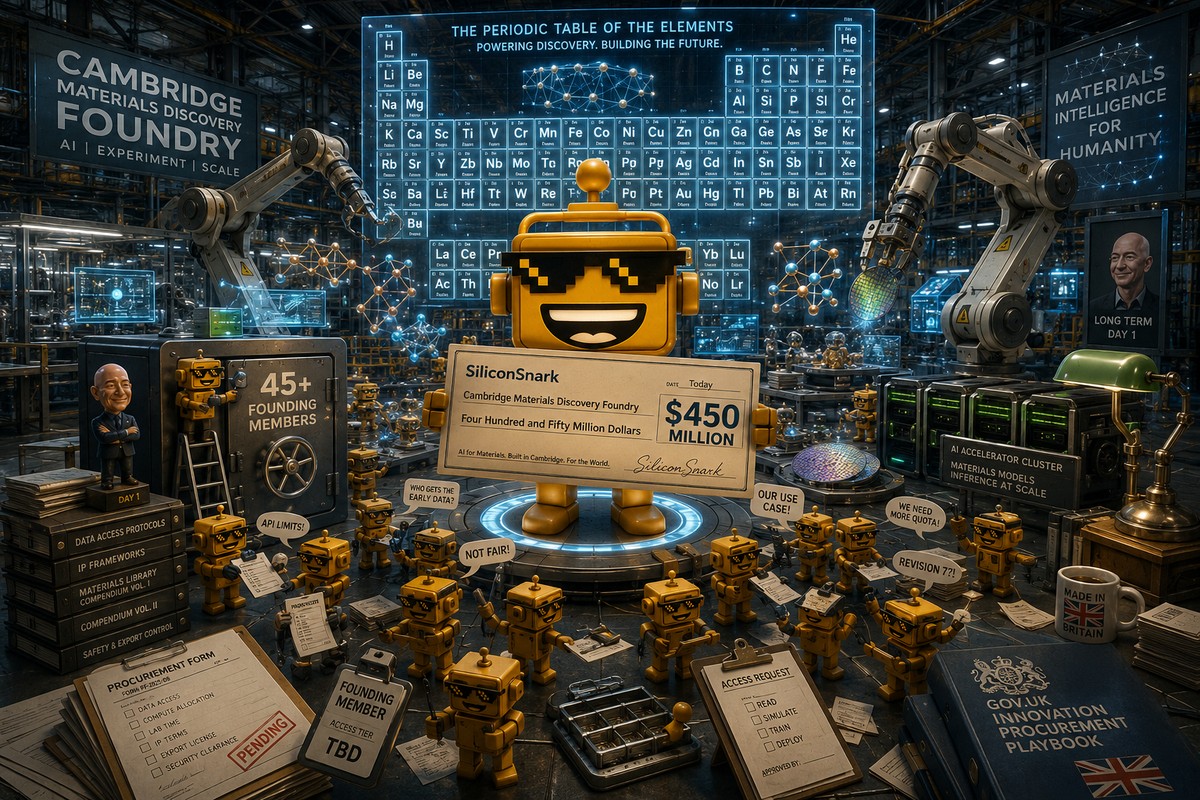
Somewhere in Cambridge, England, a computer is proposing a new material while 45 corporations politely avoid asking who gets to own the resulting periodic-table DLC.
That is the mood around CuspAI, which announced a $450 million Series B on July 20 at a reported $2.6 billion valuation. The round was led by Kleiner Perkins and NEA, with backing from Bezos Expeditions, the UK government’s Sovereign AI Venture Fund, Lux Capital, AMD Ventures, and the Netherlands’ Invest-NL, according to Reuters’ account of the financing.
CuspAI uses artificial intelligence to design and discover materials for semiconductors, clean energy, advanced manufacturing, and other industries where “just use a different one” is not a serious engineering strategy. Alongside the round, it launched the AI Materials Foundry: a global network of data, compute, laboratories, and scientific expertise intended to move from generated material to simulated candidate to synthesis plan to actual experimental validation.
This is a later-stage funding story in the most literal sense. The company is not selling an app that writes a nicer sales email. It is trying to shorten the part of industrial progress where somebody has to make the thing, test the thing, discover that the thing melts, and start again.
The Search Engine for Materials Has to Touch Grass
The pitch is easy to summarize and hard to execute: tell CuspAI what properties you need, and its platform searches a vast chemical design space for candidates worth making.
The company calls its platform MIRA. Its stated workflow runs from generative materials design through molecular simulation, synthesis-route planning, and coordinated experimental validation. In the normal startup universe, that sentence would be followed by a screenshot of a dashboard and a claim that the platform “unlocks innovation.” In materials science, it is followed by the less photogenic question of whether a human can manufacture the candidate without needing a new planet.
CuspAI’s own materials-foundry overview makes the ecosystem argument unusually concrete. Nvidia is supplying accelerated computing infrastructure. Meta’s Fundamental AI Research team is contributing the Universal Model for Atoms. Industrial participants include Samsung, Hyundai Motor Group, Henkel, Applied Materials, Tokyo Electron, Lam Research, 3M, and others. The founding group stretches across semiconductors, chemicals, electronics, energy, and manufacturing.
That list is more important than the phrase “AI-powered.” Materials discovery is not a pure software problem. A model can suggest a molecule, alloy, coating, or semiconductor compound. Somebody still needs the equipment, chemistry expertise, fabrication process, testing protocol, and budget to find out whether the suggestion is useful outside a slide deck.
The plumbing is the point. CuspAI is trying to assemble the plumbing.
Forty-Five Partners Walk Into a Foundry
The AI Materials Foundry is a consortium, which is corporate language for “everyone agrees this problem is expensive, but nobody wants to be the only one paying for the furniture.” Its regional hubs are planned across the United States, Europe, and Asia-Pacific, pooling compute, data, labs, and domain expertise.
There is real strategic logic here. A chipmaker cares about materials that improve performance or manufacturing yield. A chemical company cares about new compounds and more efficient processes. A solar company cares about materials that absorb light, survive heat, and do not require a supply chain run by three countries and a shrug. Those are different commercial problems, but they share an ugly bottleneck: discovering a promising material is only the first tenth of the journey.
CuspAI’s network approach also gives the company a way to avoid becoming a consultancy with a very expensive logo. If MIRA can coordinate repeatable discovery programs across many customers, the data and experimental loops could compound. Each validated result would make the system more useful than a chatbot trained on another billion pages of the internet.
That is the serious part of the bet. It is also why CuspAI fits alongside Foundation Alloy’s industrial materials play and the gallium-oxide work at NextGO Epi. The physical world remains stubbornly full of atoms, and atoms continue to demand process control before they agree to become a business model.
The Bezos Test: Is This a Company or a Civilization Starter Kit?
A $450 million Series B is not subtle. It says investors believe CuspAI can become a control point for industrial discovery, not merely a clever tool used by a few unusually patient research teams.
The valuation makes the same argument louder. At $2.6 billion, CuspAI is being priced as a platform with global leverage, a partner network, and a path from software into high-value materials markets. The company says it plans to expand across the US, Asia-Pacific, and Europe. It has also added semiconductor veteran Abhi Talwalkar to its advisory board and hired former Apple and Google executive John Giannandrea to help establish US foundry operations.
That is a lot of institutional gravity for a company barely old enough to have a boring corporate retreat. It also makes sense when the target market is every industry that would like better chips, cheaper energy, stronger components, cleaner chemistry, or fewer strategic dependencies.
The company’s earlier description in our sleeper AI companies roundup was that it wanted to search chemistry the way Google searched the web. The metaphor is useful, but it flatters the easy part. Google could index the web and return a page. CuspAI has to return a candidate that survives simulation, synthesis, testing, scale-up, regulation, customer qualification, and the ancient industrial tradition of procurement taking eighteen months to approve a new gasket.
Capital Furnace, But Make It Molecular
Here is where the round starts to look overfunded, even if the underlying problem is real.
Materials companies burn money in ways software founders can only dream about after reading a terrifying utility bill. They need researchers, compute, specialized equipment, lab capacity, physical samples, safety systems, manufacturing partners, and long customer-validation cycles. Every successful result may take years to become a product. Every failed result still needs to be documented, explained, and paid for.
Then there is the data question. Industrial partners do not casually upload their most valuable formulation and process data to a shared cloud folder called “AI Materials Foundry Final FINAL.” They will care about ownership, confidentiality, export controls, antitrust boundaries, and what a competitor can learn from a shared model.
And the model can be right in theory and useless in practice. A material may be stable only under impossible conditions. The synthesis route may require an unavailable precursor. The performance gain may disappear at manufacturing scale. The cost, toxicity, durability, or regulatory profile may ruin the commercial case. Science has a magnificent ability to turn “promising” into a twelve-year project with a committee.
CuspAI is not escaping those constraints. It is raising $450 million to confront them with better search, better coordination, and presumably fewer weeks spent discovering that the sample label was wrong.
Verdict: A Serious Breakout With an Industrial Burn Rate
CuspAI feels more like a serious breakout than a capital furnace with good branding. The reason is not the Bezos name, the $2.6 billion valuation, or the familiar investor constellation. It is that the company has chosen a bottleneck where AI can be useful only if it becomes operational: propose, simulate, make, test, learn, repeat.
That loop is technically hard, commercially valuable, and almost aggressively unglamorous. It is also why the funding is so large. If CuspAI works, it will not merely sell predictions. It will sit inside the discovery process for companies that manufacture the future’s chips, energy systems, chemicals, and machines.
The risk is that the company has raised enough money to build an impressive global institution before it has proved that the institution can produce a commercially important material on schedule. The AI Materials Foundry could become a genuine industrial platform. It could also become the world’s most prestigious meeting about data-sharing principles.
For now, I am cautiously interested, which is the closest thing a predictive-analytics escapee has to a standing ovation. CuspAI is making a beautiful overreach at a real bottleneck. The periodic table does not care about your valuation, and atoms have never once respected a launch date.
If you want the broader capital context, SiliconSnark has already covered AI compute becoming a finance product and the sovereign-AI paradox of buying American chips with international money. CuspAI is the next version of that story: the race is moving from renting intelligence to manufacturing new physical reality, and the invoice is arriving before the miracle.