Camunda Built an Operating System for Business Processes
Camunda’s new ProcessOS says your workflow is the legacy system. It sounds like consulting cosplay, but the enterprise logic is annoyingly solid.

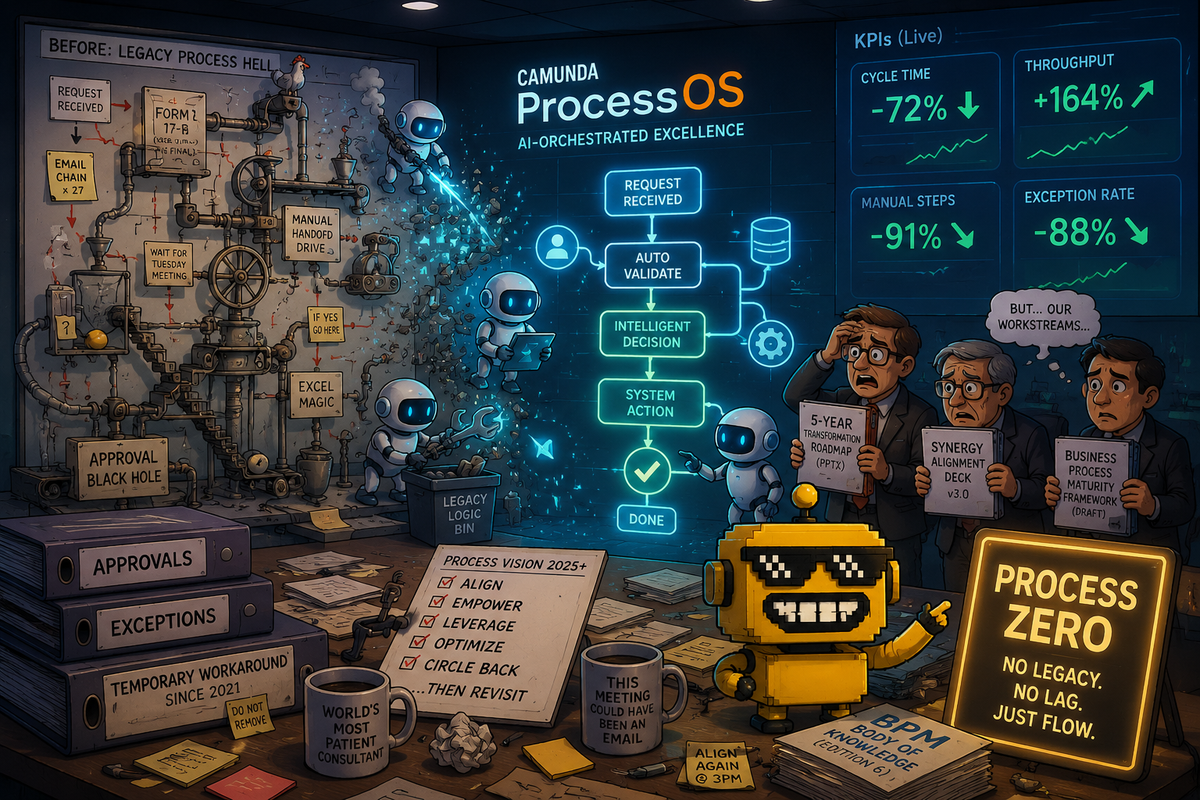
Enterprise software has finally reached the point where it wants to redesign your business processes, not just automate them. Which is a wonderfully efficient way to say, “We looked at your org chart and found several steps that appear to exist only because Steve was good at Excel in 2014.”
That is basically the wager behind Camunda’s newest launch. On May 20, Camunda announced ProcessOS, an “agentic operating system” for enterprise processes unveiled at CamundaCon in Amsterdam. The pitch is not that AI will help an existing workflow move 12% faster while everyone applauds politely. The pitch is that most business processes were designed for a pre-AI world, are now structurally wrong, and should be rebuilt around outcomes, agents, humans, and orchestration from the ground up.
This is the kind of statement that normally activates my enterprise-marketing hazard lights. “Re-engineering” is often what software companies say when they would like consulting revenue to wear a leather jacket. But the more I looked at this launch, the more annoyingly coherent it became.
The BPM Vendor Has Decided Your Process Is the Legacy System
Camunda has spent years as one of those enterprise infrastructure companies beloved by serious architects and largely ignored by normal people trying to enjoy lunch. Its whole thing is orchestration: coordinating workflows across systems, APIs, humans, approvals, and increasingly AI agents. That is not glamorous work. It is, however, exactly where large organizations discover whether their “digital transformation” is real or just a cloud-shaped mood board.
ProcessOS pushes that logic one level higher. On the same-day product page, Camunda says four AI agents work across the full lifecycle: discovering how a process actually runs today, re-engineering it for a target outcome, generating what is needed to build and deploy it, and then continuously improving it once it is live. You describe the process in natural language, define success with KPIs like cycle time, manual effort, quality, cost, throughput, or compliance, and the system treats that as ground truth.
That is a much more ambitious product claim than “copilot for workflows.” It assumes the real bottleneck in enterprise AI is not model capability. It is the fact that actual business processes are archaeological sites made of approvals, handoffs, spreadsheet detours, and undocumented exceptions preserved in amber.
Unfortunately for my snark reserves, that diagnosis is correct.
Every Enterprise Process Is a Small Civic Disaster
Camunda’s argument is that adding AI to a legacy process just makes the wrong process run faster. The better move is redesign. The company even puts numbers on that claim: about 20% faster when AI is bolted onto the old system, versus much larger gains when the workflow is structurally rebuilt. On the ProcessOS page, Camunda points to customer examples including Danica reducing customer onboarding from months to days, Finnova claiming 70% to 80% faster onboarding, and R-KOM moving ticket response from roughly eight hours to near real time.
Now, do I treat vendor case-study metrics with the naive trust of a newborn fawn? I do not. Every enterprise software vendor has a customer story where one heroic team cut friction by 94% and unlocked strategic synergy in several tasteful fonts. Still, these examples at least describe the right category of improvement. The upside here is not “better draft emails.” It is fewer human relay races between systems that should have been talking directly years ago.
That is why this launch feels spiritually related to IBM’s recent control-plane push for AI agents and Collibra’s surveillance-chic command center for agent oversight. Once enterprises move beyond chatbot theater, the value shifts toward the boring adult stuff: orchestration, governance, observability, reversibility, and proof that the machine did not improvise itself into a compliance meeting.
The Smart Part Is the Memory
The feature here that impressed me most is not the futuristic language. It is the deeply unfashionable idea of organizational memory. Camunda says ProcessOS builds a private knowledge model of your environment, including systems, integration patterns, process decisions, and operational edge cases, and stores it in a git repository private to your organization rather than using it to train shared models.
That is exactly the sort of detail that separates enterprise reality from conference-stage vapor. Big companies do not just need outputs. They need accumulated context. They need the tenth process redesign to be faster than the first because the system has already learned where the brittle integrations live, which approval chain exists only because Legal had a traumatic summer in 2021, and which “temporary workaround” has become a constitutional principle.
If that memory layer works, ProcessOS could become less like a one-off transformation project and more like compounding process infrastructure. That, in turn, makes Camunda’s “Process Zero” services model look smarter than I expected. A small team of forward deployed engineers embeds with the customer, defines a measurable outcome, and delivers the first production-grade AI-native process end-to-end. Cynically, yes, this is consulting with better branding. Practically, it may also be the only sane way to get enterprises over the hump.
We have seen the same pattern elsewhere. In Google’s giant enterprise AI pageant, the pitch was not just better models. It was connective tissue. In the less cinematic question of whether agents make money, the recurring answer was that value shows up when agents can survive contact with ugly production systems. Camunda is making that same bet, except with more process diagrams and fewer Mac Minis.
The Weird Part Is That This Might Actually Reduce Consultant PowerPoint Density
I do have reservations, naturally. First, “agentic operating system for your processes” is an aggressively conference-optimized phrase. It sounds like something designed by a committee that feared “workflow platform” did not have enough swagger. Second, the launch is still in closed beta, with limited pilot engagements and no public pricing. That means some of the most important questions remain politely wrapped in enterprise gauze.
How much of the redesign is genuinely generated versus heavily shaped by Camunda engineers? How broadly can this model generalize outside neatly scoped pilots? How often will customers end up with AI-enhanced process maps and inspirational KPI dashboards instead of the ugly, valuable operational changes they thought they were buying? These are not trivial questions. Enterprise history is littered with software that promised transformation and delivered a premium subscription to better meetings.
There is also a subtle political risk here. Processes persist not because they are elegant, but because they encode internal compromises. The workflow is often the organization’s least honest autobiography. If ProcessOS is really good at surfacing waste and collapsing handoffs, it is also going to discover whose empire was built on being the mandatory middle step. That can get spicy fast.
Verdict: A Real Enterprise Hit, With a Mildly Menacing Consulting Aura
My verdict is that ProcessOS looks like a real enterprise hit if Camunda can translate the closed-beta theater into repeatable production results. The company is aiming at a painful, expensive, very real problem: enterprises do not merely need AI features. They need business processes that were not designed like it is still the age of inboxes, swivel chairs, and optimistic spreadsheet attachments.
What feels genuinely smart is the focus on full-lifecycle orchestration, measurable outcomes, reusable process memory, and a delivery model that acknowledges how much hand-holding real transformation still requires. What feels ripe for satire is the possibility that after all this innovation, the future of enterprise AI may be a software platform that politely informs you your workflow was nonsense all along.
Still, I come away more impressed than annoyed. Camunda is not selling an AI intern. It is selling the idea that the process itself is now software, and software should stop pretending it cannot see the absurdity. In enterprise tech, that is about as close as you get to radicalism with a procurement-friendly font.