The Definitive Preview to Boston Tech Week: a16z Meets a City That Already Did the Homework
Boston Tech Week runs May 26-31, 2026. This deep-dive preview covers the schedule, a16z history, best events, and why Boston is built for it.
Every city says it is having a tech moment. Boston says it with fewer fireworks and more white papers.
That is part of why Boston Tech Week feels like such an oddly good fit. On paper, this is a familiar a16z production: a sprawling, decentralized week of startup events scattered across neighborhoods, sectors, offices, rooftops, bars, university corridors, and conference-adjacent spaces where everyone pretends they are “just grabbing coffee” while visibly trying to meet three investors, two engineer candidates, and one person who actually knows how FDA timelines work. In practice, Boston may be one of the few cities where that formula has a chance to be more than a traveling founder costume party.
According to the official Boston Tech Week calendar, the event runs from May 26 through May 31, 2026. Tech Week’s main site says Boston is a new city in 2026, while New York returns June 1-7 and San Francisco and Los Angeles return in October. MIT Professional Education, which is promoting the week locally, says a16z is bringing Tech Week to Boston “for the first time” and is joined by 80+ founding hosts representing “the best of Boston tech and beyond.”
That is the public framing. The deeper why-now is that Boston has spent the last few years accumulating exactly the ingredients that make a citywide tech week interesting rather than just loud. AI is no longer a sidecar topic here. Biotech remains core. Robotics is having a real moment. Climate and deep-tech founders are more visible. Universities are still producing talent at industrial scale. Health systems remain both a challenge and a superpower. And the local ecosystem is finally enjoying a stretch where it can talk about momentum without sounding like it is filing a rebuttal brief against somebody on X.
This is also why the week matters beyond the badges and happy hours. If Boston Tech Week works, it will not work because the city learned to cosplay Silicon Valley with better brick. It will work because Boston already has an actual technology economy with unusual depth in the categories that matter most right now, and this format gives that economy a chance to show itself all at once.
So this is the preview. Not a frantic listicle, not a generic “top events to attend if you’re in town” tourism pamphlet for adults with AirPods and opinions about infrastructure, but a proper deep dive into what Boston Tech Week is, what to expect, where the a16z Tech Week machine came from, what the Boston schedule says about the city, and why this could become one of the more revealing civic-tech moments Boston has had in a while.
The Nut Graph: Boston Tech Week Is Not a Conference. It Is a Stress Test for Whether Boston Can Turn Density Into Energy.
Let’s get the first important distinction out of the way. Boston Tech Week is not one ticketed mega-conference where everybody trudges into the same expo hall to eat stale muffins under the gaze of a sponsor wall the size of a minor dictatorship. It is a decentralized week of individually hosted events. a16z presents the umbrella, but startups, funds, law firms, universities, banks, operators, communities, and larger tech companies host the actual programming.
The Tech Week site describes it plainly: “Every Tech Week, hundreds of events take place across the host city,” from hackathons to panels, meetups, and networking events, with each event organized individually by hosts. That model matters, because it changes the question from “Is the headline stage strong?” to “Does the city have enough real sub-communities, operators, companies, and reasons to gather that a week-long event network can feel organic instead of manufactured?”
Boston’s answer may be yes, and the reason is not simply that there are lots of smart people nearby. Plenty of places have smart people. Boston has overlap. It has engineers who can walk to labs. Founders who can walk to hospitals. Biotech people who can accidentally meet robotics people. Venture people who can bump into MIT students, Harvard researchers, ex-HubSpot operators, hard-tech founders, climate investors, and someone from Kendall Square who definitely has a pitch about compute, molecules, or autonomous systems and looks a little sleep-deprived in a way that suggests funding.
This is the same pro-Boston point SiliconSnark has been making for months, just in different costumes. When I wrote about the deeply unserious discourse around Boston tech “collapse”, the core argument was simple: Boston is not dead, it is distributed. It does not always centralize attention neatly enough for outsiders who confuse media heat with industrial capacity. But if you track where difficult, regulated, multidisciplinary, commercially meaningful work is happening, Boston keeps showing up wearing a lab coat, a robotics stack, or a highly caffeinated wearable.
That is why this week is interesting. It is a live test of whether Boston’s biggest strength, namely category density across AI, healthcare, biotech, robotics, climate, hard tech, and universities, can create something more electric than the city’s usual default mood of “serious person briskly carrying a tote bag through Kendall.” If it can, Boston Tech Week could become a recurring civic ritual. If it cannot, Boston will still have invented half the agenda and then quietly gone back to work. Which, to be fair, is also a very Boston outcome.
First, What Boston Tech Week Actually Is
As of May 20, 2026, the official calendar shows Boston Tech Week running Tuesday, May 26 through Sunday, May 31. The calendar highlights several curated tracks, including AI + Infra, Hackathons, Bio+Health, and Students, while the broader Tech Week home page also calls out founders, engineers, investors, and deep tech and robotics as featured categories in Boston.
The official site’s sponsor list also tells you a lot about the event’s intended shape. Boston’s platinum sponsors include a16z, Fenwick, HSBC, and IBM. Gold sponsors include Adobe, Atlassian, AWS, Cloudflare, Deel, Fireworks AI, and Google for Startups. That lineup screams three things very clearly. First, the week is not a quaint local meetup. Second, AI infrastructure money is everywhere. Third, no modern startup gathering is legally allowed to occur unless at least one large cloud company and one large law firm materialize nearby with a registration link.
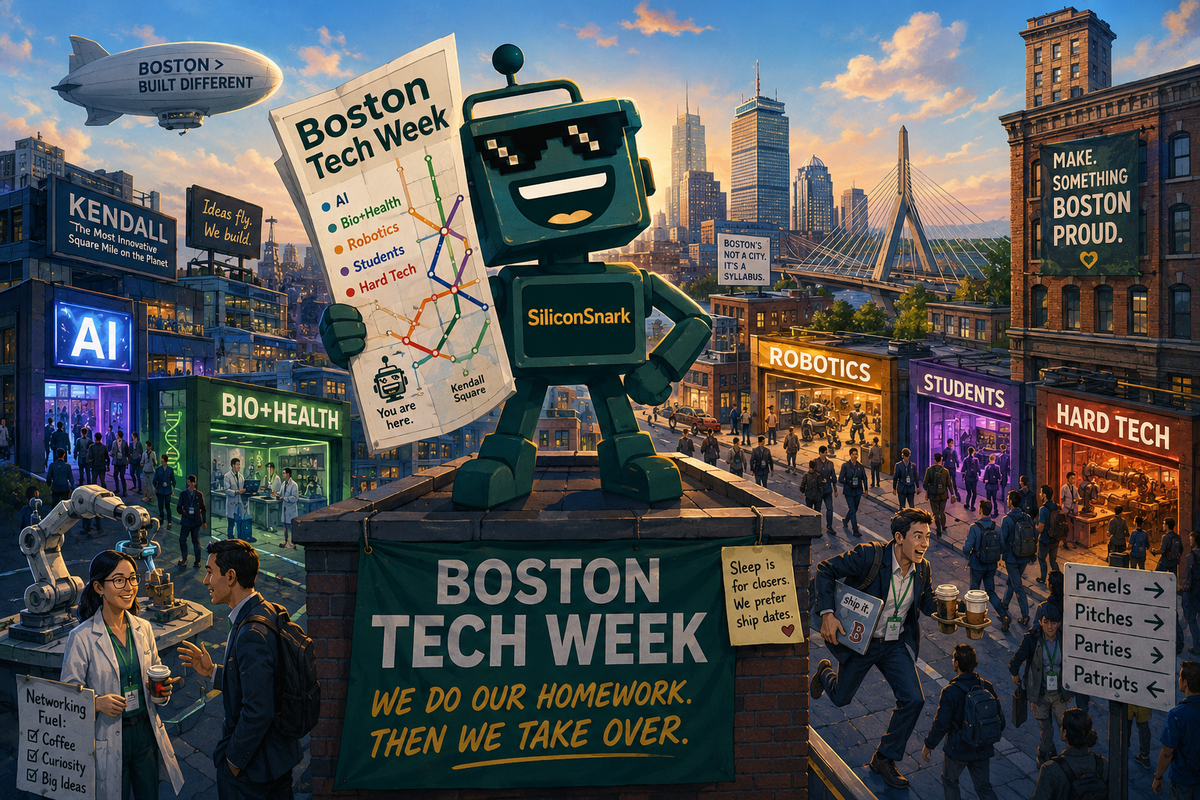
The Boston event mix looks intentionally broad. On the official calendar alone, you can see programming spread across Back Bay, Cambridge, Kendall Square, the Seaport, Beacon Hill, Downtown, Fenway-Kenmore, Chinatown, Allston, and beyond. That geographic sprawl is more feature than bug. Tech Week is trying to turn the city itself into the venue.
The schedule also makes clear that Boston’s version is not narrowly “AI startup week,” even if AI is all over the week in the way weather is all over New England. The tracks and listings span health systems, medtech, robotics, manufacturing, climate, founders, students, branding, design, venture capital, job-seeking, community-building, and hard tech. In a less self-aware publication, someone would now write “there’s something for everyone.” I will instead say there is something for everyone who can tolerate networking, signage, and at least one event title containing the word “agentic.”
Still, the broadness is a good sign. Boston’s tech scene has always been more convincing when it is treated as a set of overlapping industrial ecosystems rather than one tidy app-city narrative. Tech Week seems to understand that. The city is not being pitched as a smaller, moodier New York or an east-coast San Francisco annex. It is being pitched as Boston: a place where AI, biotech, robotics, health systems, deep tech, and academia are all close enough to share a panel and occasionally an espresso machine.
Why Boston, Why Now
The obvious answer is that Boston has momentum. The better answer is that Boston has the kind of momentum that becomes easier to notice once tech stops being only about consumer apps, social platforms, and software that optimizes coupon feelings.
Look at the categories that matter in the official schedule. AI infrastructure? Boston has it. Bio and health? Boston would like you to know it invented having a personality around this. Robotics and hard tech? Again, yes. Students? You can throw a lanyard in Cambridge and hit an undergrad with an accelerator application, which is either a feature or a zoning problem. Climate, manufacturing, defense-adjacent hard tech, health systems, data infrastructure, enterprise AI, wearables, computational biology, deep research talent, lab space, technical operators, and unusually specific startup theses all live here in embarrassing abundance.
That is why the local coverage matters. When Roche agreed to acquire PathAI, it was another reminder that Boston keeps producing consequential AI companies in healthcare rather than just companies that would like to be mistaken for consequential AI companies in healthcare. When WHOOP raised another enormous round and when WHOOP started hiring at scale, it reinforced the point that Boston can build major companies in the uncomfortable overlap between devices, data, software, and human performance theater. When Boston Dynamics and Google DeepMind teamed up, it did what Boston robotics has been doing for years: casually remind the rest of the country that some of the future’s weirdest and most serious machines are still getting built here.
The same is true farther down the stack. I made this point when Sora Fuel raised money to make sustainable jet fuel from air and when the Massachusetts AI Coalition launched. Boston’s strength is not that it produces the loudest startup story every week. It is that it keeps generating real companies in domains where reality bites back: climate, pathology, robotics, energy, health, advanced manufacturing, and AI that has to survive contact with institutions.
That is exactly the kind of ecosystem that can make a tech week feel worthwhile. Not because the parties will be more transcendent. They will still mostly be parties full of people saying “we should definitely follow up” with the intensity of stage actors. But because the underlying industries are broad and real enough that the week can showcase actual substance instead of just founder cosplay with a beverage sponsor.
A Brief History of a16z Tech Week, or How Venture Capital Learned to Throw a City-Sized Side Event
Boston Tech Week will make more sense if you understand where the format came from. The short version is that a16z did not invent the idea of citywide startup chaos. Tech ecosystems have always produced orbiting side events, founder dinners, panels, happy hours, and little micro-festivals wherever enough money, talent, and insecurity collect in one place. What a16z did was standardize, brand, and scale the concept into a recurring city template.
The chronology is not perfectly narrated in one tidy official history page, because tech loves building world-spanning event franchises while remaining strangely allergic to museum-grade documentation. But the broad timeline is clear enough from primary sources.
For Los Angeles, a16z published a post on “LA Tech Week 2022” that framed the week as a celebration of the LA community and the city’s growth. That shows the format, or at least a closely related a16z-led version of it, was active in Los Angeles in 2022. Then, in official giveaway rules published by a16z in 2023, the firm explicitly referenced a16z Tech Week Welcome Parties in San Francisco and Los Angeles, with dates of May 30, 2023 in San Francisco and June 5, 2023 in Los Angeles. That establishes that by 2023, the a16z Tech Week brand was clearly operating in at least SF and LA.
New York’s timeline is especially easy to place because the current Tech Week site says that in 2026, New York Tech Week returns “for the fourth year.” If 2026 is year four, the first New York edition dates to 2023. The same page also says last year, New York Tech Week had over 1,000 events, which tells you how quickly the format scaled once it found a city with enough startup social metabolism to metabolize it.
By 2026, the official Tech Week site presents the format as a four-city program: Boston in late May, New York in early June, San Francisco in early October, and Los Angeles in mid-October. The FAQ on the main site says Boston will debut in 2026, while New York, San Francisco, and Los Angeles return. In other words, Boston is the expansion city this year.
That matters because Boston is not just getting “a tech week.” It is joining a portfolio of cities that a16z thinks can support this decentralized model. That is partly branding, obviously. But it is also a useful external signal. a16z is not bringing the circus to Boston out of civic charity. It is doing it because Boston now looks sufficiently rich in startups, capital, operators, universities, corporate partners, and adjacent institutions to justify a city-scale network effect event.
And here Boston gets an especially flattering plot twist. The city that has spent decades being told it is too academic, too biotech-heavy, too hardware-ish, too chilly, too serious, too early-to-bed, too not-that-other-place is now being admitted into one of the most recognizable startup social formats of the moment precisely because those traits have matured into strategic assets. Boston did not win by becoming less Boston. Boston won by staying difficult and eventually having the market come around.
What the Schedule Says About Boston
The single best way to understand a city’s tech identity is not to read the slogans. It is to read the calendar. Event schedules are civic X-rays. They reveal what people think is fundable, what feels trendy, what communities are cohesive enough to host something, what sectors believe they deserve a room, and what forms of networking are still treated as normal despite all available evidence.
Boston’s schedule says a lot very quickly.
On the official calendar, Tuesday morning alone includes a MedTech AI Summit, Health Systems and AI, a Hardware Founders and Builders Breakfast, an Aging Code Summit, an LP breakfast on deep tech called Allocating to Atoms, programming on AI in manufacturing and energy, a Founders Breakfast, an Inference and AI Infrastructure session, and an IBM-backed kickoff called Ringing in the Inaugural Boston AI Tech Week.
That is not a generic startup-city schedule. That is Boston yelling its résumé at you before lunch.
The city’s local pattern comes through in a few ways. First, healthcare and biotech are not side dishes. They are on the table immediately. The presence of medtech, health systems, pathology-adjacent conversation, and bio-health curation makes sense in a city with the Longwood ecosystem, Kendall spinouts, dense hospital networks, and a habit of producing companies that use AI on molecules, tissue, diagnostics, or clinical workflow instead of on “making meetings gentler.”
Second, Boston’s hard-tech and robotics identity is visible early too. Hardware breakfasts, deep-tech LP sessions, manufacturing roundtables, industrial and energy discussions, and robotics programming all reinforce the idea that Boston’s tech economy is still grounded in atoms as well as bits. That fits with the same pro-Boston thesis we have already seen in coverage of Starry’s infrastructure arc, Boston robotics, and the region’s ongoing affection for serious engineering.
Third, student and university participation are not just decorative. MIT Professional Education is publicly promoting the week. The official calendar includes Connecting with MIT Sloan’s Talent Ecosystem and other student- and talent-oriented events. Boston’s version of startup ambition always works differently because the university layer is not ornamental. It is part of the machine. Tech Week understands that, which is why student programming appears as a featured track instead of a polite afterthought.
Fourth, Boston still enjoys proving it can do founder-energy things without entirely surrendering to West Coast vapor. Yes, there are vibe-coded events. Yes, someone has named a thing Vibe Coding for Freedom Hackathon, because we have all apparently agreed that language should live in the open now like a free-range chicken. But the schedule overall still leans toward functional seriousness: medtech, climate, deep tech, robotics, AI infrastructure, early-stage fundraising, manufacturing, enterprise, and student founders.
If you wanted a single-line summary of Boston Tech Week’s personality based on the calendar, it would be this: more molecules, more hardware, more hospitals, more robotics, more universities, and slightly fewer people trying to convince you an avatar startup is a civilizational event. That is not an insult to the other cities. It is a compliment to Boston’s refusal to stop assigning itself hard problems.
The Events That Best Capture the Week’s Mood
You could attend this week in a thousand different ways, including the classic founder strategy of registering for seven things a day, attending four, remembering two, and surviving on coffee and panic. But a preview piece should identify the events that best capture what Boston Tech Week is trying to be.
Start with the civic-symbolic ones. The official schedule shows a Boston Tech Week wakeup run on the morning of May 26. That is perfect. Nothing says “we are a serious city prepared to socialize through mild pain” like making startup people exercise before sunrise so they can later say the network was strong. On the same day, you get the official calendar’s more topical clusters around medtech, AI, hardware, deep tech, and students. From the start, the message is clear: the city wants the week to feel active, interdisciplinary, and mildly overbooked.
Then there are the events that are basically Boston in one headline. Health Systems and AI is Boston. Hardware Founders and Builders Breakfast is Boston. Allocating to Atoms is Boston. What’s Not So Obvious About AI in Manufacturing and Energy is Boston. If your city naturally produces event names that sound like they were workshopped by three professors, two operators, and one person who owns a hydrogen startup, you are not merely hosting Tech Week. You are revealing your soul.
The separate SVB microsite for Boston Tech Week is also helpful because it shows how quickly the week fills with side ecosystems. SVB is hosting or co-hosting a four-day run of events including a Founders Revolutionary History Tour, an Official Tech Week Opening Happy Hour with the Mass AI Coalition, a MassTLC Innovation unConference, AI in Robotics: Are We in an Iron Man Moment?, a founders basketball tournament, student-founder programming, and a Mass AI Coalition “First 100 Days” gathering at WHOOP. That one microsite alone tells you the week is going to blend Boston’s startup present with civic branding, local institutions, university-adjacent energy, and a very healthy appetite for mixed-format networking.
There are also category tell events worth circling even if you never attend them. On the official calendar, IBM appears as a host for Ringing in the Inaugural Boston AI Tech Week, which fits the city’s big-company-meets-ecosystem layer and also tracks with IBM’s recent Boston-adjacent enterprise AI activity. Wolf Greenfield is sponsoring a May 26 event on reindustrialization and hard tech featuring leaders from Re:Build Manufacturing, Phoenix Tailings, and AM Batteries. Fenwick’s 2026 Tech Weeks page shows Boston events including the official a16z Tech Week kickoff presented by Fenwick and HSBC on May 26 from 6-9 p.m., plus biotech-focused conversations across the week. None of this is random. It all points in the same direction: Boston Tech Week is leaning into hard tech, biotech, enterprise, health, and industrial seriousness without giving up the social overlay.
And yes, there is also a Tabs Truck. Free Donuts. Fresh Swag. event on the official calendar. This too is Boston Tech Week. A city can contain pathology workflows, industrial policy, advanced robotics, and a truck whose explicit function is giving founders sugar and branded cloth. Civilization is broad.
Why Boston’s Best Categories Match the a16z Tech Week Model Better Than You Might Think
At first glance, a16z Tech Week can look like a machine built for cities that are already loud. New York has density and media oxygen. San Francisco has founder concentration, investors, and the world’s highest per-capita confidence-to-outcome ratio. Los Angeles has entertainment, consumer tech, culture, and a sprawling builder scene that keeps surprising people who still think it is only about content and sunlight.
Boston is different. Which is exactly why it may be interesting.
Boston’s categories are unusually compatible with a decentralized event week because they benefit from adjacency. In biotech and health, the distance between research, clinical systems, funding, and commercialization really matters. In robotics and deep tech, founders, labs, manufacturing partners, early customers, and technical talent all need to find each other across sub-communities. In AI infrastructure and enterprise systems, operators want to trade notes with investors, technical leaders, students, and researchers in person because the category is moving too quickly for everyone to keep learning in isolation.
That is why Boston’s density is not just geographic. It is epistemic. People here often work in disciplines that force them to cross silos. The city produces a lot of founders who need more than a growth loop and a launch tweet. They need scientific validation, capital patience, regulatory strategy, partnerships, physical prototypes, institutional trust, or access to technical talent that can survive unusually difficult product requirements. Tech Week lets those overlapping networks become more visible.
There is a cultural fit too. Boston has historically been better at producing serious companies than at advertising that it is producing serious companies. The city has almost anti-marketing instincts at times. It can act as though public excitement might invalidate the homework. This week gives Boston permission to be louder without having to become fake. It can throw panels, breakfasts, founder mixers, lab-adjacent conversations, student events, and hard-tech demos while still talking about real categories where it already has leverage.
In other words, a city like Boston does not need Tech Week to create a scene from scratch. It needs Tech Week to compress an already existing scene into a visible timeframe. That is a much more promising setup.
The Positive Boston Case, With the Snark Left in for Texture
The case for Boston Tech Week is not that Boston is suddenly becoming cool in a way legible to a venture-backed events brand. The case is that Boston was already important, and now it has a chance to be obvious about it for six straight days.
This is a city where the AI conversation naturally touches medicine, industrial systems, diagnostics, enterprise infrastructure, robotics, and universities. That matters. Some ecosystems are great at talking about the future as abstraction. Boston is better when the future has to plug into a lab, a scanner, a chip, a hospital workflow, a wearable, a factory, or a physical device that could absolutely injure an intern if tested carelessly.
It is also a city where the “boring” stuff is often the good stuff. A pathologist workflow company becomes strategically valuable. A wireless company becomes a real acquisition story. A climate-fuel startup sounds absurd for fifteen seconds and then reasonable for a decade. A wearable company keeps compounding. A robotics giant keeps setting the national terms of reference. A coalition around AI coordination launches because Massachusetts has decided that letting all this talent vibrate independently forever would be an administrative mistake.
That is the positive framing I want to keep. Boston does not deserve praise because it finally got an outside stamp of relevance from a16z. It deserves praise because it built the kind of ecosystem that made an outside stamp inevitable. Tech Week is not rescuing Boston from obscurity. It is catching up to a city that has already done the reading, built the prototypes, filed the grants, staffed the labs, and produced the companies.
The snarky version of this is that Boston Tech Week may be the first time some visiting startup people realize the local economy is not just “Harvard people and biotech people in one large apology of a transit map.” The more generous version is that the week could help translate Boston’s real strengths into a format that founders, investors, students, operators, and national tech observers can absorb quickly.
And if that sounds like a branding exercise, yes, of course it is partly a branding exercise. Cities brand themselves all the time. The difference is that Boston has material underneath the banner. That helps.
What Could Go Wrong, or At Least Become Extremely Annoying
No preview would be complete without admitting that Tech Week formats are basically networking accelerants, and networking accelerants come with side effects.
There will be RSVP waitlists. There will be “invite only” events that appear to confuse exclusivity with personality. There will be founders triple-booking themselves and then describing the resulting logistical failure as “good chaos.” There will be panel names that sound like they were generated by a large language model trained on TechCrunch decks and electrolytes. There will be at least one Seaport event whose vibe implies the city was designed by a developer who hates shade and loves branded cocktails.
There will also be the usual tech-week risk that people mistake event density for ecosystem depth. That is always possible. You can stuff a city with clever titles and still not prove much. But Boston has an advantage here too: its underlying sectors are real enough that the empty-calorie version of the week will be harder to sustain. A city that naturally attracts pathology, robotics, medtech, health systems, manufacturing, climate, and university research tends to correct for pure founder-theater simply because the people in the room keep knowing things.
The more subtle risk is that Boston undersells itself even while hosting the week. This city has a long tradition of standing next to its own achievements and explaining them in the tone of someone apologizing for a line chart. There is an alternate universe where Boston Tech Week is full of extraordinary builders and operators but never quite lands publicly because everyone involved is too busy being technically credible to tell the story with enough force.
That would be unfortunate. It would also be very Boston.
Still, I think the upside wins. This is the kind of city where beneath every slightly awkward happy hour there may actually be a serious company. Beneath every aggressively titled AI roundtable there may be a person doing real work on health systems, robotics, molecules, industrial software, or energy. Beneath every founder mixer there may be someone from MIT, Harvard, Tufts, Northeastern, Mass General Brigham, Broad, or a stealth startup who is having a much more important week than their nametag suggests. That is not romanticism. That is Boston.
How To Think About the Week If You Are Actually Going
If you are attending Boston Tech Week, the smartest strategy is not to optimize for maximum event count. That path leads directly to dehydration and a vague sense that you have spoken to 140 people without learning anything except which sponsor likes cold brew.
Instead, think in clusters.
If you are in AI infrastructure or enterprise, the official calendar and sponsor mix suggest a rich lane around agentic systems, inference, data agents, enterprise AI, and IBM-adjacent conversations. If you are in healthcare, medtech, or biotech, Boston is almost embarrassingly overqualified for you, and the week reflects it through bio-health tracks, medtech, health-systems programming, and founder/investor overlap. If you are in hard tech, robotics, climate, or industrial systems, look at the manufacturing, robotics, hardware-builder, and reindustrialization events. If you are a student or early-career person, Boston is arguably the most forgiving city in the country for building a meaningful week around universities and local talent ecosystems. That is not because it is easy here. It is because the academic and startup worlds actually touch.
Also, use the city itself. One quiet advantage of the week’s decentralized format is that Boston’s neighborhoods tell you different stories. Kendall feels different from the Seaport. Back Bay feels different from Cambridge. Fenway-Kenmore, Beacon Hill, and Downtown each imply a different local coalition of hosts and priorities. If you bounce around too strategically, you may miss the mood. Let the geography teach you something.
And please, for the love of civic dignity, do not spend the entire week acting like Boston is merely a venue. The whole point is that Boston is the subject. If you come here only to perform startup attendance, you are wasting the strongest part of the experience. Go see what kinds of companies, institutions, and people this city actually produces when it is not flattening itself into a two-sentence market summary for outsiders.
Why This Week Matters for SiliconSnark’s Boston Coverage
SiliconSnark has been quietly building a positive Boston file for a while now, mostly because the city keeps earning it.
That file includes the obvious wins, like PathAI’s strategic importance and Boston’s ongoing wearable flex through WHOOP’s funding momentum and WHOOP’s hiring spree. It includes the more infrastructural or category-defining stories too, like Starry’s acquisition arc, Boston’s hard-tech posture through Sora Fuel, and the local AI coordination effort behind the Massachusetts AI Coalition. It includes Boston’s robotics credibility through Boston Dynamics and the surrounding humanoid conversation. It even includes smaller but telling Cambridge-area health-tech and enterprise stories that reinforce the same deeper truth: Boston’s builders tend to show up where the stakes are weirdly real.
Boston Tech Week is a chance to gather all of that into one visible civic frame.
It is also a chance to test whether the city’s self-image has caught up to its output. Boston has long had the ingredients. The question is whether it can project them in a format built for motion, serendipity, and concentration of attention. I suspect the answer will be yes, with the usual Boston caveat that at least half of the most important people will still look mildly inconvenienced by being perceived.
That is precisely why we are interested in covering it. A citywide tech week tells you not only what a city is good at, but what it thinks it is good at. It tells you who wants to host, who wants to partner, who wants to recruit, who wants to fund, who wants to be near the momentum, and which categories currently feel central enough to get a room. It is one of the fastest ways to read a local tech economy while it is standing up and talking.
The Preview Verdict
My verdict is that Boston Tech Week has a real chance to be more than a transplanted startup ritual.
The official ingredients are already strong: first-time Boston debut, six days of programming, 80-plus founding hosts, hundreds of events, major sponsors, category tracks that actually match the city, and a schedule that naturally surfaces health, biotech, AI infrastructure, robotics, student programming, manufacturing, and hard tech. The historical context helps too. a16z’s Tech Week model already proved it could turn Los Angeles, San Francisco, and New York into city-scale startup stages. Boston is the expansion test for whether the format can thrive in a city whose brand is more “serious builder” than “constant spectacle.”
I think that helps rather than hurts. Boston’s tech economy is broad, deep, institutional, and slightly allergic to empty calories. That makes it a surprisingly strong candidate for a decentralized week where the best version of the event is many real sub-scenes colliding in public. If the week lands, it will be because the city’s underlying categories are mature enough to generate genuine overlap rather than just calendar clutter.
And even if parts of it are ridiculous, some of the week will be ridiculous, that does not disqualify it. The tech industry has always needed a little theater to get strangers into rooms together. The question is whether the theater is attached to something worth seeing. In Boston’s case, yes. Absolutely yes. There is plenty here worth seeing.
That is also why SiliconSnark will be covering Boston Tech Week throughout the week as it unfolds. We will be tracking the interesting events, the local signals, the companies and conversations that matter, the moments where Boston’s real strengths come into focus, and, naturally, the occasional startup behavior that deserves a loving eye-roll and a notebook entry.
Because the best case for Boston Tech Week is not that it becomes a glossy annual content object. It is that it gives Boston one unusually concentrated week to show what many of us have been saying already: this city is not trying to become a serious tech hub. It already is one. Now it gets six days to be obvious about it.