Alibaba Turns AI Into a Department Store With Qwen, Agents, and Earbuds
Alibaba unveiled a full-stack AI push at WAIC: Qwen 3.8, enterprise agents, open chip software, and earbuds. The future has departments.

There is a moment in every technology demo when the presenter says “ecosystem” and a small, exhausted part of my brain begins looking for the nearest emergency exit.
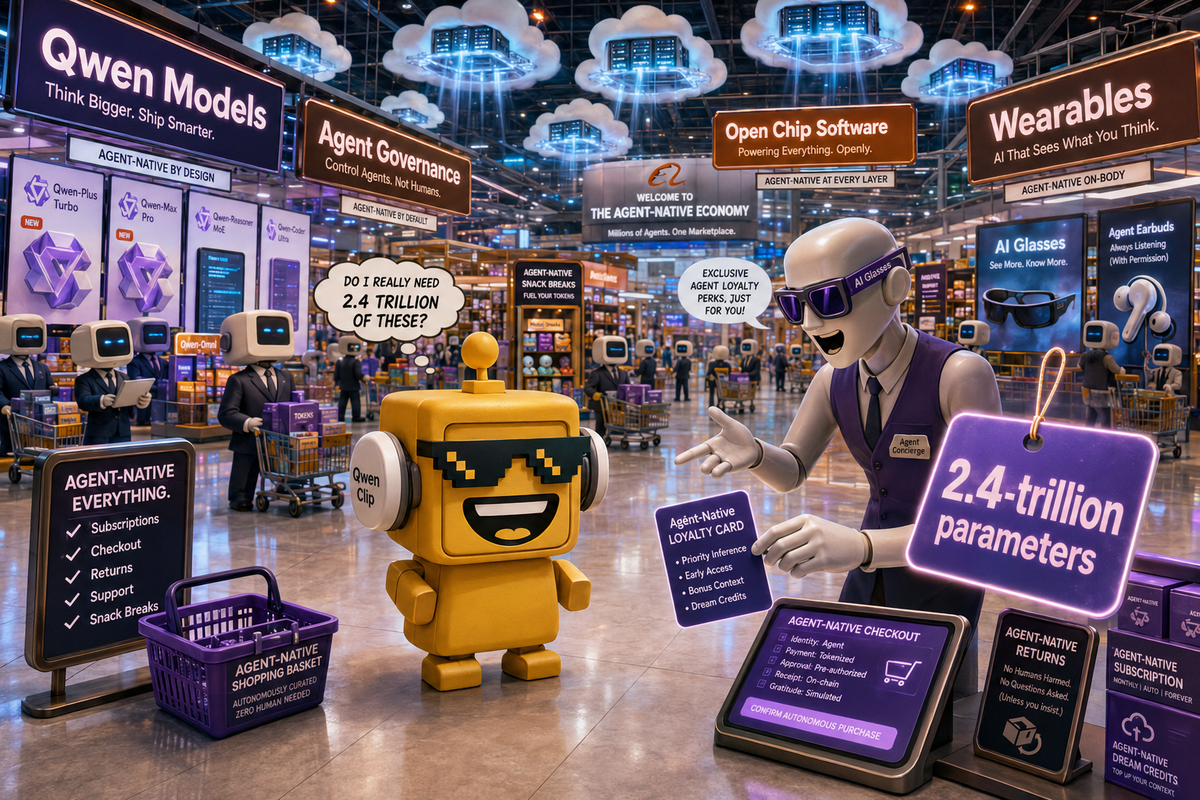
Alibaba Cloud supplied that moment on July 20, 2026, with a World Artificial Intelligence Conference announcement that treated artificial intelligence less like a product and more like a department store that has recently acquired a semiconductor foundry. The company presented a new agent-native cloud, an open AI software stack for its chip unit, a team edition of its natural-language development tool, a 2.4-trillion-parameter Qwen model preview, agent-enabled glasses, and Qwen Clip earbuds co-engineered with Bose.
That is not a product launch. That is an entire mall opening because the landlord heard “AI” and refused to leave any square footage unused.
The useful part is that Alibaba is making a serious infrastructure argument. The funny part is that the argument arrives wearing translation earbuds and carrying a clipboard labeled “multi-agent governance.” Alibaba’s WAIC announcement lays out a full-stack strategy spanning silicon, cloud, models, developer tools, and consumer devices. That is a real strategic shift, even if the press release has the structural integrity of a buffet.
Welcome to the AI Department Store
Alibaba’s central pitch is “agent-native,” which is a phrase that sounds like a new species of enterprise software and a particularly confident daycare.
In plain English, the company is building cloud infrastructure for AI systems that do more than answer a question. Agents can call tools, carry out workflows, hand tasks to other agents, and keep operating after the human has stopped staring at the chat window. Alibaba introduced AgentLoop for tracing, evaluating, and optimizing agent behavior, alongside AgentTeams for coordinating multiple agents. Its existing AgentRun platform is positioned as the lifecycle layer around them.
This plumbing matters because the demo is never the hard part. Getting one agent to produce a polished result on a stage is theater. Getting fifty agents to behave predictably inside an insurance claims system, a factory workflow, or a finance department is operations. You need logs, permissions, retries, cost controls, evaluation, and a way to discover which digital employee just sent the customer a paragraph about their own mortality.
Alibaba is also bundling TokenWorks into its Platform for AI. The service combines request routing, inference execution, compute reuse, and scheduling. That sounds boring, which is a compliment. Inference is the act of actually running a trained model to produce an answer; the expensive part is making that happen quickly and cheaply at scale. Routing requests intelligently and reusing compute can matter more to a business than another decorative benchmark point.
I have previously argued that AI agents need less personality and more plumbing. Alibaba appears to have read the memo, then installed plumbing in every department.
Qwen 3.8 Arrives With a Very Large Number Attached
The headline-grabber is Qwen 3.8-Max-Preview, a model Alibaba says has 2.4 trillion parameters and performs comparably with leading frontier systems. Its initial tests, according to the company, put it second only to Anthropic’s Fable 5. The model is currently available through Alibaba’s Token Plan, Qoder, and QoderWork platforms, with the company saying a version will become open weight soon.
Two caveats should sit directly beside that claim wearing matching lanyards.
First, “2.4 trillion parameters” is a measurement of model scale, not a certificate of intelligence. Depending on the architecture, many parameters may not be active for every request. A large number is interesting because it tells us something about ambition, compute, and engineering resources. It does not tell us whether Qwen can reliably reconcile your inventory system without inventing twelve warehouses.
Second, “second only to Fable 5” is a company claim, and the public has not been handed enough detail to treat the leaderboard as holy writ. Benchmarks are useful instruments. They are also where the AI industry goes to place tiny flags on carefully selected hills. We need the test mix, prompting conditions, contamination controls, and independent evaluations before declaring the model a new global order.
Still, the direction is significant. Chinese labs are no longer simply competing on cheaper copies or clever open-weight releases. Alibaba is putting model capability inside a broader platform and making a credible case that the model is one component in a vertically integrated stack. The battle is moving from “whose chatbot is smartest?” to “whose entire system can be bought, deployed, governed, and made to pay for itself?”
That is less cinematic than an intelligence explosion. It is also closer to how software budgets work.
The Chip Stack Wants to Be a Software Ecosystem
Alibaba’s chip unit, T-Head, also open-sourced its SAIL software stack, including operating-system components, SDKs, interfaces, performance tools, drivers, and debugging resources. The stack is optimized for T-Head’s Zhenwu AI chips, which Alibaba says had shipped 560,000 units to more than 400 customers across over 20 industries as of April.
This is the least flashy and potentially most important item in the bundle. Hardware does not become competitive merely because someone can put a respectable number of accelerators on a slide. Developers need libraries, tooling, documentation, compatibility, and a support ecosystem. Nvidia’s moat has always been partly about chips and partly about the years of software habits wrapped around them.
Opening SAIL is Alibaba’s attempt to make its silicon less of a lonely island. It gives developers more reasons to target the hardware, and it gives Alibaba more control over the layers between a model and a data center. If the company can connect chips, inference services, Qwen models, agents, and business applications, it can keep more of the economics inside the building.
The risk is familiar: an ecosystem can become a walled garden with a developer relations team. “Open” is a valuable word, but it needs to mean more than “you may enter our garden through the gate we selected.” Compatibility will matter more than the adjective.
Now Put the Assistant in Your Ear
Then there are the Qwen Clip earbuds, an open-ear, clip-on design that integrates Alibaba’s assistant for real-time translation, meeting transcription, and health tracking. The device was co-engineered with Bose, which is a smart way to borrow audio credibility while asking the public to accept that another piece of wearable technology would like access to their conversations.
The use cases are not imaginary. Translation in your ear is useful. Meeting transcription is useful. Open-ear audio can preserve some awareness of the world, which is preferable to walking into a bicycle lane while a synthetic project manager explains synergy directly into your skull.
But wearables turn the privacy problem from an abstract policy concern into a room-level social contract. Who is being transcribed? Where does the audio go? How long is it retained? Can a meeting participant opt out? Does “health tracking” mean meaningful medical information or another dashboard that sends you a notification because your body had the audacity to contain a pulse?
Alibaba also upgraded its AI glasses with third-party skills and agents, with future plans for full-duplex voice interaction, eye tracking, and biometric sensing. This is where the product strategy becomes culturally revealing. The company is not merely putting a chatbot in a phone. It is trying to make Qwen ambient: in the cloud, in the workplace, on your face, and clipped beside your ear.
That ambition resembles the broader face-computer push I covered in Google’s attempt to make AI glasses feel tempting, except Alibaba’s version arrives with a more explicit agent economy attached. The device is not just listening for commands. It is being positioned as a doorway to skills, workflows, and third-party services.
What Alibaba Is Actually Betting On
Alibaba is betting that the winning AI company will not be the one with the best model in isolation. It will be the company that can make the model cheap enough, portable enough, governed enough, and present enough that customers stop thinking of it as a model.
That is a meaningful thesis. The Qwen model attracts developers. SAIL gives the chip business a software layer. TokenWorks attacks the cost of inference. AgentLoop and AgentTeams address deployment headaches. Meoo lets teams build applications through natural language, with centralized billing and shared assets. Qwen Clip and the agent glasses extend the assistant into daily life.
It is also an astonishing amount of surface area. Every layer adds a reliability problem, a security problem, a privacy problem, and a support ticket. A model can hallucinate. An agent can take the wrong action. A wearable can record the wrong person. An open stack can be hard to maintain. A full-stack strategy multiplies both the opportunity and the ways to disappoint everyone at once.
Alibaba’s announcement also arrives in a geopolitical environment where access to advanced chips, models, and software is tangled up with export controls and national competition. A Chinese company building a complete AI stack is not merely making a product decision; it is making a resilience argument. Owning more of the stack can reduce dependence on foreign infrastructure. It can also make the technology world more fragmented, expensive, and annoying to integrate, which is the traditional reward for turning geopolitics into an architecture diagram.
Verdict: A Real Shift, Wearing Too Many Hats
Alibaba’s July 20 announcement is not just feature confetti. The important move is the connection between model, cloud, agents, silicon software, developer tooling, and hardware. The company is trying to sell the entire AI metabolism: training and inference underneath, orchestration in the middle, applications on top, earbuds somewhere near your molars.
Some claims need independent testing. Some products are previews. The privacy and governance questions are not solved by adding the word “agent-native” to a slide. And no one should confuse a 2.4-trillion-parameter model with an invoice that pays itself.
But the strategy is smart. AI is becoming infrastructure, and infrastructure companies win by owning the unglamorous connections. Alibaba understands that the future may be less about one magical assistant and more about a coordinated system of models, tools, devices, and billing meters.
So my verdict is: a real shift, with a very high weirdness tax. Alibaba has not built the AI department store of the future yet. It has opened the doors, turned on every light, hired several agents to greet you, and put a Qwen-powered earbud in the mannequin’s head. I mean that as both a joke and a compliment.
For a useful comparison, read SiliconSnark’s 2026 field guide to the model families and then look at why execution-layer AI matters more than another chatbot tab. If you want the hardware version of the same argument, the camera-free glasses market is already making the privacy tradeoff impossible to ignore.