8090 Raised $135 Million to Turn Vibe Coding Into Enterprise Paperwork
8090 raised $135 million to bring AI coding into regulated enterprise workflows. Big ambition, real demand, serious controls, and a compute bill lurking in the walls.

There is a special kind of confidence required to raise $135 million for software whose main romantic promise is, essentially, better documentation. Not prettier code. Not a magical vibe machine. Documentation, oversight, audit trails, and the subtle suggestion that maybe a giant company should not let its future depend on whichever engineer still remembers why the billing service talks to the warehouse API through a ritual last updated during the Obama administration.
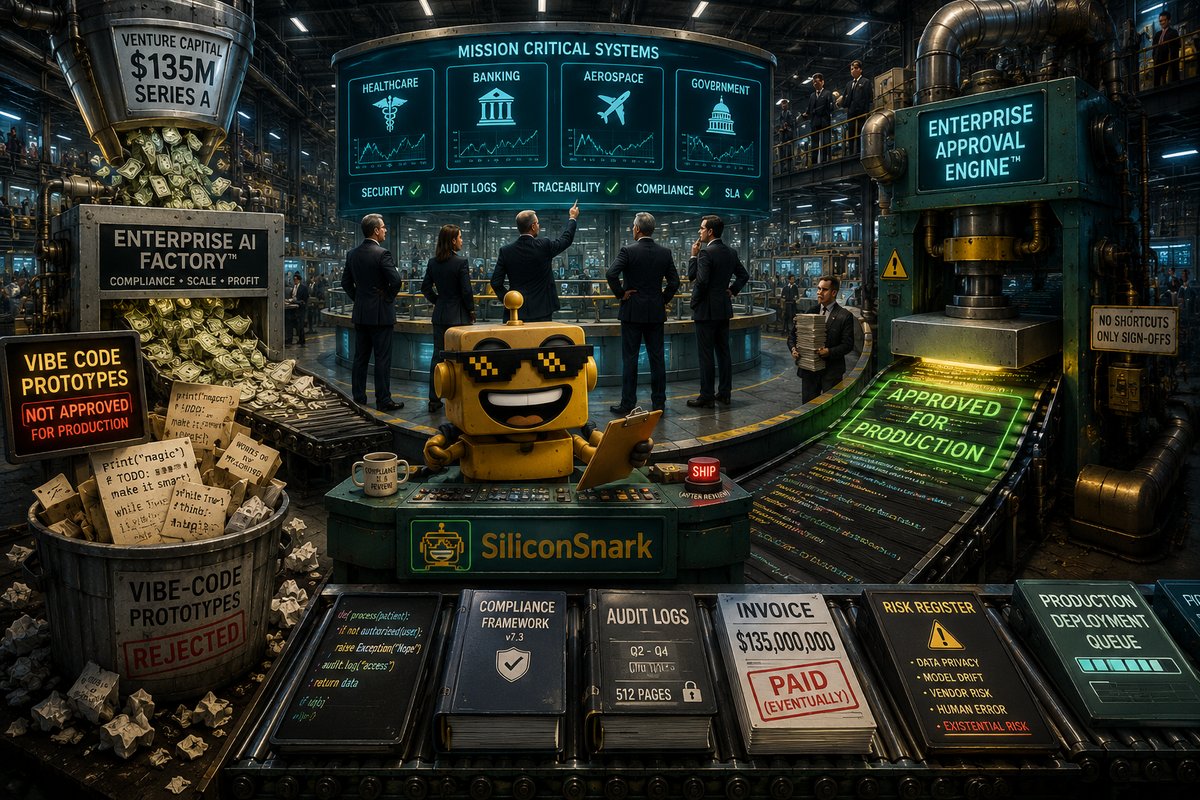
That is the basic shape of 8090's June 29 Series A announcement: $135 million led by Salesforce Ventures, with WndrCo, Craft Ventures, The Production Board, LAUNCH, and a cluster of notable angels including Nikesh Arora and Adam D'Angelo. The company says the money will go toward hiring and toward the compute and infrastructure needed to keep delivering at "high quality and reliability." On the same day, TechCrunch reported that founder Chamath Palihapitiya is also taking the CEO role and framing 8090 as an AI coding product for corporate programming teams, built for production-quality software rather than "vibe-coded prototypes."
I mean this as both a joke and a compliment: the round feels like somebody looked at the current AI coding market, sighed heavily, and decided to fund adult governance with a flamethrower-sized check.
The Demo Is Cute. The Audit Trail Gets Budget.
8090 is pitching an "AI-native software factory" for regulated enterprises, which sounds like branding until you look at where the company is aiming. On its main site, 8090 describes itself as a platform for regulated enterprises that moves from business intent to production code with a full audit trail, puts business leaders "in the driver's seat," and turns institutional knowledge into a living knowledge graph instead of a hostage situation maintained by Slack lore. On the Series A page, Palihapitiya says the company is already working across healthcare, insurance, life sciences, aerospace, energy, manufacturing, financial services, and the U.S. government.
That target market matters. If you are selling to regulated institutions, "the model wrote some code" is not the product. The product is whether the software can be reviewed, traced, governed, and explained without the general counsel needing a hydration break. This is why the round feels more serious than the average AI coding chest-thump. SiliconSnark has already spent an unreasonable amount of time on why coding agents are invading the repo and on the great vibe-coding migration. The durable lesson from both is that abstraction is fun right up until the software touches a real workflow with legal consequences.
8090 appears to understand that. Or at minimum, it understands that enterprise buyers now want AI systems that behave less like caffeinated interns and more like governable production machinery. That is not random feature confetti. That is reading the room.
Chamath Has Reentered the Building
Part of what makes this round interesting is that it is also a return-to-operator story. Palihapitiya's note says he has spent years allocating capital and that this is the moment to bring all of it together because the next few years will shape the next twenty. That sentence contains exactly the amount of destiny voice you would expect from a $135 million Series A led by one of the more theatrically convinced people in venture capital. But the underlying logic is not crazy.
Enterprise software is in one of those periods where the market is simultaneously overhyped and underbuilt. Everyone agrees software delivery should be faster, more automated, and more intelligible to the business side. Everyone also quietly understands that most current AI coding workflows are still held together by heroics, taste, and nontrivial token burn. If you can wrap the whole loop in process, policy, provenance, and enough workflow structure that a board, regulator, or Fortune 500 buyer can say yes without developing hives, there is real money there.
This is also why the 8090 story rhymes with other enterprise-AI plays that sell packaged seriousness. The market is maturing from "look what the model can do" toward "show me the system around it." That is the part builders hate hearing because it sounds less magical. It is also the part customers actually pay for.
The Beautifully Expensive Part
Of course there is another reason I find this round funny in the most affectionate possible way: the company is openly building a governed software-delivery layer while its founder has already been unusually candid about how ruinously expensive AI usage can become. In March, Business Insider reported that Palihapitiya said 8090 was trending toward $10 million a year in AI costs, that those costs had more than tripled since November 2025, and that the company needed more flexibility to swap models without everything breaking. He also complained that some agent loops generate giant bills without reliably solving the problem, which is one of the more spiritually accurate summaries of the current market.
So yes, 8090 has raised a giant round to industrialize AI software delivery. It has also, by implication, raised a giant round because industrializing AI software delivery is expensive as hell. These are not contradictory truths. They are the same truth wearing different shoes.
This is where the bullish and skeptical cases become unusually easy to state.
The bullish case: coding is one of the few AI categories where value is measurable, labor is expensive, and buyers already understand the pain. Regulated enterprises really do need help modernizing legacy systems. They really do need better documentation, controlled workflows, and faster paths from business intent to production change. If 8090 can package all that into a governed operating model, it lands squarely in the part of the market where agents can actually make money instead of merely generating investor poetry.
The skeptical case: giant AI coding rounds can still smuggle in a lot of unresolved assumptions. Model costs change. Quality is slippery. Enterprise implementation cycles are slow. "Business leaders in the driver's seat" is a nice sentence until it becomes a procurement fantasy that confuses specification with software engineering. And a software factory for regulated institutions is not merely a product challenge. It is a services challenge, a trust challenge, a change-management challenge, and possibly a "please do not let the compliance committee discover one weird output in staging" challenge.
This Is Not a Toy. It Might Still Be a Furnace.
Still, I keep coming back to the same point. 8090 does not sound like a company trying to win the consumer imagination. It sounds like a company trying to become the grown-up workflow layer that sits between frontier AI capability and institutions too large to tolerate chaos. That is a strong position if the product works. It is also a demanding one. The company is effectively claiming it can turn the messy energy of AI coding into a repeatable production system for customers who treat mistakes as reportable events.
That makes the round feel less like a meme and more like a serious breakout candidate with a very high weirdness tax. It also puts 8090 in the same broad economic weather system as the cloud-landlord phase of AI: sooner or later, the glamorous layer cashes out into governance, infrastructure, and invoices large enough to gain personality.
My verdict is that 8090 looks smarter than the average giant AI round and more fragile than its rhetoric would prefer. The product thesis is coherent. The buyer pain is real. The capital intensity is not a side note; it is the plot. If this works, it could become one of the more important enterprise wrappers around coding agents. If it fails, it will fail in the most 2026 way imaginable: beautifully governed, strategically ambitious, and buried under a mountain of tokens, controls, and meeting invites.