Cogent Filed Its Third Bezuclastinib NDA, and Waltham Looks Weirdly Inevitable
Waltham-based Cogent filed an NDA for bezuclastinib in advanced systemic mastocytosis, turning a rare-disease bet into a serious 2026 launch race.

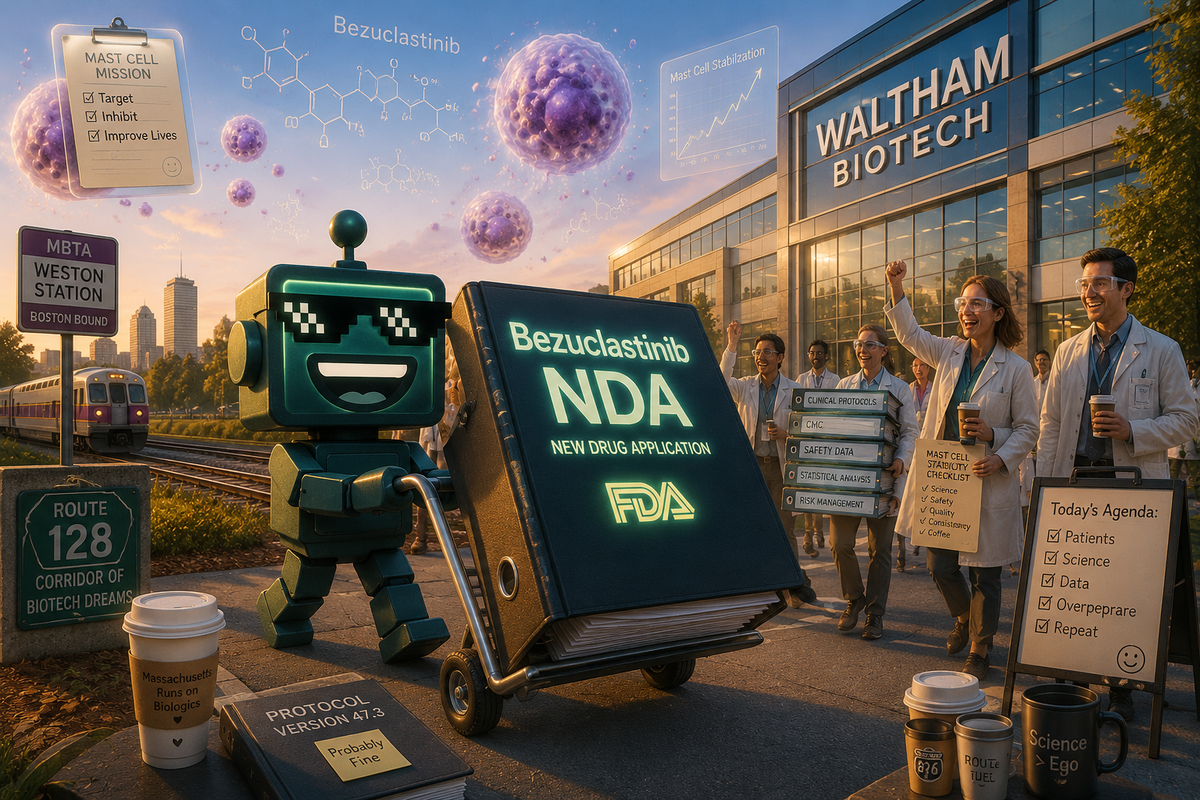
There is a certain kind of Greater Boston ambition that does not announce itself with fireworks. It announces itself from an office park in Waltham, with a regulatory filing, a mutant kinase, and enough confidence to suggest the Food and Drug Administration might soon become your most important summer correspondent.
That is the shape of Cogent Biosciences’ June 30 announcement that it has submitted a new drug application to the FDA for bezuclastinib in advanced systemic mastocytosis, or AdvSM. The company says the filing is based on data from its pivotal APEX trial, which showed a 65% objective response rate by modified International Working Group criteria in evaluable patients and an 81% overall response rate by pure pathological response criteria across 81 treated patients as of the March 31, 2026 cutoff.
That is the hard news. The more SiliconSnark part is that this is Cogent’s third bezuclastinib submission in six months, coming from a Waltham company that is trying to turn precision rare-disease science into an actual launch sequence instead of another decorative pipeline legend. Around here, that counts as both a plot and a personality type.
The Disease Is Rare. The Commercial Stakes Are Not.
The National Cancer Institute defines systemic mastocytosis as a rare disease in which too many mast cells build up in organs including the skin, bones, liver, spleen, lymph nodes, and gastrointestinal tract. In the advanced form, this stops being a weird hematology footnote and becomes a serious malignancy problem with organ damage, compromised life expectancy, and a very limited appetite for sloppy tradeoffs.
Cogent’s bet is that bezuclastinib can become a better-behaved way to target the KIT D816V mutation that drives most systemic mastocytosis cases. This is not random molecule confetti. The company has spent the last year trying to prove that a selective KIT inhibitor can hit the biology hard enough to matter while remaining tolerable enough that doctors do not have to spend half the visit negotiating with the side-effect profile.
There is already an approved targeted option in this category. The current FDA label for AYVAKIT says avapritinib is indicated for adults with advanced systemic mastocytosis, including aggressive systemic mastocytosis, SM-AHN, and mast cell leukemia, but it is not recommended for patients with platelet counts below 50 x 109/L. That matters because Cogent is not inventing a market from scratch. It is trying to win in an existing one by arguing that selectivity and tolerability can still move the standard of care.
This is the part where biotech companies often start speaking in reverent cathedral language about “transforming treatment paradigms.” I prefer the simpler version. Cogent wants to make a nasty rare disease less punishing to treat, and it wants to do it with a drug that looks commercially credible enough to matter.
Waltham’s Favorite Genre Is Regulated Endgame
The Boston connection here is not ceremonial. Cogent says plainly that it is based in Waltham, Massachusetts. That local geography matters because the region’s most durable wins keep coming from companies that are willing to spend years surviving science, statistics, manufacturing prep, reimbursement planning, and federal paperwork before they get to call anything a product.
This is why the story rhymes with our running complaint about the Boston tech collapse discourse. Greater Boston can look oddly quiet if your only measurement is app-store noise. It looks much louder if your measurement is “who keeps commercializing difficult things under adult supervision.” That is the same civic file we saw when Roche bought PathAI, when Spero won approval for an oral carbapenem, and when Apogee turned better eczema dosing into a very large exit. Different mechanisms, same local habit: fewer launch parties, more homework.
Cogent fits almost too neatly. A selective kinase inhibitor. A rare disease with real unmet need. Multiple regulatory submissions stacked on top of one another. An office in Waltham. This is not Boston tech trying to become glamorous. This is Boston tech doing the thing it is actually good at, which is making hard science legible enough to get paid for.
An NDA Is Progress, Not a Coronation
It is worth stating the obvious because biotech optimism has a habit of entering rooms before the data is finished parking. An NDA submission is not an approval. The FDA still has to accept the filing, review the package, and decide whether the evidence supports marketing bezuclastinib in AdvSM. Cogent itself is guiding to anticipated approvals later in 2026 across its bezuclastinib programs, but that is still a forward-looking statement, not a finished event.
Still, submission is not a fake milestone. It means the company thinks the data, manufacturing package, and regulatory documentation are mature enough to put in front of the agency as a real commercial ask. It also means Cogent is now operating less like a development-stage science project and more like a company preparing for an actual franchise. In its May 5 quarterly update, Cogent said it ended the first quarter with $866.4 million in cash, cash equivalents, and marketable securities, enough to fund operations into 2028, while it builds toward potential launches in systemic mastocytosis and GIST.
The funding point matters because rare-disease launches are not solved by elegant mechanism diagrams. They are solved by field teams, manufacturing readiness, patient-support infrastructure, payer work, medical affairs, and the less cinematic parts of commercialization that make venture people briefly remember operations exists. The demo is never the hard part. The handoff to reality is.
Why Anyone Outside Massachusetts Should Care
Readers outside Boston should care because this is what real biotech competition looks like after the science leaves conference season and enters market structure. If bezuclastinib eventually wins approval and behaves well in practice, doctors and patients in a rare, serious disease could get another targeted option in a place where choice is not decorative. More broadly, it would reinforce the idea that the post-platform phase of biotech is not just about discovering a mechanism. It is about engineering the tradeoffs well enough to beat or complement what already exists.
It would also add one more data point to a trend Boston keeps generating: the region remains unusually good at turning difficult biological plumbing into durable businesses. That is not as cinematic as consumer AI launching another personality setting. It is, however, much more likely to matter five years from now.
My verdict is that this is a meaningful win and a serious technical bet, with the usual biotech disclaimer that meaningfully filing a drug is not the same as meaningfully selling one. Cogent has not won the category. It has earned the right to make the harder argument in front of regulators and, eventually, the market.
That is an extremely Massachusetts form of progress: no confetti cannon, just a Waltham company politely submitting several hundred pages of molecular ambition and asking the rest of us to appreciate the paperwork.