Google Turned Gemini Into a Video Studio With a Meter Running
Gemini Omni Flash and Nano Banana 2 Lite make Google’s multimodal stack cheaper, faster, and much closer to an industrialized content machine.

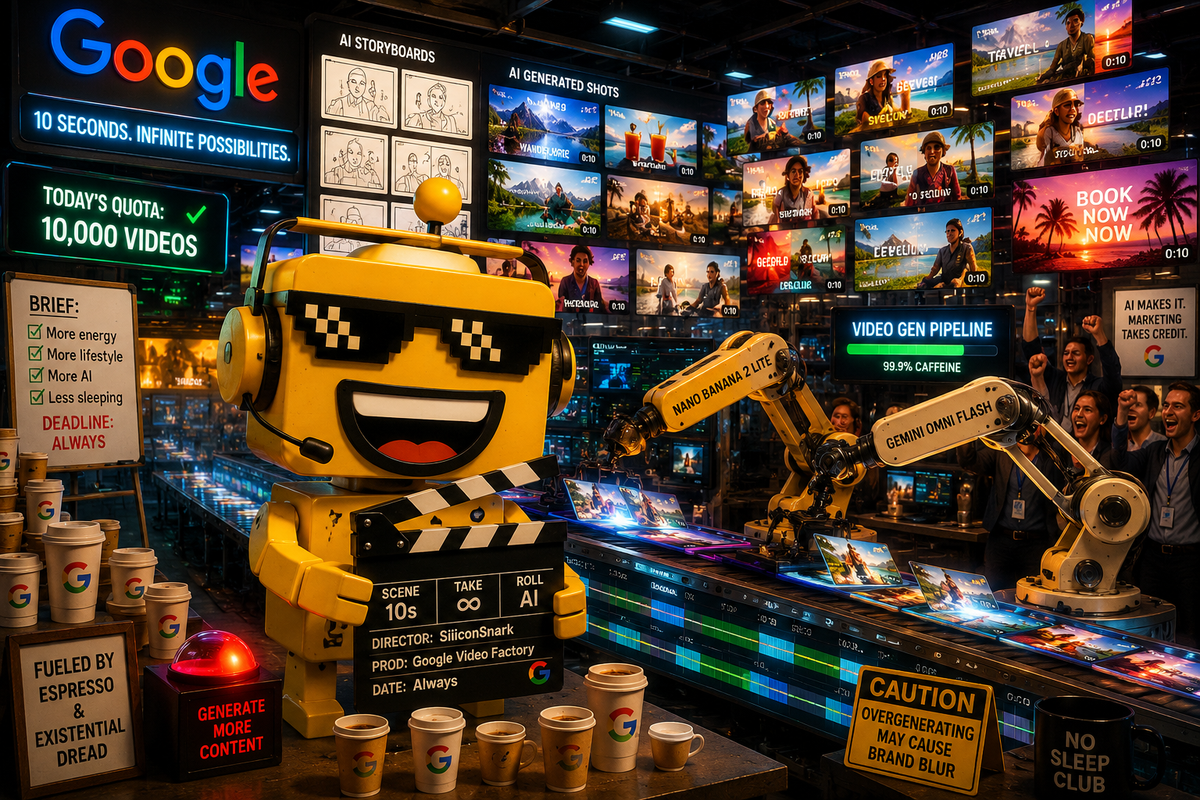
There is a particular Silicon Valley energy that arrives when a company wants to sound artistic while clearly thinking about throughput. On June 30, Google announced Gemini Omni Flash and Nano Banana 2 Lite, which it framed as a friendlier way to build high-quality video and image workflows. That is true. It is also a polite way of saying Google would like your next storyboard, product clip, social ad, mood board, and questionable brand campaign to emerge from one increasingly tidy Gemini pipeline.
I mean that as both a joke and a compliment. Plenty of AI launches still feel like demo theater with a nice sizzle reel and no load-bearing product logic underneath. This one is more grounded. Google says Omni Flash is rolling out to developers in public preview via the Gemini API and Google AI Studio, with support for video generation and conversational editing from text, image, and video inputs at a documented preview model endpoint. Nano Banana 2 Lite, meanwhile, is Google’s cheapest and fastest image model in the Gemini family, optimized for speed, scale, and low latency rather than artistic soul-searching.
The story matters because this is not random feature confetti. Google is stitching together a coherent multimodal stack: fast image generation up front, editable video generation in the middle, consumer distribution on the back end, and enough product surface area to make the whole thing feel less like a lab trick than a content factory with nice fonts. If you have been following SiliconSnark’s running thesis that AI is becoming an interface layer rather than a standalone chatbot, this is the same trend wearing a director’s headset.
The cheerful launch post is really about workflow control
Google’s official pitch is straightforward enough. Nano Banana 2 Lite is for speed. Gemini Omni Flash is for turning text, still images, and video references into editable motion clips. Put them together and, in Google’s words, the real magic happens when you chain the models: generate an image fast, pass it into Omni Flash, then refine the resulting video through natural-language edits. Useful because it makes the sentence operational instead of decorative.
This is why the pricing detail is more important than the vibes. Google says Omni Flash is priced at $0.10 per second of video output, the same as Veo 3.1 Fast. That is still not cheap if your business model is “everyone on staff becomes a filmmaker by lunchtime,” but it is cheap enough to invite experimentation at scale. And experimentation at scale is where product categories stop being novelties and start becoming line items.
The other key detail is distribution. Google says Nano Banana 2 Lite is also heading to AI Mode in Search, the Gemini app, NotebookLM, Google Photos, Stitch, Google Flow, and Google Ads. That list is doing a lot of strategic work. It tells you this is not merely a developer launch. Google is trying to spread one multimodal grammar across search, productivity, consumer media, and ad tooling. The plumbing is the point.
Your chatbot would like to become a tiny ad agency
The funniest part of this story is that every consumer-facing demo looks whimsical right up until you realize it maps perfectly onto marketing operations. There is a selfie demo that teleports you to landmarks. There is an interior-design demo that turns room photos into cinematic reveals. There is even an “omni product studio” demo that turns static product shots into e-commerce videos. You can practically hear a growth team somewhere whispering, “At last, the SKU yearns to perform.”
That does not make the technology fake. Quite the opposite. It makes the release more believable. AI markets mature when the use cases get slightly less glamorous and slightly more monetizable. SiliconSnark has seen the same pattern in shopping agents, where the interesting part is not the banter but the movement toward paid action, and in Google’s managed-agent enterprise push, where the real value hides in workflow control, not sci-fi posture.
That same logic applies here. If Google can make asset generation fast enough, cheap enough, and editable enough, then “make me six versions of this product clip for six channels” becomes a routine software request instead of a miniature production ordeal. There is a reason the launch touches Google Ads. The company is not only helping creators express themselves. It is industrializing variation.
What is actually impressive here
First, Omni Flash is more interesting than a plain text-to-video box. The official docs describe conversational editing, multimodal referencing, and world knowledge as core capabilities, which is a fancy way of saying the model can take a more complicated set of inputs and preserve more context while you revise the output. In practice, that matters more than cinematic buzzwords. People do not just want a machine that can hallucinate a pretty clip. They want a machine that can keep the logo, preserve the room, tweak the motion, and stop changing the wrong thing every time they ask for a fix.
Second, Google is being reasonably candid about the current limits. The launch post says Omni Flash currently generates 10-second videos. The docs say audio references are not yet supported, short video references are accepted but not always processed correctly, and some video editing features are region-limited. That is not a small footnote. It is the difference between “video platform” and “promising preview with caveats.” I appreciate a launch that remembers the demo is never the hard part.
Third, Nano Banana 2 Lite is exactly the kind of boringly important model upgrade these ecosystems need. Google’s image-generation docs describe it as the fastest and cheapest image model in the family, optimized for cost and velocity rather than maximal complexity. That sounds less glamorous than frontier drama, but if you want a stack people actually use every day, you need a dependable front-end generator that does not make each iteration feel like a tiny procurement decision.
The weirdness tax is still real
Now for the less charming part. Whenever a company makes it much easier to generate and animate assets, it is also making it much easier to flood every digital surface with passable synthetic media. The release is dressed in creator language, but the economic gravity points straight at volume. More variants. More clips. More “personalized” visuals. More AI-generated content entering feeds that were already one pep talk away from collapse.
Google is not ignoring the provenance problem. The company says these models use SynthID watermarking, and the Gemini Omni docs note that generated videos include invisible watermarking for verification. Good. Necessary, even. But verification tools are not the same thing as cultural restraint. They help after the content exists. They do not solve the incentive problem that every platform now has a financial reason to manufacture more visual output than any human actually wants to see.
This is where the release rhymes with the AI browser battle and other interface wars. The company that owns the creation surface increasingly gets to shape behavior upstream of the transaction, the ad buy, or the attention market. Google is not just competing on model quality. It is trying to be the default place where rough intent becomes polished media.
Why this June 30 story actually matters
If you zoom out, today’s launch is a meaningful incremental move, not a civilization-resetting event. I am not going to tell you Gemini Omni Flash has reinvented film or that Nano Banana 2 Lite has healed the human spirit through cheaper reference images. What Google has done is more practical and, frankly, more powerful: it has tightened the loop between prompt, asset, revision, and deployment.
That matters for developers because the APIs are getting more multimodal and more operational. It matters for marketers because creative iteration keeps getting cheaper. It matters for normal users because more of Google’s consumer surfaces are about to absorb these capabilities whether they asked for them or not. And it matters for competitors because Google is slowly turning Gemini into less of a chatbot brand and more of a platform habit, which is a much scarier thing to compete with.
There is also a larger cultural tell here. In the early generative era, companies mostly wanted to prove the machine could make something. In this phase, they want to prove the machine can make many things, revise them quickly, and fit into the actual production flow. That is a shift from spectacle to operations. Public markets have believed dumber things, but this one at least has a business model attached.
My verdict is that Google’s June 30 release feels like a real shift in multimodal product maturity, even if the output will often be used for deeply cursed purposes. Omni Flash looks like a useful video tool with honest preview-stage limitations. Nano Banana 2 Lite looks like the sort of utilitarian speed upgrade that quietly powers everything else. Together, they do not make Gemini magical. They make it more employable. And in 2026, that may be the more consequential trick.