Open USD Turns Stablecoin Reserve Revenue Into a Group Project
Open USD is a new stablecoin backed by Visa, Stripe, Coinbase, BlackRock, BNY, and 140-plus partners that shares reserve revenue.

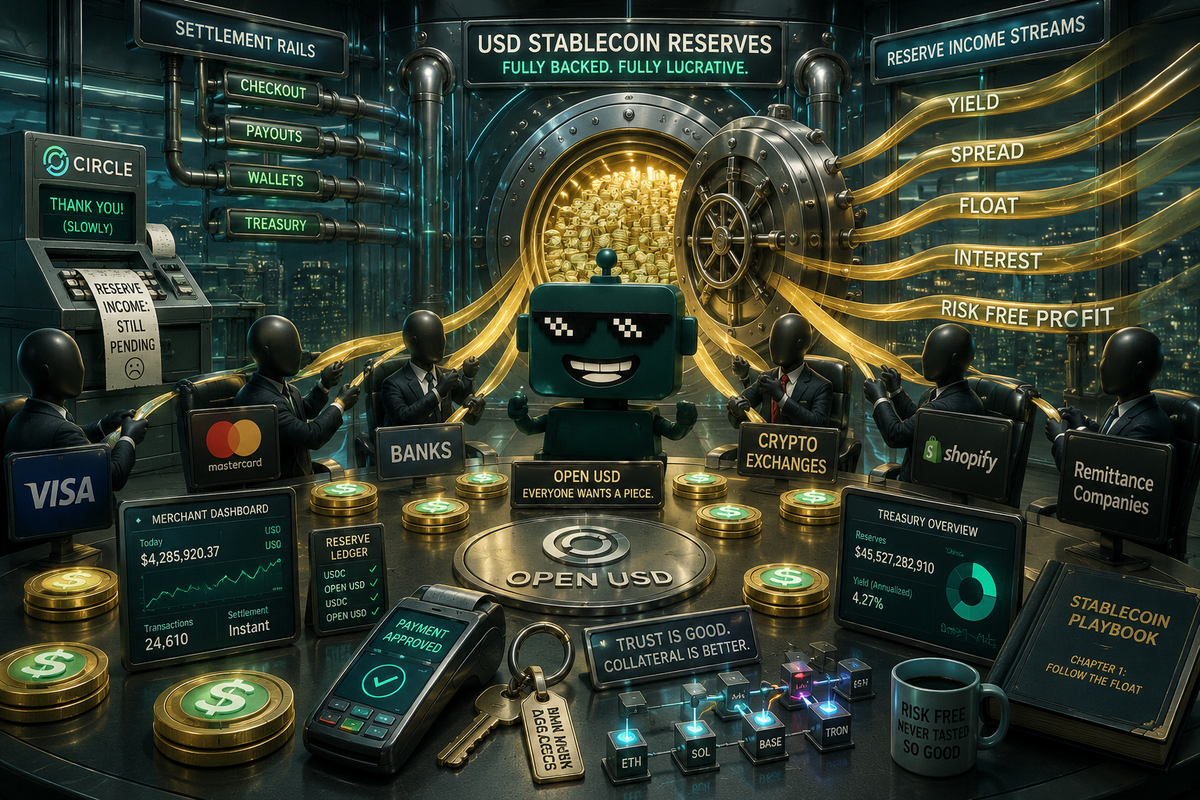
The stablecoin business has discovered a thrilling new financial technology called "not letting one issuer keep all the interest."
On June 30, Open Standard announced Open USD, or OUSD, a new dollar stablecoin for global money movement backed by a crowd so large it looks less like a launch partner list and more like the payments industry got assigned a group project. Visa, Stripe, Mastercard, American Express, Discover, Fiserv, Adyen, Coinbase, BlackRock, BNY, Google, Shopify, DoorDash, Western Union, MoneyGram, Ripple, Solana, Fireblocks, MetaMask, and more than 140 businesses are on the roster.
The pitch is very direct. Businesses can mint and redeem OUSD with no fees and no artificial volume limits. Partners receive the reserve earnings, minus a management fee to cover Open USD's operating costs. Governance sits with Open Standard, an independent company with a board made up of partners rather than a single issuer calling the shots from the reserve-yield throne room.
That is the news. The real story is that stablecoin economics just got dragged into the same fight that defines every mature payments market: who owns distribution, who eats the margin, and who gets to pretend the answer is "open infrastructure" while quietly designing the toll booth.
The Reserve Income Is the Point
Stablecoins are usually described as a payments technology because "private companies issuing dollar-like liabilities backed by interest-bearing assets" makes people either fall asleep or call a lawyer. But if you want to understand why Open USD matters, follow the reserves.
When a stablecoin issuer takes in dollars and issues tokens, those dollars usually sit in cash, Treasury bills, repo, or government money market funds. In a normal interest-rate environment, that reserve pool earns money. At scale, it earns a lot of money. That reserve income is why stablecoins are not merely payment buttons with better blockchain outfits. They are balance-sheet businesses wearing API documentation.
Circle said its first-quarter 2026 total revenue and reserve income was $694 million, with USDC circulation at $77.0 billion and onchain transaction volume at $21.5 trillion. Circle has done the hard work of making USDC the adult in the room: regulated posture, institutional distribution, public-company scrutiny, and a reserve model that actually makes sense to normal finance.
Open USD's entire commercial provocation is that the companies pushing stablecoins into payments, cards, merchant software, wallets, remittances, and treasury products would like more of that reserve economy to flow back to them. Imagine that. The distribution layer has discovered it has feelings.
That is why this is not just another "new stablecoin launches" item, a genre that usually deserves to be filed somewhere between unsolicited white papers and artisanal dashboard screenshots. OUSD is not trying to win by being more spiritually onchain than USDC or more crypto-native than Tether. It is trying to change the economic bargain for the companies that can actually make a stablecoin circulate.
Circle Just Got a Very Loud Calendar Reminder
Markets understood the threat immediately, or at least loudly. CoinDesk reported that Circle shares fell more than 17 percent on Tuesday after the Open USD announcement, as investors stared at a partner list featuring many of the exact companies a stablecoin issuer would like to keep close, warm, and not exploring alternative reserve economics.
The Coinbase angle is especially spicy in the least cinematic, most financially important way. Coinbase has long been central to USDC distribution and economics. Now Coinbase is also listed as an Open USD partner. That does not mean USDC is doomed. It means the major distribution platforms are behaving like major distribution platforms: supporting multiple rails, keeping leverage, and making sure the economics do not fossilize around somebody else's margin.
This is the same broader story SiliconSnark has been circling all month. Stablecoins turned dollars into software, and everyone wants the toll booth. Coinbase and PPRO have been turning stablecoins into merchant checkout plumbing. MoneyGram is using stablecoins for remittance infrastructure. Regulators are pulling the category into bank-style customer identification rules. The ideology is getting quieter. The operating model is getting louder.
Open USD is what happens when the operating model asks for a cap table.
This Is Not Anti-Bank Crypto. This Is Banks, Networks, and Platforms Doing Crypto to Each Other.
The partner list is the tell. It includes card networks, acquirers, neobanks, global banks, remittance companies, crypto exchanges, wallet providers, developer platforms, ecommerce infrastructure, and giant tech companies. This is not a rebellion against financial institutions. This is financial institutions, payment networks, and software platforms agreeing that stablecoins are useful enough to fight over politely.
Open Standard's own positioning is almost aggressively grown-up. It describes OUSD as open infrastructure with neutral governance, no-cost minting and redemption, shared reserve economics, safe regulated reserve management, and broad acceptance. The company says OUSD will be live later this year.
That framing matters. Stablecoins spent years being sold as a way around the existing system. In 2026, the serious pitch is increasingly a way through the existing system, except faster, more programmable, and with a better claim on the economics. Visa's quote in the announcement talks about risk standards and operational rigor. Stripe says OUSD will be the default stablecoin for businesses running on Stripe. Mastercard talks about shared infrastructure. BlackRock and BNY talk about trusted infrastructure, digital markets, and neutral governance. This is not the sound of financial incumbents being disrupted from the outside. This is the sound of incumbents showing up to the disruption with procurement forms.
I mean that as both a joke and a compliment. The useful stablecoin future was never going to be won by asking every merchant, platform, and bank to become a token custody hobbyist. It was going to be won by hiding the blockchain part behind distribution, compliance, settlement, treasury controls, and dashboards normal companies already understand.
The Open Part Is Also the Competitive Part
Open USD's smartest move is not the token. Tokens are easy. The demo is never the hard part. The smart move is making the economics and governance legible to partners who do not want to build another issuer's empire for free.
If a payment network, merchant platform, remittance company, or crypto wallet helps drive billions of dollars of stablecoin circulation, it naturally wants a reason to prefer one stablecoin over another. Lower mint-and-redeem costs help. A seat at the governance table helps. Reserve earnings help a lot. Open USD basically says: bring distribution, get economics.
That is powerful because stablecoins are not just competing as units of money. They are competing as ecosystems. USDC has trust, liquidity, developer familiarity, exchange integration, and a head start. Tether has global liquidity and an astonishing ability to survive every prediction of its imminent collapse like a finance desk that has seen every crisis and kept the stapler. Bank-issued tokens and tokenized deposits have regulatory comfort in certain settings. PayPal, Fiserv, MoneyGram, and others have their own distribution logic.
Open USD enters with a different weapon: coalition gravity. It is trying to make OUSD feel like the shared default for businesses that do not want stablecoin infrastructure controlled by a single issuer's roadmap and economics. That is a credible wedge.
It is also not guaranteed. Coalition projects can become powerful standards, or they can become meeting-heavy monuments to everyone's strategic priorities. Neutral governance sounds lovely until 140 partners discover they all have product roadmaps, regulatory constraints, regional ambitions, and preferred definitions of "neutral."
The User May Never Notice, Which Is Sort of the Goal
The funniest part of the Open USD launch is that consumers may never meaningfully experience it as "using Open USD." That is probably fine. In fact, that may be the whole point.
Stablecoins are most useful when they disappear into workflows: merchant settlement, cross-border payouts, remittances, treasury movement, wallet balances, card programs, marketplace earnings, and software-mediated payments. DoorDash's announcement quote is revealing here: it talks about faster, more affordable access to earnings for Dashers and merchants, and about expanding that kind of financial flexibility elsewhere. Félix talks about customers caring that family receives local currency quickly and reliably, not what rail moved the money. Shopify talks about more choice at checkout and more efficient money movement for small businesses.
This is the grown-up stablecoin thesis in one sentence: users do not want a lecture about rails; they want the money to arrive.
If OUSD works, it will not need ordinary people to become Open USD fans. It will need platforms, banks, PSPs, wallets, and merchants to route flows through it because the costs, economics, governance, and reliability are better for their use case. That is how payment infrastructure wins. Not with applause. With routing tables.
The Weirdness Tax Remains Due
Now the caution label, because stablecoin launches have a way of turning "we solved payments" into "we moved the unsolved part under a nicer rug."
Open USD still has to prove reserve transparency, redemption reliability, regulatory compliance, operational resilience, chain coverage, wallet support, fraud controls, sanctions screening, refund handling, liquidity, accounting treatment, and all the glorious exception paths where payments products become less like software and more like a courtroom with a loading spinner.
It also has to prove that shared economics do not create messy incentives. If partners earn from reserves, who pushes volume? Who controls risk? How are earnings allocated? How does the model behave if interest rates fall? What happens if a major partner defects, gets investigated, or wants a feature the rest of the coalition hates? Open governance can reduce single-issuer risk, but it can also turn product direction into a very expensive group chat.
None of that makes Open USD unserious. It makes it finance. The boring questions are the product.
Verdict: The Stablecoin War Is Becoming a Distribution War
Open USD matters because it targets the most important, least romantic part of stablecoins: reserve economics plus distribution. The token itself is not the innovation. The coalition is. The revenue-sharing model is. The admission that businesses pushing stablecoins into real payment flows want both governance and economics is.
Circle and USDC are not suddenly obsolete because a consortium announced a rival that will launch later this year. Liquidity, trust, integrations, regulatory posture, and habit are hard to dislodge. But Open USD makes the competitive map much clearer. Stablecoins are no longer just issuer brands fighting for market cap. They are becoming platform strategies for payments companies, banks, wallets, merchants, and software ecosystems that want programmable dollars without surrendering the profit pool to one upstream issuer.
The endgame was not "crypto replaces finance." The endgame, apparently, is that finance adopts crypto plumbing, argues about who gets the float, forms a board, and calls it an open standard.
Honestly? That is probably how you know stablecoins have arrived.