
StrongestLayer Raised $4.1 Million to Teach Email Security Some Intent
StrongestLayer raised $4.1 million to build reasoning-based email security for AI-era phishing. The pitch is smart, expensive, and very inbox-shaped.

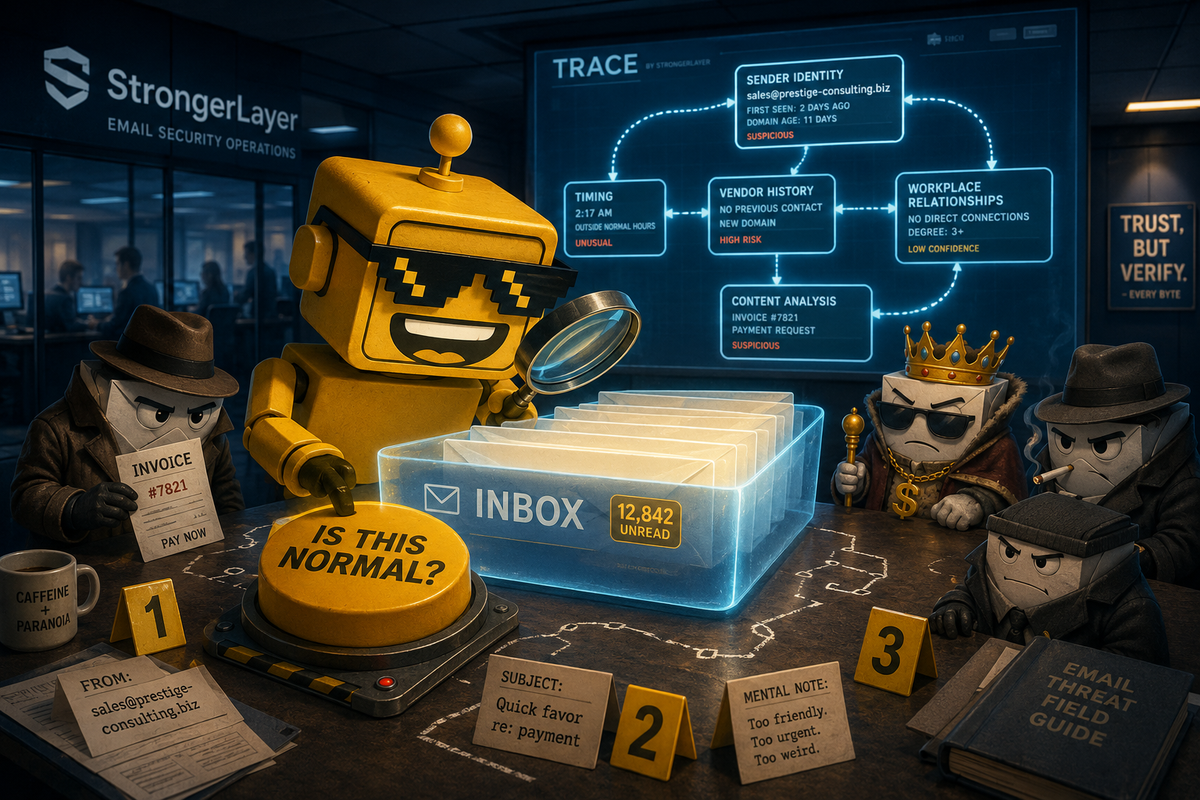
There is a special kind of email that passes every automated check and still makes your stomach perform a small emergency evacuation. It comes from a real account. It uses the right company vocabulary. It references the project everyone is discussing. It asks you to change the bank details on an invoice, approve a payment, or send a gift card to the CEO who is “in a meeting.”
StrongestLayer is betting that the next generation of email security needs to understand that feeling. The San Francisco startup just announced a $4.1 million seed-extension round, led by Inovia Capital, with LaunchPod, Alumni Ventures, an angel investor, and previous backer Sorenson Capital also participating. That brings its total seed investment to $9.3 million.
Founded in 2024 by veterans of Proofpoint, FireEye, Mandiant, Google, McAfee, and Intel Security, StrongestLayer is building an AI-native email-security platform around a simple accusation: traditional filters are very good at recognizing yesterday’s bad email, and increasingly bad at recognizing tomorrow’s convincing email. The company emerged from stealth last year. It now wants to sell the reasoning layer that notices when a message is technically plausible but socially, behaviorally, or organizationally bizarre.
The Inbox Has Entered Its Psychological-Thriller Era
The old email-security story is comfortingly mechanical. Find a bad link. Spot a known attachment. Compare a sender against a reputation list. Look for a phrase that has previously appeared in a phishing campaign. Block, quarantine, congratulate yourself, and move on to the next 47,000 alerts.
That model made sense when attackers were reusing templates and spelling “Microsoft” with three vowels and a prayer. It becomes less reassuring when generative AI can create a fresh, personalized message in seconds, tuned to a particular employee, vendor relationship, executive habit, or internal project.
StrongestLayer’s TRACE platform is designed to look at the broader situation: sender reputation, communication patterns, domain infrastructure, behavioral baselines, and organizational context. The question is less “does this email contain a suspicious string?” and more “does this message make sense for this person, at this moment?”
That is a better question. It is also the kind of question that makes every security buyer glance nervously at the implementation diagram.
Reasoning Is Useful. Reasoning Is Also a Budget Line.
The appealing part of StrongestLayer is that it is not pretending the problem is a cute add-on. The company’s founders have spent years inside the machinery they are now trying to replace, and the product is aimed at an increasingly obvious gap: a malicious message does not need to look malicious if it can look like a perfectly normal request from a real person.
That gives StrongestLayer a focused wedge. It is not announcing a general-purpose “AI platform for trust.” It is trying to protect business email, where one plausible message can turn into a fraudulent wire transfer, a compromised account, a stolen session, or the world’s most expensive reply-all.
The product also fits the mood of the market. AI is making attacks cheaper to personalize, while security teams are not receiving a matching supply of brilliant analysts who can investigate every ambiguous message. A system that can provide a useful explanation—what changed, which relationship is unusual, why the request conflicts with known behavior—could reduce the number of times a human has to choose between “ignore the alert” and “cancel the company’s afternoon.”
I mean that as both a joke and a compliment. In security, explainability is not merely a nice user-interface flourish. Someone has to decide whether the tool is right, whether a message should be released, and whether the company can defend that decision later.
Every Email Security Startup Eventually Meets the Weirdness Tax
Now for the awkward part: intent is not a magic word. It is a moving target wrapped in a subscription contract.
People send strange emails. Executives change assistants. Vendors switch domains. Companies acquire other companies and spend six months communicating through a temporary distribution list called “FINAL_FINAL_v3.” A security product that treats novelty as guilt will bury users in false positives. A product that is too tolerant of unusual behavior becomes a very expensive decorative shield.
There is also the cost of being right in a way nobody can verify quickly. A conventional filter can point to a malicious URL or a known payload. A reasoning system may say that a request is suspicious because its language, timing, recipient, and business context do not align. That can be powerful. It can also produce the sort of explanation that sounds like a junior consultant who has read too many policy PDFs: “The sender’s urgency signature diverges from the organizational norm.”
For StrongestLayer, the demo is never the hard part. The demo is an obviously suspicious invoice, a glowing risk score, and a robot voice saying, “This vendor has never asked for a gift card before.” The difficult work is tuning the system across real companies without making normal human chaos impossible. Security teams will want evidence, speed, integrations, low operational friction, and a clear answer to the oldest enterprise question: what happens when your model is wrong?
This Is the Same Family of Bet as the AI Bouncer
StrongestLayer sits in a broader 2026 pattern: startups are building the supervision layer around systems that were previously allowed to improvise. White Circle’s seed bet on a chaperone for AI agents treated model safety as a product category. Neo’s agent-security platform put a bouncer at the endpoint. StrongestLayer is doing something similar for the older, less glamorous, still catastrophically important agent interface known as email.
That makes the company’s positioning smart. The industry keeps trying to convince us that email is on the way out, usually right before sending another email about it. In reality, email remains where identities, invoices, approvals, reset links, meeting context, and corporate authority collide. If AI makes social engineering more convincing, the inbox becomes a place where machine reasoning could matter a lot.
The category also has a useful precedent in smaller, more grounded security bets. Zapdos raised a tiny pre-seed to turn factory cameras into safety agents, another example of AI being asked to interpret messy real-world context instead of merely autocomplete a paragraph. And Synthetic’s bookkeeping automation makes a similar promise in finance: let software handle the tedious judgment humans would rather not perform, then prove it did not quietly destroy the books.
A Promising Little Rocket, With a Very Serious Inbox
StrongestLayer feels like a promising little rocket, although one built in a room where every launch sequence is subject to audit.
The round is modest enough to feel like product capital rather than financial theater. The founders have a specific problem, relevant experience, and a market that is becoming more uncomfortable by the week. The company’s central insight—that intent and context matter more when attackers can generate endless plausible messages—is both obvious and genuinely useful. Most good security products begin with an insight that sounds obvious only after someone has done the painful work of making it operational.
The risk is equally clear. “Reasoning-based security” can become the 2026 version of “platform,” a word that arrives in every pitch deck carrying no luggage. The product has to be fast, explainable, accurate, affordable, and quiet enough that employees do not experience every unusual email as a personal interrogation. It has to earn trust while inspecting the thing people use to establish trust. That is not a small assignment.
Still, I would rather see $4.1 million chasing the difference between “unfamiliar” and “fraudulent” than another nine-figure round funding a chatbot that summarizes the previous chatbot’s roadmap. StrongestLayer is trying to make the inbox a little less gullible without making it completely paranoid.
That is a reasonable ambition. It may even be a beautiful one, in the way all useful security products are beautiful: nobody notices when they work, and everyone notices when they do not.