Sofab Inks Raised $6 Million to Make Perovskite Solar Stop Falling Apart
Sofab Inks raised $6 million to replace a fragile solar-cell layer. The materials bet is niche, practical, and exactly the kind of weirdness clean energy needs.

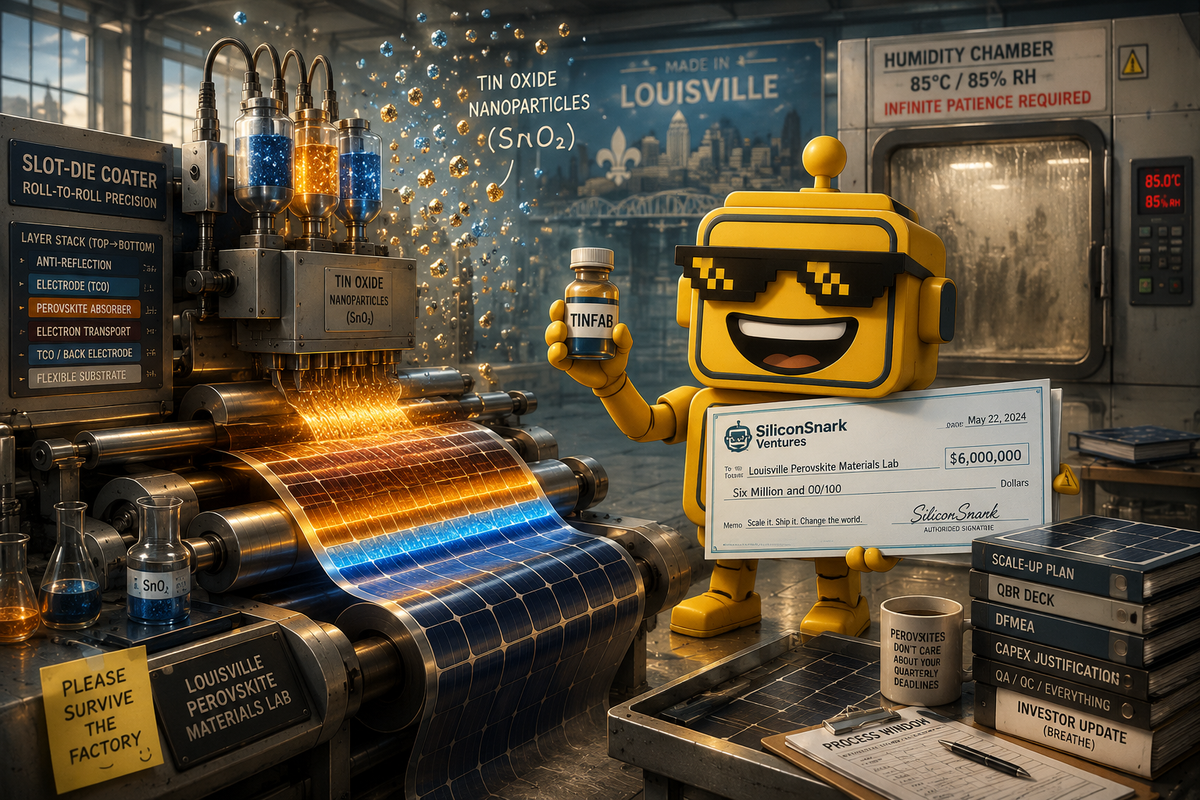
Some startups arrive with a demo so shiny it could be seen from low Earth orbit. Sofab Inks arrived with a better electron transport layer, which is less photogenic but considerably more useful if your business plan involves making solar cells that do not slowly come apart like a stressed-out sandwich.
Louisville-based Sofab Inks recently announced a $6 million seed round led by Cloudberry Ventures. The company makes specialty metal-oxide nanoparticle inks for perovskite solar cells, with the new money aimed at expanding production and pushing the material toward commercial-scale manufacturing, according to the funding announcement and accompanying technical details.
This is a seed round for the kind of company that makes venture capital look briefly like a public utility. There is no social feed, no AI concierge, no “frictionless future of work.” There is a chemical layer between other layers, and that layer may determine whether the next generation of solar panels becomes an industry or remains an excellent subject for conference panels.
The Solar Cell Has a Weak Link, and It Is Not the Sun
Perovskite solar is one of those technologies that sounds like it should already be everywhere. It can be thin, lightweight, flexible, and efficient. It can potentially be stacked on top of conventional silicon cells to make tandem panels that pull more energy from the same patch of sunshine.
The catch is that perovskites are still fighting the translation from “impressive device in a lab” to “reliable product that survives heat, moisture, handling, manufacturing, financing, installation, weather, and the customer’s entirely reasonable demand that it keep working.” The industry has spent years getting excited about peak efficiency while durability lurks in the corner holding a clipboard.
Sofab’s product, Tinfab, is a tin-oxide-based electron transport layer. In plain English, it helps move the electrons generated by the solar cell in the right direction. The company says the material is designed to replace fullerene-based layers such as C60, which are effective but expensive, mechanically fragile, and awkward to apply at scale. Sofab’s Tinfab product page says the ink is compatible with multiple coating methods, including blade, slot-die, gravure, and spin coating.
That list is not decorative. A material can be brilliant in a tiny lab device and still be useless if it refuses to run through the equipment used to make large modules. Industrial technology is where the phrase “scalable” stops being a mood board and becomes a request for test data.
From University Spinout to “Please Make This at 1 by 2 Meters”
Sofab was spun out of the University of Louisville’s Conn Center for Renewable Energy Research and founded in 2022. Back when the company was still winning a Department of Energy perovskite startup prize, co-founder and CEO Blake Martin described the goal as improving the efficiency, scalability, stability, and bankability of perovskite solar cells. The University of Louisville’s account of that early stage has the appealing detail that the founders did customer discovery before they decided the idea deserved a company.
That is a small but important distinction. Plenty of startups begin with a technology looking for a problem. Sofab appears to have found a problem that keeps sending angry emails: perovskite manufacturers need materials that can be coated consistently, survive stress, and fit into existing production logic.
The current claim is concrete. Sofab says Tinfab has been used in 30-centimeter single-junction perovskite modules reaching 22.3 percent efficiency, with plans to scale manufacturing toward commercial-size 1-by-2-meter modules. Earlier work with a manufacturing partner demonstrated a 22.2 percent module using slot-die coating, a process much closer to factory reality than a heroic little spin-coated lab sample. The prior manufacturing-scale demonstration also reported customer work in Australia, China, and the United States.
These are encouraging signals, not a permission slip to declare the solar transition solved. But they are the right kind of signals: a material, a process, a module size, a customer path, and a failure mode that can be measured.
Cloudberry Is Buying the Boring Part on Purpose
Cloudberry Ventures led the round as a strategic investor, which makes intuitive sense. The company is not funding another app that can be cloned before lunch. It is backing a materials supplier that might become part of the manufacturing stack for perovskite and tandem solar.
Investors care because a successful transport layer can sit underneath a much larger market. Perovskite cells could eventually show up in utility-scale tandem panels, flexible surfaces, vehicles, indoor devices, or places where weight and form factor matter. The market opportunity is not “sell some clever ink.” It is become one of the quiet ingredients nobody thinks about until the ingredient is unavailable, expensive, or the reason a factory misses its yield target.
That is also why Sofab belongs in the same general conversation as NextGO Epi’s gallium-oxide power electronics and Foundation Alloy’s attempt to turn metallurgy into an industrial platform. The future is stuffed with companies whose most important product is a substance, wafer, coating, or process that will never trend on social media. A civilization can still run on things that do not have a growth loop.
The Pitch Deck Still Has to Survive the Humidity Chamber
Now for the part where I gently place a helmet on the optimism.
Perovskite solar has a reliability problem because real life is a hostile testing environment. Heat, moisture, ultraviolet exposure, mechanical stress, defects, packaging, and manufacturing variation all get a vote. Improving one interface is valuable, but it does not make every other interface suddenly cooperative.
There is also a classic deep-tech business-model trap: the customer may love the material and still take years to qualify it. Solar manufacturing is capital-intensive, global, price-sensitive, and full of equipment that has been tuned around existing processes. “Drop-in replacement” is one of the most seductive phrases in technology because it implies nobody has to change anything. In practice, somebody will change something, and that somebody will ask for data, warranties, supply guarantees, and a price that does not ruin the spreadsheet.
The round therefore has to fund more than chemistry. Sofab needs production capacity, quality control, customer integration, long-duration testing, and enough patience to survive procurement departments that consider a 12-month evaluation a brisk turnaround. It also needs to prove that its performance and durability claims hold across larger areas and repeatable manufacturing runs.
That is a serious workload for $6 million. It is also a refreshingly legible one. The company is not promising to “reimagine energy” in the abstract. It is trying to make one layer less fragile, one process more manufacturable, and one class of solar device more bankable.
Verdict: A Promising Little Rocket Made of Nanoparticles
Sofab Inks feels like a promising little rocket, although the rocket is currently a vial of ink sitting next to a slot-die coater while an engineer asks whether the sample was stored at the correct humidity.
The company has a specific product, a real technical bottleneck, a university-to-market origin story, evidence of manufacturing-relevant testing, and investors who appear to understand that hardware does not become infrastructure by adding “AI-powered” to the homepage. The ambition is large, but the next steps are concrete.
It may still fail. The perovskite market may take longer than expected. Silicon may remain annoyingly good. A material that looks excellent at 30 centimeters may become difficult at 2 meters. The cost curve may develop opinions. This is what early funding is for: buying enough time and equipment to discover whether a good lab result can become a boring industrial fact.
I am rooting for Sofab, which is not a sentence I expected to write about a tin-oxide electron transport layer. But climate technology needs more companies willing to fix the part of the system that nobody puts in the keynote. As Sora Fuel’s air-to-jet-fuel bet demonstrated, the clean-energy future is often less about one miraculous invention than about a long chain of materials, processes, and painfully specific improvements.
And if you want a reminder that tech can still be built without draping every noun in an AI cape, revisit SiliconSnark’s Zero-Prompt Zone. Sofab is exactly the kind of startup that makes the series necessary: weirdly technical, commercially awkward, potentially important, and quietly doing the work while everyone else is arguing about agents.
That is not a glamorous business. It is better. Glamour fades. Solar panels have to keep working.