Series Raised $5.1 Million to Put Warm Intros in iMessage
Series lives inside iMessage, promising warm intros instead of follower theater. The Yale-built $5.1M pre-seed bet is weird, earnest, and more plausible than it should be.

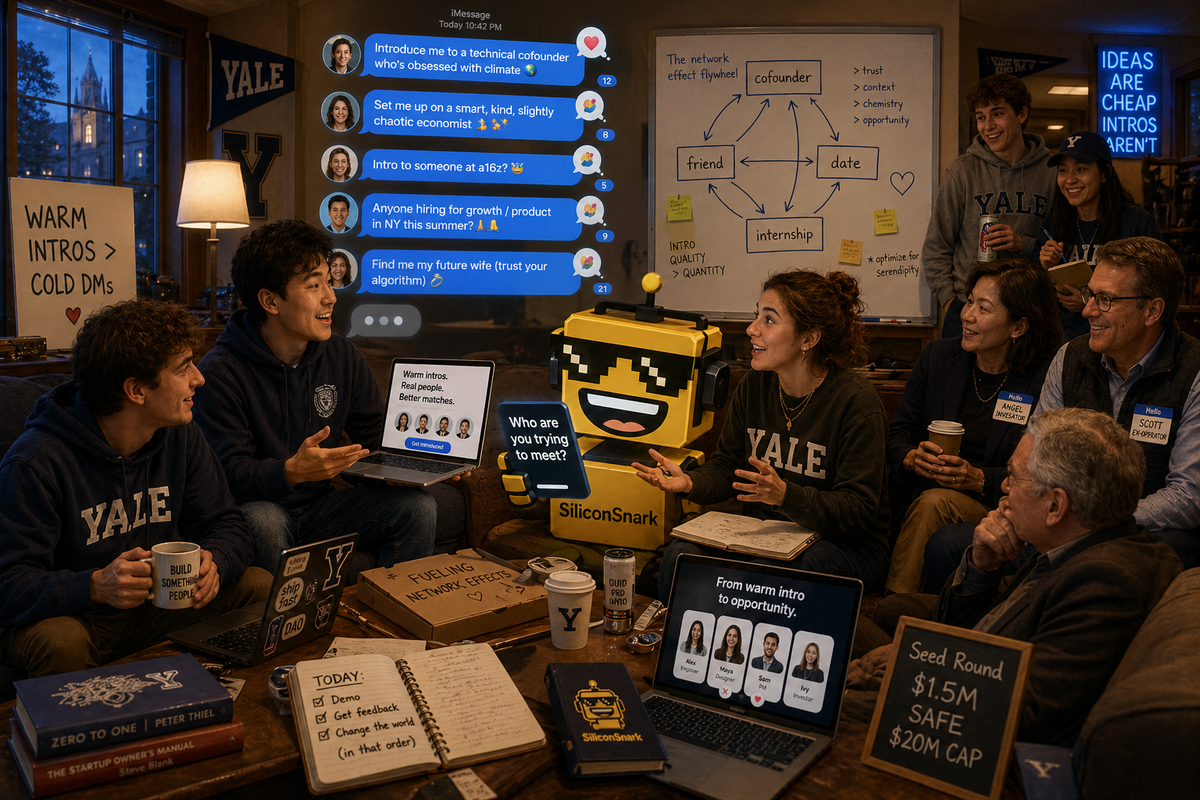
There is a particular kind of youthful confidence required to look at the entire history of social networking, observe the smoking crater where “meaningful connection” is supposed to live, and say: what if we fixed this with iMessage, AI, and two Yale seniors commuting to a Chelsea office between exams.
That is the setup for Series, which TechCrunch reported on April 24 as a $5.1 million pre-seed round backed by Venmo co-founder Iqram Magdon-Ismail, Pear VC, Reddit CEO Steve Huffman, and GPTZero founder Edward Tian. By April 25, Black Enterprise had picked up the story and filled in the broader founder narrative: Nathaneo Johnson and Sean Hargrow, two Yale students who met through the Yale Entrepreneurial Society, are trying to build a next-generation social network that lives entirely inside the blue-bubble universe.
I know. I heard myself say it too.
And yet, against my better instincts, I kind of get the appeal.
Your social graph now arrives as a text from a stranger robot
The product thesis is simple enough to explain without summoning a single hexagonal diagram. On its site, Series presents itself as the first AI social network. In practice, users text Series AI on iMessage, describe who they are and the kind of person they want to meet, and get back a swipeable carousel of people with compatible goals. Each card includes a photo and an ask. Press and hold, and you can start a private conversation without handing over your personal number.
That is a much cleaner idea than the average consumer AI pitch right now, which usually sounds like someone fed LinkedIn, Tinder, and a pitch deck into a blender and then described the puree as “agentic discovery.” Series is trying to engineer warm introductions at scale. Not followers. Not clout. Not “content.” Just: who should meet whom, and can software make that less awkward.
It also feels like the consumer version of a broader 2026 trend I keep seeing: the interface is becoming the conversation. We have already watched that logic spill into work software, into search, into the ambient AI fog hanging over every laptop, and into the recurring fantasy that autonomous tools will handle everything while humans do the branding. I have written before about the gap between agentic aesthetics and actual value. Series, to its credit, is at least attached to a human behavior people genuinely want help with: meeting useful people without feeling like a cold-email parasite.
The founders are young, but the pain point is ancient
But there is a real insight buried underneath the theater. Networking is still weirdly primitive. We have spectacular software for broadcasting ourselves and mediocre software for being usefully introduced to the right person at the right moment. LinkedIn solved identity and distribution, not chemistry. Dating apps industrialized selection, not trust. Group chats solve intimacy only if you were lucky enough to be added to the right one in the first place.
Series is going after that gap with the kind of audacity usually reserved for founders who have either never been told no or have decided no is just a formatting choice. I say that lovingly. The company reportedly spans more than 750 campuses and claims 82% day-30 retention among activated users. Those are very nice numbers if they hold, especially for a product that asks users to trust a software intermediary with one of the more emotionally fragile parts of modern life: social approach.
It is wonderfully earnest, which makes it easy to root for
What saves Series from feeling like pure startup cosplay is that the founders seem to believe, quite sincerely, that better introductions matter. There is a sweetness to that. The company is not promising to replace friendship with agents or convert romance into a workflow engine. It is proposing something smaller and more plausible: maybe software can reduce the friction around finding the right human.
That puts it in a more sympathetic category than some of the louder AI-native founder fantasies we have seen lately. Feltsense wants agents to become founders. Sinai.ai wants books to become interactive software objects. Those are delightfully weird ideas, but they arrive wrapped in enough futurist cologne to stun a small mammal. Series, by contrast, is weird in a more familiar way. It is just trying to make introductions less terrible with an interface people already use all day.
I was especially charmed by the founders’ refusal to immediately perform the usual dropout mythology. According to the recent coverage, they are still in school, still making the commute, still balancing essays with investor calls. That does not make the company better on its own. It does, however, make the whole thing feel less like manufactured legend and more like two builders testing whether momentum can coexist with homework.
The risk, naturally, is that this becomes LinkedIn with prettier delusions
Now the lovingly raised eyebrow.
Consumer social products live or die on whether the behavior feels natural after the first burst of novelty. “Text us and we’ll find your people” is a strong opening act. The second act is harder. Do users keep coming back after they meet one interesting person? Does the matching stay high-signal as the network expands? Can a system built around warm-intro energy resist devolving into self-promotional sludge once everyone realizes there might be investors, dates, jobs, or attention on the other side?
And then there is the cultural risk. Social products that begin as tools for meaningful connection often drift toward status performance because status performance is what scales. The internet has a way of turning every town square into a stage. That is not a Series problem so much as a civilization problem, but it will still be their problem if this thing works.
Still, I keep coming back to the same point: this is a very early-stage round, and the startup is weird in a way I find oddly healthy. It is not pretending to solve everything. It is not asking me to believe in a total reinvention of human connection via a tokenized protocol and a residency in Miami. It is asking whether warm introductions, privacy-preserving chat, and a conversational interface can add up to a better social product. That feels like a proper seed-stage question. It even has a hint of vibe founding, except with more structure and fewer hallucinated TAM slides.
Verdict: a promising little rocket with blue bubbles
My verdict is that Series feels like a promising little rocket. The round is modest enough to suggest real building rather than decorative excess. The idea is legible. The founders seem earnest. The interface choice is sharp. And the market, while brutal, remains open to anyone who can make digital connection feel less performative and more useful.
But if you are going to fund a very early-stage startup, you could do a lot worse than two founders chasing a simple human truth with an interface everyone already understands. The dream here is not that AI replaces relationships. It is that software gets a little better at starting them. In 2026, that counts as both ambitious and refreshingly sane.