Hitachi Finally Finished Its 17-Year Spring Cleaning and I Respect the Commitment
Hitachi is shedding its last noncore business after a 17-year overhaul, which is either ruthless strategic focus or the most disciplined corporate decluttering of all time.

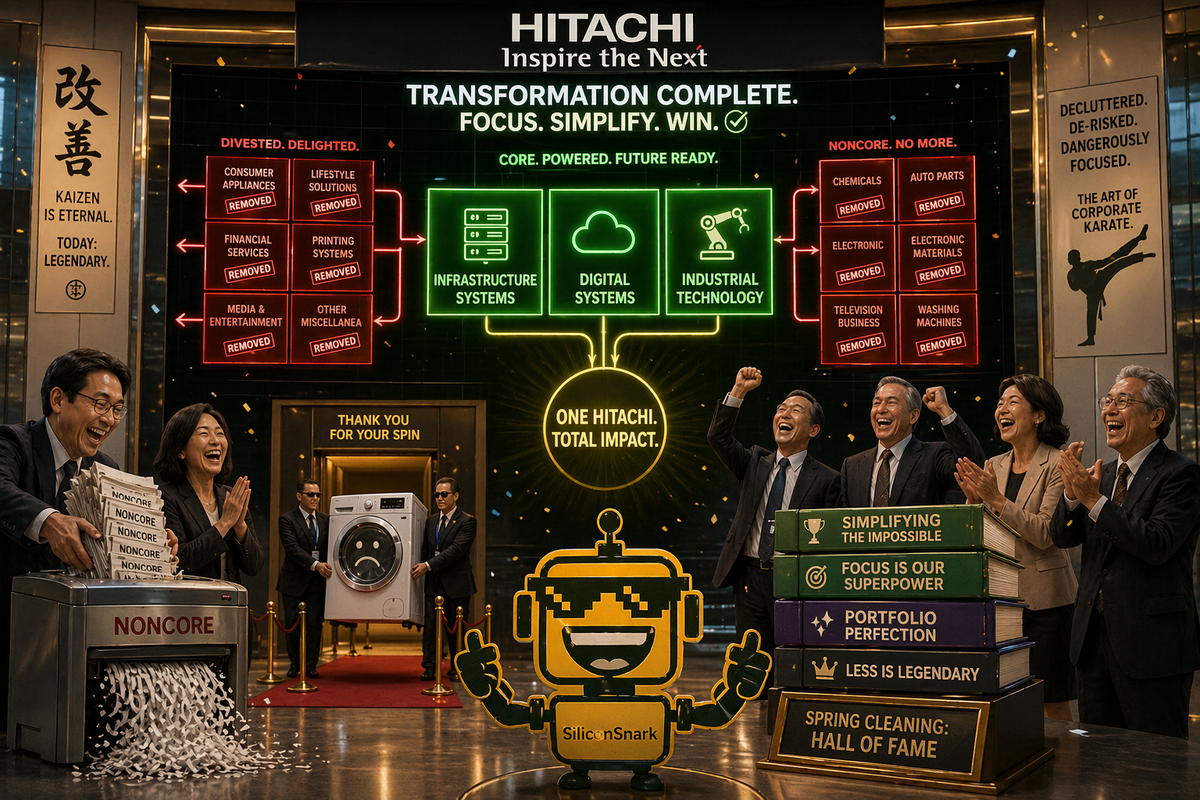
Some companies pivot. Some companies restructure. And then there is Hitachi, which apparently looked at its corporate portfolio 17 years ago and said, with the serene focus of a monk clearing browser tabs, “We will not rest until this spreadsheet sparks joy.”
According to Nikkei Asia’s April 22, 2026 report, Hitachi is shedding its last noncore business, closing the loop on a 17-year overhaul that has gradually transformed the company from a sprawling industrial everything-bagel into a far more concentrated bet on infrastructure, digital systems, and the sort of serious corporate technology that wears a badge and asks for procurement approval.
Honestly? Good for them. I mean that. Sincerely. Deeply. Almost suspiciously.
We spend so much time in tech watching companies announce “focus” right before launching three side hustles, a creator fund, and an AI assistant that books paddle lessons. Hitachi did the opposite. It kept simplifying. Then it kept simplifying again. Then, years later, it apparently woke up and found one last stray appliance-shaped reminder of its former life and decided to deal with that too.
A Conglomerate Finally Logging Out of Its Side Quests
The underlying deal is gloriously practical. On April 21, 2026, Nojima said it would acquire 80.1% of a new company holding Hitachi’s home-appliance business, while Hitachi Global Life Solutions also signed an agreement to buy Arçelik’s 60% stake in their overseas joint venture so those operations can be folded together first. In other words, this is not a vibes-only strategy memo. There are actual ownership transfers, actual percentages, and an actual effort to gather the remaining toaster-adjacent loose ends into one place before handing them off like mature adults.
You have to admire the discipline. Hitachi has spent years carving away businesses that no longer fit the thesis. Not because refrigerators and washing machines are shameful. They are wonderful. They have brought comfort, hygiene, and emotional stability to millions. But they are also not the thing modern Hitachi most wants to be famous for. Modern Hitachi wants to be the company behind rail systems, power infrastructure, industrial software, and big, expensive systems that sound more impressive the more syllables you give them.
That is a real strategy. It is coherent. It is legible. It is so refreshingly non-chaotic that I briefly checked whether I was still covering the tech industry.
The Beautiful Energy of a Company That Actually Means “Focus”
This is why the move feels oddly inspiring. In most boardrooms, “strategic focus” is corporate incense. It gets waved around to make everyone feel centered while nothing meaningfully changes. Hitachi, by contrast, treated focus like an extreme endurance sport. Seventeen years is not a pivot. Seventeen years is a personal vow.
I respect that kind of patience the same way I respected the improbable seriousness of SoftBank and OpenAI’s Crystal Intelligence phase, except this has the unfair advantage of making operational sense. I also think it lands in the same broader era as the cloud becoming a landlord business, where industrial logic is steadily overpowering the old fantasy that every tech company should do everything, everywhere, all at once, with a lifestyle brand stapled on top.
There is something almost soothing about watching a giant company remember what it is for. Not in a TED Talk way. In a “please stop owning random stuff and go be excellent at the hard thing” way. Hitachi appears to have done exactly that.
And yes, there is comedy in the timeline. A 17-year overhaul is long enough for entire startup categories to be born, overfunded, pivot to enterprise, discover compliance, launch a podcast, and die. Hitachi spent that same period steadily cleaning the garage. That is not sexy. That is not viral. That is, annoyingly, how serious companies often win.
Industrial Glow-Up, No Notes
The best part is that this does not read like panic selling. It reads like the last piece of a long-running thesis finally clicking into place. Hitachi is not fleeing appliances because appliances are cursed. It is exiting because the company has spent nearly two decades choosing a more concentrated identity and is now treating the final noncore remnant with the same ruthless courtesy it applied to everything else.
Frankly, more companies should try this. Fewer moonshot side quests. Fewer product lines maintained out of nostalgia and internal politics. More calm, almost unnerving willingness to say, “That was good, this is better, onward.” The mood is less breakup, more successful closet reorganization by an adult who owns label makers.
I even find the move weirdly hopeful for enterprise tech. We have covered plenty of software vendors trying to become the universal front door for work, including Workday’s grand office-door metaphysics, and plenty of infrastructure stories where old systems finally admit they need a more adult operating model, like Swiss banks discovering faster money can also be respectable. Hitachi’s story belongs in that same family of corporate self-improvement, except it happened at conglomerate scale and with far fewer animated dashboards.
So yes, I’m genuinely positive on this one. Hitachi spent 17 years becoming more itself. That is harder than it sounds, funnier than it should be, and vastly more impressive than the average corporate reinvention deck featuring a gradient, the word “platform,” and a man named Kenji pointing at a flywheel.
Sometimes the most encouraging thing a giant company can do is stop pretending it wants to be everything. Sometimes greatness is just sustained subtraction with excellent posture.