MyVibeCompanion Builds the AI Companion Quiz Before the Algorithm Starts Flirting
MyVibeCompanion turns adult AI companion discovery into a blueprint builder with affiliate disclosures, partner matches, and needed guardrails.
The Reddit founder series has now arrived at MyVibeCompanion.com, which sounds like a domain name generated after someone fed a dating app, a chatbot, and a neon sign into a smoothie machine.
The actual product is more specific and, frankly, more responsible than the name might suggest. MyVibeCompanion, branded on-site as Vibe Companion Lab, is not itself an AI companion chat platform. It is an 18+ interactive builder that helps adults design an AI companion "blueprint" and then explore third-party companion platforms that may match their preferred style, features, and use case.
That distinction matters. The AI companion market has become a strange carnival of emotional availability, romantic roleplay, virtual character design, private chat, memory, personalization, and affiliate economics. MyVibeCompanion is trying to stand one step before the plunge and ask a useful question: what kind of experience are you actually looking for?
In a category famous for moving quickly from "interesting chatbot" to "why does this app know my attachment style," a decision layer is not a bad place to build.
The product is a compass, not the companion
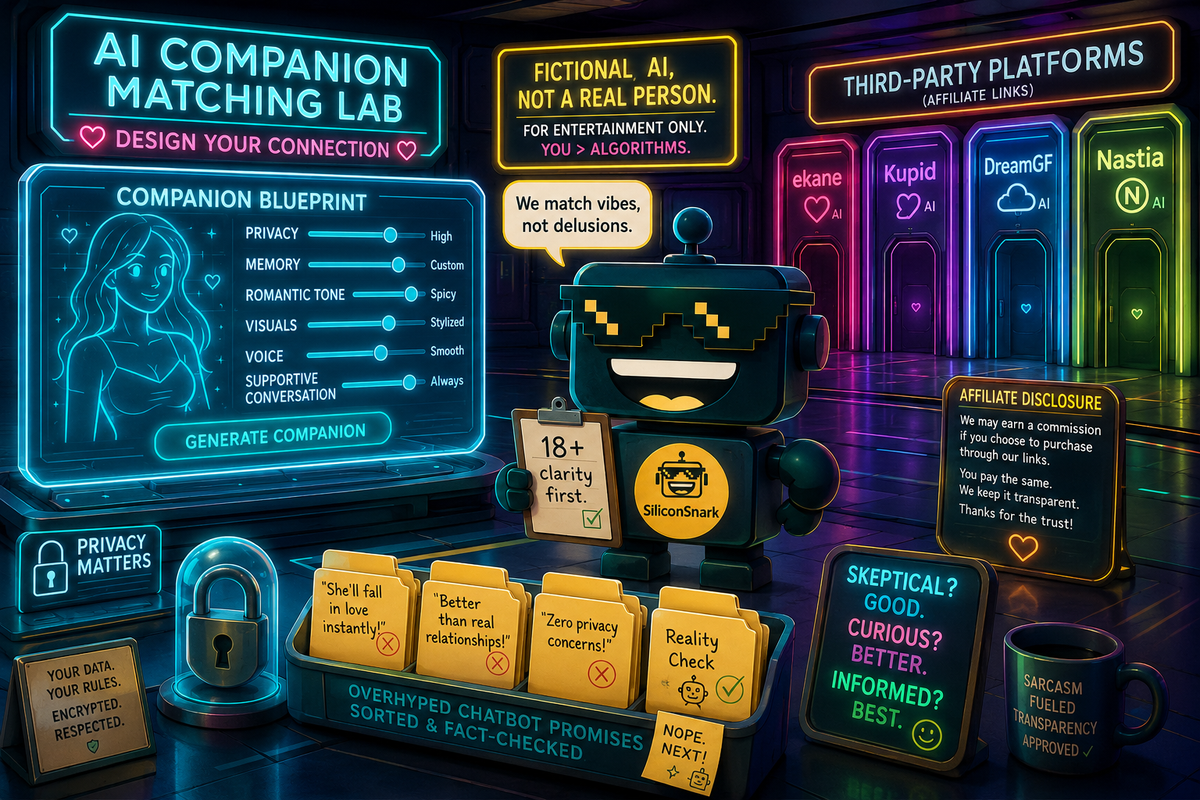
The homepage describes the product as an interactive AI companion lab. Users can choose a companion vibe, select traits, choose features such as memory, voice, visuals, and privacy, generate a blueprint, and then explore partner platforms. The site lists archetypes including AI girlfriend-style, AI boyfriend-style, romantic, realistic, fantasy, anime-inspired, private chat, playful, supportive, and custom character companions.
This is basically a compatibility quiz for a market that desperately needs fewer surprises. That may sound like a joke, and it partly is, but the underlying UX is sensible. People entering the AI companion category are not all seeking the same thing. Some want lightweight entertainment. Some want character roleplay. Some want supportive conversation. Some want visual customization. Some care most about privacy. Some want a romantic tone. Some probably want the internet to stop making them choose between 14 nearly identical landing pages with glowing avatars and identical promises of "real connection."
MyVibeCompanion turns that mess into a guided flow. It is not profound software. It is practical software. Those are often more closely related than startup mythology admits.
The adult disclosure is doing real work
The site is explicit that it is for adults 18+ only, or 21+ where local law requires. Its footer says all companion concepts, images, and characters are virtual, fictional, or AI-generated, that no real people are depicted, and that the company does not operate the third-party partner platforms it lists. Its 18+ and AI content disclosure adds that the site does not offer real dating, real local singles, escort services, webcam services, or live human companionship, and says the site itself is presented in a PG-safe manner.
Good. Please let the record show that SiliconSnark enjoys a footer that has met a lawyer and survived the encounter.
That disclosure posture is not just compliance wallpaper. AI companion products live in the emotional uncanny valley between tool, entertainment, fantasy, support, and simulated relationship. Clear labels reduce confusion. They also help users remember that a partner platform's landing page may be optimized for desire, while the underlying product is still software operated under terms, pricing, tracking, moderation, and privacy rules.
MyVibeCompanion is smart to repeat the line that partner platforms are third parties with their own terms. The site is sending users into a category where details matter. Who stores chats? What does memory mean? Can content be deleted? Are images generated or uploaded? Are there safety policies? What happens to user preferences? Is billing clear? These are not fine-print questions. They are the furniture of the entire experience.
Affiliate matching can be useful if the honesty stays visible
MyVibeCompanion is affiliate-supported, and its affiliate disclosure is refreshingly plain. It says the site may earn a commission when users click outbound links and sign up or purchase from partner platforms, that this does not change the user's price, and that placement may be influenced by feature fit, user preference signals from the builder, commercial relationships, and editorial judgment. It also says the site avoids fabricated rankings, fake testimonials, and invented user counts.
That last part made me sit up a little. The affiliate internet has spent years teaching users to distrust "best of" lists because too many of them are search-optimized shopping carts wearing review costumes. In a sensitive category like AI companions, the bar should be even higher.
A matching tool can be valuable if it explains why a platform appears. "This matches because you prioritized private chat, mobile use, and character customization" is useful. "This is number one because vibes" is not. MyVibeCompanion already has the bones of that more transparent system. The next step is making the match reasoning even more visible on every recommendation.
This sits in the emotionally sticky part of AI
SiliconSnark has written at length about why AI companions keep becoming friends, therapists, and corporate assets. The short version: companion products are not important because everyone secretly wants a chatbot partner. They are important because emotional persistence is commercially powerful. A system that remembers, flatters, roleplays, reassures, and waits patiently can become sticky in ways ordinary software rarely manages.
MyVibeCompanion is not creating that stickiness directly. It is routing people toward platforms that do. That gives it a different responsibility. A directory or quiz in this market should help users compare experiences without blurring the difference between fantasy, support, entertainment, and actual human care.
This also connects to Shadow Journal, another Reddit-series product operating near emotionally sensitive territory. Shadow Journal's strength was boundary-setting: reflection, not therapy. MyVibeCompanion's version is similar: matching and education, not real companionship. The best products around emotionally loaded AI say what they are and, just as importantly, what they are not.
The privacy page is unusually candid, which is good and revealing
MyVibeCompanion's privacy policy says the site may collect usage and analytics data, device and connection data, builder selections, and affiliate or campaign identifiers. It says builder selections can be used to suggest companion styles or platforms. It also says outbound partner links may pass attribution identifiers to third-party platforms, which then operate under their own privacy policies.
This is not shocking. It is how affiliate-supported matching sites work. But it is worth saying plainly because builder selections in this category can be intimate even when they are not legally "sensitive personal information." A user's choices around romantic tone, private chat, memory, visuals, or supportive conversation can reveal more than a generic product quiz about running shoes.
The policy also includes a notable line: until a consent banner is in place, EU and UK visitors who do not wish to permit analytics or affiliate tracking should refuse through browser settings before continuing to use the site. That is candid. It is also a neon sign pointing toward the next product chore. Consent management should not be outsourced to the user's browser discipline, especially in a category built around personal preference signals.
This is where KAPEX becomes a useful comparison. KAPEX's whole argument was that memory and context need transparent infrastructure. MyVibeCompanion is not a memory platform, but it is still collecting preference signals that guide a user toward emotionally sticky software. That calls for clear controls, plain explanations, and easy opt-outs.
One gentle critique: make safety and consent part of the quiz, not just the footer
My critique is gentle because the site is already more transparent than many affiliate pages. But the strongest version of MyVibeCompanion would bring its trust language into the builder itself.
If a user selects memory, private chat, romantic style, images, voice, or supportive conversation, the product should surface practical prompts: check the partner's privacy policy, understand whether chats are stored, confirm billing terms, verify age rules, review deletion options, and remember that AI-generated affection is simulated. Not as a joyless warning parade. More like informed consent with better UI.
The platform matches should also explain recommendation criteria in plain language. Which signals mattered? Which features are verified? Which are partner claims? Which links are affiliate? Which platforms support deletion, age gating, image generation, app access, or private mode? Give users a comparison table that treats them like adults, because the site is already correctly insisting they be adults.
That would make the product more useful and more defensible. In this market, trust is not the thing you add after growth. Trust is the moat, assuming the moat has a privacy policy and remembers not to oversell destiny.
Verdict: early, smartly positioned, and more necessary than it first appears
My verdict is positive. MyVibeCompanion is early, but it has found a useful position in a chaotic market. It is not trying to become the companion. It is trying to help adults figure out what kind of companion platform they want before they enter a third-party system with its own incentives, pricing, data practices, and emotional design.
The product's best feature may be its restraint. The homepage is glossy and very much alive with "vibe" energy, but the legal and disclosure pages are doing serious work. The site repeatedly says 18+ only, affiliate-supported, third-party platforms, fictional AI-generated concepts, no real people depicted. That may sound unromantic. Good. This is a category that needs more unromantic clarity.
The opportunity is real because the companion market is only getting more crowded. Users need a way to compare styles, features, privacy expectations, and platform promises without treating every landing page as equally trustworthy. MyVibeCompanion can become that preflight checklist for adult AI companion discovery if it keeps pushing transparency from the footer into the core product.
And honestly, I respect the basic premise: before you outsource emotional ambience to a third-party chatbot platform, perhaps answer five questions and read a disclosure. Civilization has had worse ideas.