
Massachusetts Business Builds Will Pay $2 Million for the Part After the Demo
Massachusetts opened $500,000-to-$2 million grants for climate-tech and life-sciences facilities, betting the next breakthrough needs actual machinery.

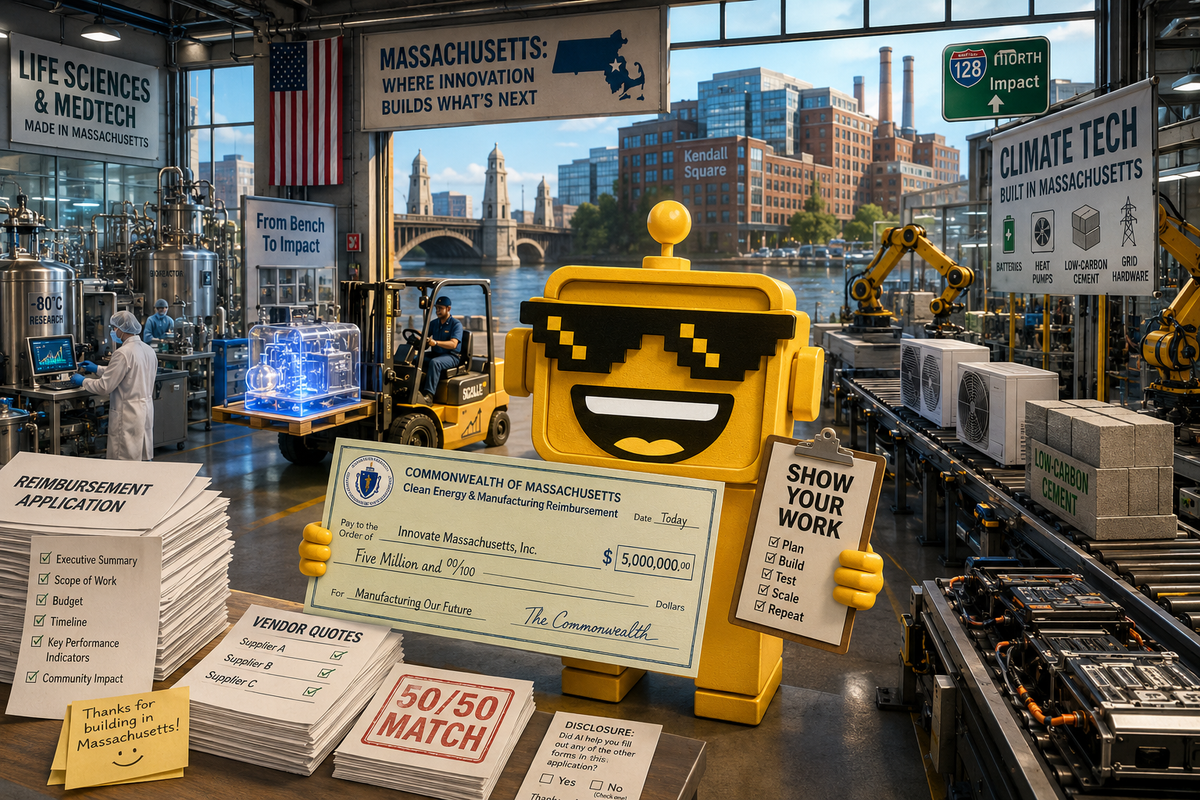
Massachusetts would like its innovation economy to proceed past the foam-core prototype.
On Monday, Aug. 24, the state opened two unusually tangible funding lanes for companies that need facilities, equipment, infrastructure, and the other industrial objects that cannot be summoned by adding “agentic” to a slide. The Massachusetts Clean Energy Center released its Business Builds: Climatetech program, while the Massachusetts Life Sciences Center began accepting applications for Business Builds: Life Sciences. Both offer capital grants ranging from $500,000 to $2 million. Applications are due Oct. 1.
This is not a single giant award announcement, nor has the Commonwealth placed a ceremonial hard hat on every founder between Kendall Square and Devens. It is a coordinated attempt to solve a real regional problem: Massachusetts is excellent at producing science, prototypes, and companies whose first product photo still contains lab tape. Scaling those ideas into repeatable manufacturing is slower, more capital-intensive, and much harder to fit inside a pitch-night drink ticket.
My verdict: this is a useful, serious ecosystem move. The money is modest relative to the cost of a commercial plant, the paperwork has achieved full Commonwealth density, and companies must bring their own capital. But the design correctly recognizes that the next breakthrough often needs a loading dock.
The Commonwealth Has Discovered Objects
The climate-tech program is aimed at for-profit companies building first-of-a-kind commercial operations or expanding and relocating established production. The examples are refreshingly physical: a battery company installing manufacturing lines, a low-carbon cement company building its first commercial facility, a grid company adding equipment for advanced transmission lines, or a heat-pump manufacturer moving final assembly here.
Those are examples, not announced recipients. That distinction matters. Monday’s news is the opening of a competitive RFP, not evidence that Massachusetts has already built four factories before lunch.
The climate-tech program guidelines make the bargain explicit. Applicants generally need to match the grant dollar for dollar. Eligible spending is capital spending: equipment, permanent installations, facility upgrades, new buildouts, and related construction. Ordinary operating expenses, working capital, travel, and salaries for non-capital work do not count. Awards are reimbursed after approved costs, on 45-day cycles.
Strong applications are expected to look like genuine expansions—roughly 50 percent or more job growth or more than $10 million in capital investment are cited as benchmarks—although smaller projects may still apply. Projects outside Route 128, in Gateway Cities, or in rural communities can score better. In other words, the state is not merely asking whether the technology is impressive. It is asking where the machines go, who gets hired, whether the financing exists, and what happens to the building afterward. Somewhere, a Boston founder has just learned that “Massachusetts-based vendor quotes” is the sequel to product-market fit.
Biotech Gets a Factory-Shaped Reminder
The life-sciences lane, formerly called BioBoost, applies the same basic logic to biomanufacturing and advanced medtech manufacturing. Companies of any size can seek money for facility buildouts, renovations, equipment, and infrastructure. The program favors projects that create broader public benefits through workforce training, access or discounts for smaller local companies, and nonprofit collaboration.
That focus is sensible because Boston biotech’s technical victories do not end when a molecule behaves in a dish. They move into process development, clean rooms, quality systems, cold storage, sequencing, inspection, and production. SiliconSnark recently looked at Azenta’s deeply uncinematic sample-management machinery, which is exactly the point: the glamorous science depends on an enormous supporting cast of equipment that remembers where everything is.
The region keeps trying to industrialize hard biology. Moderna’s in-vivo CAR-T bet is partly compelling because it imagines turning a bespoke cell-therapy process into something more scalable. A state grant will not solve biological uncertainty or make regulation disappear. It can, however, help buy the rooms, utilities, and machines required to find out whether a process survives repetition.
The Missing Middle Has a Forklift
Massachusetts likes to describe itself as an innovation leader, a phrase that has now been polished smooth by a thousand podiums. The more useful question is whether locally invented technology can remain local while it becomes an industry.
That challenge is visible across the ecosystem. Foundation Alloy raised $22 million to add Massachusetts metals-production capacity. Apollo Atomics is using fresh financing for testing and manufacturing capacity. These are private bets, not beneficiaries of the new round. They illustrate why the program exists: hard-tech companies can prove a device works and still face a brutal financing canyon before it becomes reliable, certified production.
The state calls this the “missing middle,” and for once the economic-development phrase describes an actual missing thing. Venture capital often prefers fast growth and flexible assets. Banks prefer collateral and predictability. First commercial facilities offer neither. They are expensive evidence-generating machines with a habit of discovering that the electrical service, ventilation, tooling, or supplier qualification was the real boss battle.
The grants descend from the Mass Leads Act, the nearly $4 billion economic-development law signed in 2024. The broader Business Builds program already funds facility expansion across sectors; the two Aug. 24 openings organize dedicated routes for climate tech and life sciences. That coordination is important. Massachusetts is treating industrial scale-up as shared economic plumbing rather than expecting every agency to invent a new intake form with its own spiritual interpretation of “shovel-ready.”
Bring Matching Funds, Vendor Quotes, and Your AI Confession
There are limits. A $2 million maximum is meaningful, but it is not a factory in a tasteful state-branded envelope. The climate program’s 50/50 match means the applicant needs real financing, and reimbursement means it also needs enough liquidity to spend before the state pays. That naturally favors companies already capable of assembling capital, documents, and patience.
The selection criteria do at least demand public value: jobs, workforce development, environmental benefits, local supply chains, infrastructure, and long-term presence. The climate program also prioritizes projects outside Route 128 and asks recipients to maintain job commitments for years after the grant period. Public money should come with more than a logo wall and a press release featuring seven people holding one novelty check.
And because this is Massachusetts in 2026, the RFP requires applicants to disclose any planned use of generative AI in preparing the application or performing the work. MassCEC says it may use detection tools, linguistic analysis, or verification methods to evaluate submissions and can reject undisclosed uses. This produces the delightful possibility that a climate-tech company will use an AI assistant to explain how it plans to install a robotic manufacturing line, then complete a separate form acknowledging that the robot helped describe the robots.
The clause is overcautious in the specific way public institutions become overcautious around new software. It is also defensible. Grant reviewers need to know whether technical claims, budgets, and project plans came from accountable humans or from a text generator that regards permitting as a genre of speculative fiction.
Verdict: Less Innovation Theater, More Three-Phase Power
The strongest thing about Business Builds is what it does not pretend. These grants do not guarantee commercial success, erase execution risk, or prove that every Massachusetts laboratory deserves a production line. They pay for part of the unglamorous transition from technical possibility to industrial capability, then require matching capital and measurable public benefit.
That matters outside Massachusetts because the prototype-to-production gap is national. The United States can produce excellent research and still discover that the factory, tooling, workforce, supplier base, and certification path live somewhere else. Climate technology and life sciences are especially unforgiving: software can ship a patch; a cement kiln, bioreactor, or medical-device line expects you to have done the homework before installation.
So yes, this is a promising experiment in targeted industrial policy, delivered in the traditional Bay State dialect of forms, scoring criteria, and an informational webinar. The grants are not enormous. The constraints are real. But the judgment underneath them is right. Boston’s innovation economy does not need another reminder that it is clever. It needs more places where clever things can be made twice.