
Intel Is Teaching SteamOS to Use the GPU It Already Bought
Intel is adding XMX-accelerated XeSS to Proton, potentially making Arc handhelds faster on Linux. The upgrade is smart, unfinished, and gloriously invisible.

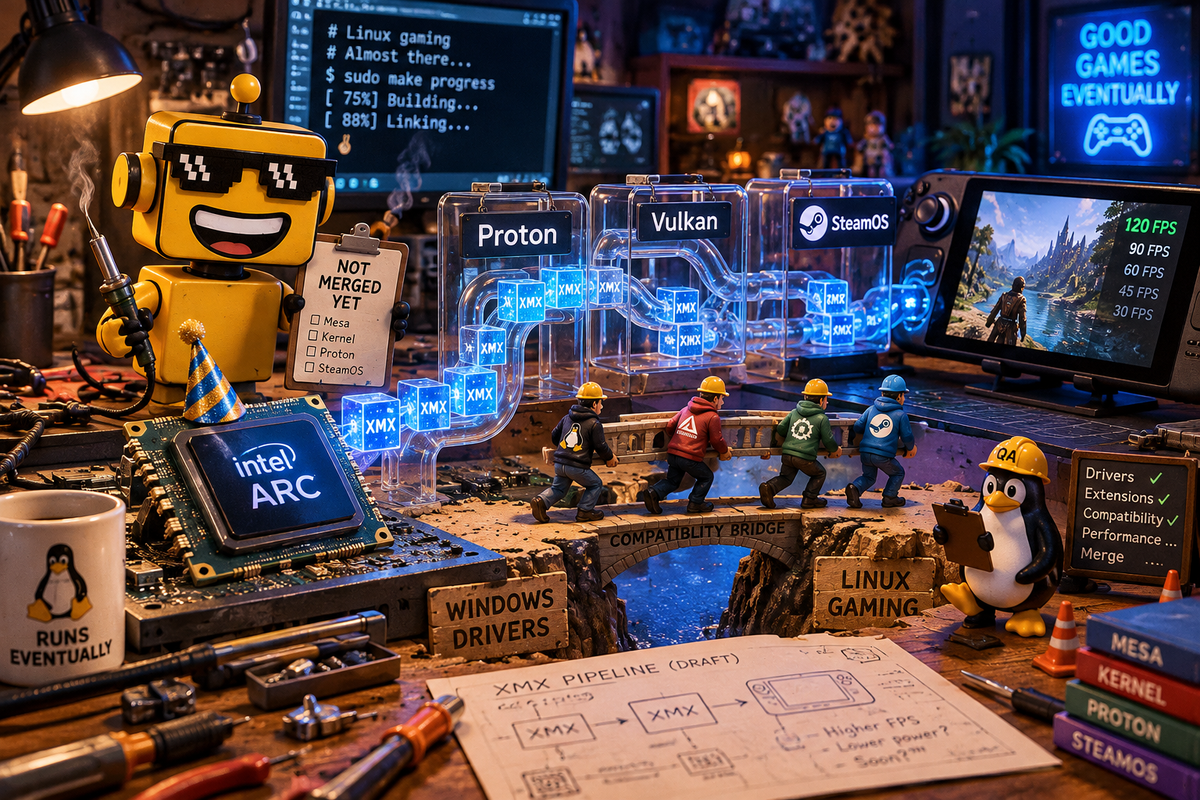
Some gaming launches arrive with a trailer, a price, and a man standing beside a giant illuminated logo. Intel’s latest gaming launch arrived as four pull requests, a compatibility-layer ticket, and the quiet hope that your handheld will stop leaving performance on the floor.
On October 19, an Intel engineer opened a set of changes aimed at bringing XMX-accelerated XeSS to Valve’s Proton, the translation layer that lets Windows games run on Linux. The work was reported by Phoronix on October 19 and by GamingOnLinux on October 20. None of this is merged yet, which is the Linux gaming equivalent of saying, “The restaurant has received the ingredients.”
But the ingredients are good. Intel’s Arc graphics have dedicated XMX matrix engines designed for the AI calculations behind XeSS, its image-upscaling system. Under Proton today, Intel hardware can fall back to a slower DP4a path instead. The new work would let the game’s Direct3D 12 calls reach Intel’s native Linux XeSS library, with Vulkan doing the translation in the middle. In other words, Intel is trying to make the hardware’s expensive little brain cells available to the operating system that currently asks them to wait in the lobby.
The Best Gaming Upgrade Is Apparently a Four-Repository Group Project
XeSS is Intel’s answer to Nvidia DLSS and AMD FSR: render a game at a lower internal resolution, then reconstruct a sharper image so the GPU can spend fewer resources drawing every pixel at full price. On a handheld, that trade is not academic. You are balancing a small battery, a modest thermal envelope, a screen that may be 1080p or higher, and a game engine that would happily turn a six-watt computer into a space heater.
Intel’s own XeSS developer guide describes both a cross-vendor implementation and an Intel-optimized implementation for Arc and Iris Xe graphics. The XMX route is the latter: the version that uses the silicon Intel built specifically for matrix-heavy workloads instead of the broadly compatible fallback. That is a meaningful distinction, especially for Arc G-Series handhelds, where Intel is selling XeSS 3, frame generation, and low latency as part of the platform story.
The awkward part is that a game running through Proton is not simply “a Windows game on Linux.” It is a stack of translations wearing a trench coat. Direct3D 12 becomes Vulkan through vkd3d-proton. Other graphics paths can involve DXVK. The game may ship its own XeSS library. Proton may need to supply one. The driver has opinions. The hardware has opinions. Somewhere, a developer has named a compatibility variable in all caps and is now emotionally attached to it.
The proposed changes acknowledge that reality. One adds a built-in libxess.dll that forwards D3D12 calls to Linux’s libxess.so. Another enables the Vulkan features XeSS requires. A DXVK change stops hiding Intel GPU identification when Proton provides XeSS. The final Proton change makes the native library available when it exists. This is not random feature confetti. It is the minimum number of bridges required to cross a river that the PC industry keeps insisting is a sidewalk.
Arc Handhelds Have Been Carrying a Secret Disadvantage
The immediate audience is small but unusually motivated: people with Intel Arc graphics cards, Intel Arc G-Series handhelds, and enough interest in Linux gaming to know why a shader cache is both useful and a personal insult.
Intel’s Arc G-Series messaging is aimed directly at portable PCs. The company describes the chips as purpose-built for handheld gaming, with up to Arc B390 graphics, ray tracing, XeSS 3, controller-first Xbox Mode, and precompiled shaders. That is an appealing bundle. It says: here is a compact machine with dedicated graphics tricks and a software layer that might let you play without negotiating with Windows before breakfast.
The snag is that the Linux version of the story has not been getting the whole sandwich. A long-standing Proton feature request explains the old problem plainly: XeSS on Intel hardware could use the DP4a fallback, which is slower and potentially lower quality, while the XMX-optimized path remained out of reach. The new patches are an answer to that request, opened by an Intel engineer rather than a forum user with three monitors and a heroic tolerance for compiling things.
If the work lands cleanly, an Arc handheld running SteamOS could get more of the performance Intel has been advertising on Windows. That does not mean an instant frame-rate miracle. It means the upscaler can use the hardware it was meant to use, which is a lower-level and more credible improvement: finally stop taking the bus.
Proton Is Becoming the Console Layer, One Weird Fix at a Time
This is also a sign of where PC gaming is heading. Valve’s Proton began as a compatibility project, but on Steam Deck and other Linux handhelds it increasingly behaves like a console operating system with a large, unruly back catalog. The player does not want to know whether the frame was produced by D3D12, Vulkan, Wine, DXVK, vkd3d-proton, or an engineer’s last remaining nerve. The player wants to open the game and see the right number in the corner.
I wrote about Microsoft’s Windows-as-Xbox front end because the same transition is happening above the graphics stack: launchers are becoming consoles, and the operating system is becoming part of the gaming experience. Intel’s Proton work is the subterranean version. It is not trying to make Linux look like Xbox. It is trying to make the rendering pipeline disappear.
There is a similar lesson in GeForce NOW becoming official on Linux: the platform is valuable when it handles the infrastructure instead of presenting the infrastructure as a personality test. Proton is doing the same thing locally. Its best work is invisible, until the missing piece makes a game stutter or a feature fail.
The Catch: This Is a Patch, Not a Victory Lap
Let’s keep the confetti in the drawer. The four changes are not merged. Valve has not announced a release date. Intel has not published a benchmark showing how much faster XeSS becomes on a specific Arc GPU under Proton. Game implementations vary, drivers vary, and a compatibility layer can turn “works in the demo” into “works after you install Proton Experimental and sacrifice a weekend.”
There is also the familiar upscaling problem: higher output frames do not automatically mean better-feeling games. Reconstruction can introduce ghosting or shimmering, and frame generation can add smoothness without improving input response. The GPU can produce a more beautiful lie, but it remains a lie with latency attached.
Still, the direction is right. Intel is not launching another dashboard, subscription tier, or AI assistant that wants to explain your own settings menu back to you. It is repairing a specific gap between its hardware, its graphics software, and a platform people increasingly use for handheld gaming. The plumbing is the point.
Verdict: Intel’s XMX-on-Proton work is a niche flex today and a potentially important quality-of-life upgrade tomorrow. It will not turn every Arc handheld into a Steam Deck killer, because “Steam Deck killer” is a phrase that has already survived too many product launches to be trusted. But it could make Intel’s portable graphics story more honest on Linux: the performance features are not merely present in the brochure; they are finally being invited into the room.
That makes this a real hit for the people it reaches, and exactly the kind of invisible engineering that makes PC gaming feel less like maintaining a private datacenter. I mean that as both a joke and a compliment.