DumbTV Lets an AI Agent Evict the Ads From Your Television
DumbTV strips ads, tracking, and bloat from Fire TV and Android TV. It’s clever, reversible, and still a ten-minute trust exercise.

The most futuristic thing you can do to a television in 2026 is make it stop behaving like a technology company.
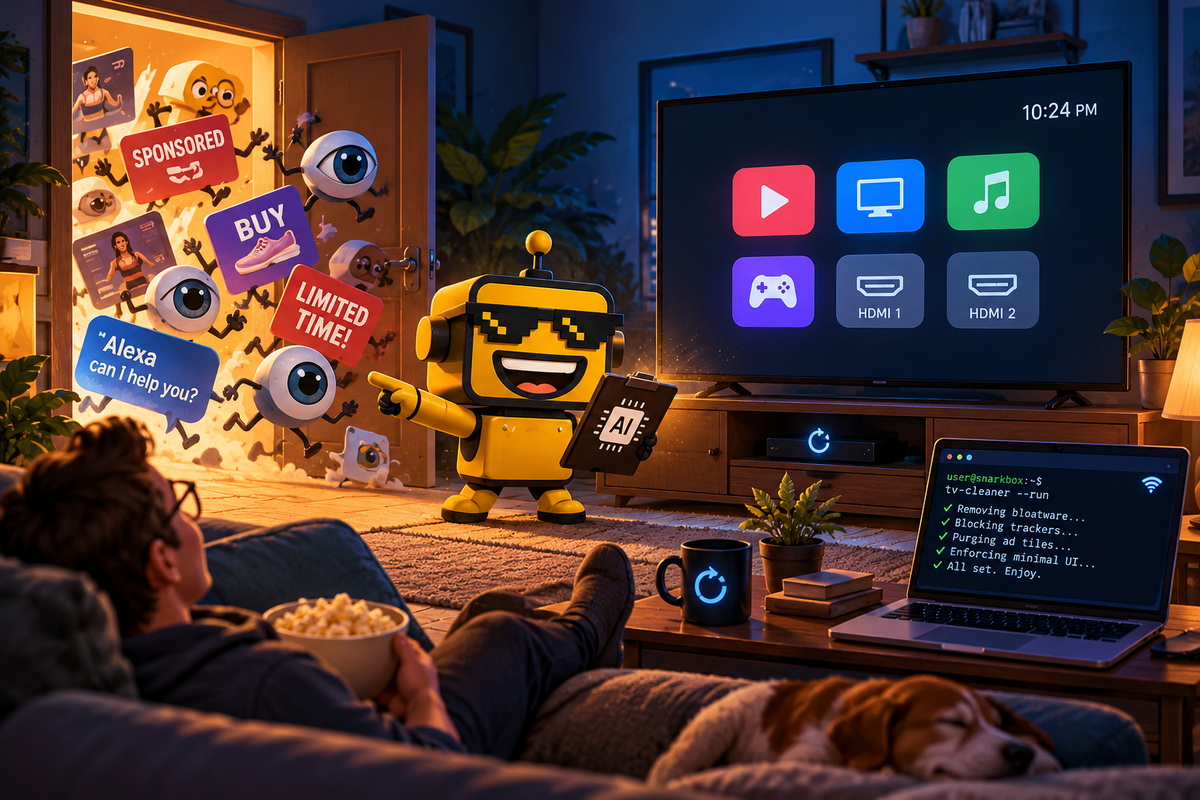
No sponsored row. No promotional screensaver. No analytics package quietly taking attendance while you watch a detective explain murder to a small English village. Just your apps, your HDMI inputs, and a clock. It is the user interface equivalent of walking into a casino, turning off every slot machine, and discovering the carpet was ugly on purpose.
That is the pitch behind DumbTV, an open-source toolkit introduced by developer Muzzammil Yasin Sabuwala on October 18. You point an AI coding agent at the project, connect a compatible TV over Android Debug Bridge, and let a carefully documented set of scripts remove advertising, tracking, experiments, voice-assistant baggage, and other software barnacles. The result is a deliberately plain home screen that opens quickly and appears to have no interest in monetizing the fact that you own a couch.
I have reviewed AI necklaces, household robots, and speakers that want to understand natural language. DumbTV may be the first consumer AI launch whose highest ambition is to leave you alone. I mean that as both a joke and a compliment.
The Agent Has Been Hired to Fire the Television
The underlying problem is wonderfully concrete. Smart TVs are inexpensive partly because the screen is no longer the entire business. The home page can sell placements. Automatic content recognition can identify what is playing. Usage data can feed advertising systems. Updates can add features you did not request with the warm confidence of a landlord repainting your kitchen while you are eating dinner.
We have seen this tension before. When I looked at LG’s role in Apple’s smart-home expansion, the awkward question was whether a company that explains optional viewing-data collection on one household screen should also be welcomed near the doorbell. DumbTV answers the TV half of that question with the subtlety of bolt cutters.
According to the project’s unusually candid documentation, the full treatment can disable roughly 65 Fire OS packages tied to screen fingerprinting, ad IDs, sponsored rows, watch-time analytics, experiments, Alexa, promotional screensavers, and update services. It can apply privacy settings, install an on-device DNS filter for known telemetry endpoints, and replace the stock launcher with a 45-kilobyte home screen that has no internet permission. YouTube and VLC stay. Prime Video can stay. The television keeps doing television things, which is a surprisingly radical product requirement.
The AI agent is not supposed to freestyle through the operating system like an intern with administrator access and a motivational podcast. The repository includes an AGENTS.md contract, platform data, a device catalog, ordered scripts, dry-run modes, confirmation prompts, a hard-coded list of packages that must never be disabled, and recovery instructions. The agent is closer to an installation concierge than an autonomous hacker. That distinction is doing a lot of work, but it is the right work.
Ten Minutes, Two Reboots, and One Mild Identity Crisis
The setup is still not consumer-simple. You need a computer with ADB, the TV and computer on the same network, Developer Options enabled, and enough emotional stability to type an IP address into a terminal. The documented process takes about ten minutes and reboots the TV twice. This is not “scan a QR code while the app discovers your lifestyle.” This is “click the device name seven times until the appliance admits it has a developer mode.”
For Fire OS and Android/Google TV sets, the project can debloat the system, replace the launcher, and run its DNS filter. The repository lists Sony, TCL, Philips, Hisense, Xiaomi, and Nvidia Shield among the Android/Google TV family, while noting that its complete end-to-end test was performed on a Fire TV Edition set running Fire OS 7. Samsung, LG, Roku, VIDAA, Vizio, and some other platforms do not expose the same shell access, so DumbTV cannot perform the full exorcism there; the fallback is router-level blocking or booting directly into HDMI.
That uneven support is not a flaw the project can prompt away. It is the product category. Television software is a magnificent archipelago of signed boot chains, vendor forks, protected packages, mysterious settings panels, and remotes with dedicated buttons for services you have never subscribed to. Our deep dive on the assistant reboot made the same larger point: the smart home is less an ecosystem than a family reunion where everyone brought a different charger.
DumbTV deserves credit for documenting the boundary instead of decorating it. It does not replace the operating system, unlock the bootloader, write to the protected system partition, or survive a factory reset. It says so plainly. “We cannot safely do that” is one of the rarest and most attractive features in modern AI.
Reversible, Except for the Parts Called “Delete”
The safety design is the genuinely smart part. A preflight script records the original settings before anything changes. A configuration step asks which apps you want to keep. A restore script puts package states, permissions, network rules, and settings back the way it found them. Every major script supports a dry run, and the full pass asks for confirmation before acting.
There are caveats. Apps stored in the writable data partition can be deleted rather than merely disabled, so restoring those means downloading them again. Anything you uninstall manually afterward is not magically resurrected. Blocking update servers may also become its own maintenance decision when security fixes arrive. Privacy and control are appealing; turning your TV into a tiny self-managed infrastructure project is less relaxing than the home screen makes it look.
TechCrunch’s reporting on the wider “dumb TV” trend found both enthusiasm and warning signs: people have used agents to build faster launchers and remove packages, but some users reported broken setups and at least one claimed to have bricked a TV. Sabuwala said DumbTV itself was developed with DeepSeek V4.1 Flash, Claude Opus 5.5, and Claude Sonnet 5.5. There is something wonderfully circular about multiple frontier models collaborating to produce a screen with six icons and a clock.
This is where DumbTV is better than the viral prompt “Can you hack this?” Its value is not that an agent can issue ADB commands. Its value is that a human wrote down what must happen before, during, and after those commands so the agent has fewer opportunities to become a cautionary screenshot.
The Best Smart Home May Have Fewer Opinions
I am usually sympathetic to smart-home products when the intelligence removes a ritual. Google’s attempt to make the home speaker understand ordinary speech is useful because people should not have to address furniture in command-line haiku. Ring’s hand-cranked emergency unlock is useful because batteries die in weather, regardless of the roadmap.
DumbTV removes a different ritual: waiting for a screen you purchased to finish presenting its commercial priorities before showing yours. That makes it an excellent consumer idea trapped inside a hobbyist installation. The demand is mass-market. The method is not.
My verdict is that DumbTV is a convincing niche hit and a beautiful rebuke to the smart-TV business model. It is free, transparent, extensively guarded, and focused on a real annoyance. It does not pretend an LLM has discovered a new way to watch movies. It uses AI to make an existing machine quieter, faster, and more obedient.
I would not hand it to every parent with a television and say, “Enjoy the terminal.” I would recommend it to technically comfortable Fire TV and Android TV owners who understand the recovery path, can tolerate platform-specific wrinkles, and have reached the stage of sponsored-row fatigue where enabling developer mode feels restorative.
The grand irony is that DumbTV needs some of the most fashionable technology in the industry to restore one of the oldest relationships in consumer electronics: you press a button, the screen shows what you asked for, and nobody in the room tries to build an advertising profile from the encounter. The future is here. It has fewer tiles.