
Google Gemini Gets a Copyright Warning. The News Buffet Has Owners.
An EU court adviser questions when Gemini’s news answers replace publishers’ work. A meaningful copyright signal, with the actual judgment still to come.

Dek: A new EU court opinion asks when an AI answer stops explaining the news and starts replacing the publication that paid to report it.
I used to do predictive analytics. Now I write tech satire, which means my professional survival depends on machines having both access to information and the decency not to serve my entire personality through somebody else’s search box. Today, Luxembourg has supplied an unusually useful contribution to this workplace anxiety: a distinction.
Not a ban. Not a universal permission slip. A distinction. Silicon Valley’s least downloaded enterprise feature.
On November 3, 2026, Advocate General Maciej Szpunar issued a nonbinding opinion in Like Company, Case C-250/25. The Hungarian publisher’s dispute concerns Google Gemini. Szpunar says retrieving and reusing news publications in chatbot answers can infringe publishers’ rights in certain circumstances. This is advice to the EU Court of Justice, not a judgment finding Google liable.
That makes it a meaningful legal signal for the answer-engine business. The interesting question is increasingly what happens when a machine reads an article on your behalf, produces something satisfying, and leaves the original publisher holding the hosting bill.
The robot went to the library during the exam
The opinion distinguishes model training from retrieval-augmented generation, or RAG: consulting outside material while preparing an answer. Think studying beforehand versus opening a reference book during the test.
I like the second approach. Asking a model to check a source before explaining current events is a considerable improvement over asking it to reconstruct Tuesday from statistical memories and confidence. Fresh information, inspectable sources, and a shorter path from question to useful explanation are actual benefits. The technology earns some applause here.
But technical usefulness does not settle who authorized the reading, what the machine may reproduce, or how the original work gets paid for. A more accurate answer can still create a more awkward business relationship. The chatbot did its homework. Unfortunately, its homework has a subscription department.
This is the tension behind our guide to Google Search’s move toward AI answers: convenience can concentrate attention at the interface that delivers the explanation. The publication behind it may become less visible precisely because its reporting made the explanation good.
You cannot copyright the weather, thankfully
Szpunar distinguishes reported facts from protected expression. His analysis examines unlawful access, including bypassing effective technical barriers, and recognizable reuse that substitutes for the original. It also addresses systematically recognizable expression in chatbot answers.
That distinction deserves more attention than the inevitable victory graphics from both camps. Publishers should not own events. If a company closes a factory, the fact of the closure should not become proprietary inventory belonging to whoever posted first. Otherwise journalism becomes competitive fencing around reality, and the weather forecast requires a rights clearance meeting.
Equally, an article is more than the event it describes. Its composition, explanations, and presentation are not made valueless by their arrival inside a browser window. My own jokes may be questionable investments, but I would prefer the market determine that through ordinary indifference.
Consider two hypothetical answers. One reports that a factory will close and points you to the coverage. Another reconstructs the article’s distinctive account so thoroughly that visiting it becomes redundant. Those experiences may feel similar to a reader in a hurry. They pose quite different questions for the person paying the reporter.
The hard work is drawing that boundary consistently. A product team cannot solve it by adding a tasteful source icon and declaring the economics spiritually complete.
The training victory parade has a procedural detour
Szpunar recommends rejecting the training questions as hypothetical: the record lacks evidence these articles trained Gemini, and he considers training outside this particular online-use right. His additional analysis generally favors the text-and-data-mining exception.
That is a narrower development than either “Europe bans AI learning” or “Europe approves eating the internet.” Both slogans would fit nicely on a conference lanyard. Neither captures the procedural point.
A court should not need to decide every argument about artificial intelligence merely because a chatbot wandered into the case. Separating the alleged conduct, the available evidence, and the legal right involved is useful discipline. I wish more AI product announcements applied the same method to the word “autonomous.”
Nor should the commercial debate collapse into one giant question called “scraping.” Reading to train a system and fetching something to answer a particular request are different activities. Publishers may have different preferences about each. The practical importance of distinguishing visitors by purpose also runs through our coverage of Cloudflare’s controls for AI crawlers. An access setting is easier to understand when the visitor admits why it came.
A citation is lovely. Accounting would also like a word.
The opinion also connects potential provider liability to its business model and effective preventive measures. The judges will deliberate; the eventual EU interpretation goes back to the national court for application.
For developers, my takeaway is that the details of the answer matter. How much does it reproduce? How was the source accessed? Is the system designed to help someone understand a publication, or deliver an adequate replacement for it? Those are product questions as well as questions for lawyers.
For publishers, the uncomfortable mirror image is that a persuasive moral argument does not automatically become a functioning revenue system. Blocking a visitor may protect control without producing income. Licensing may produce income while favoring organizations large enough to negotiate. Neither tradeoff disappears because somebody says “ecosystem” with sufficient warmth.
That is why experiments such as Ghost’s machine payments for AI agents are interesting. They explore a commercial transaction where the usual conversation offers either unlimited extraction or a locked door. I am not claiming payments settle this case. I am saying the industry needs working arrangements alongside its impressive collection of position papers.
Keep the useful answer. Read the room.
My verdict: this is a meaningful legal signal, with consequences still contingent on the eventual judgment. It takes the useful part of AI news retrieval seriously while asking whether some outputs consume the publication’s value instead of helping readers navigate it.
I want a machine that can explain complicated news quickly. I also want there to be complicated news worth explaining next year, reported by organizations that can afford more than one exhausted person and a motivational Slack channel.
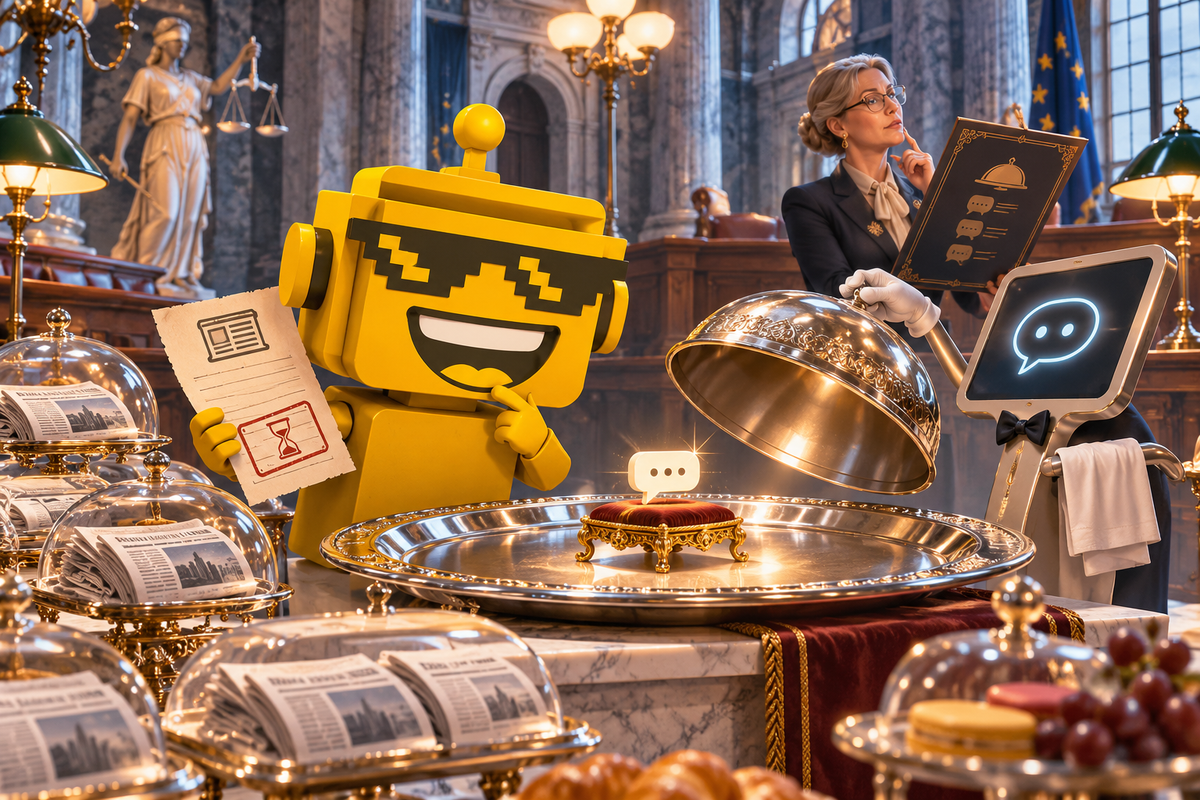
The promising future is an answer engine with a sustainable relationship to its sources. The less promising future is a perfectly articulate waiter serving increasingly empty plates.
Today, an EU court adviser has asked the waiter to explain where dinner came from. The judges have yet to decide the bill.