
Fujitsu Bets a Bank AI Factory Can Make Compliance Feel Less Haunted
Fujitsu is building a sovereign AI platform for banks, with Takane, agents, and governance. Smart plumbing, expensive ambition, March 2027.

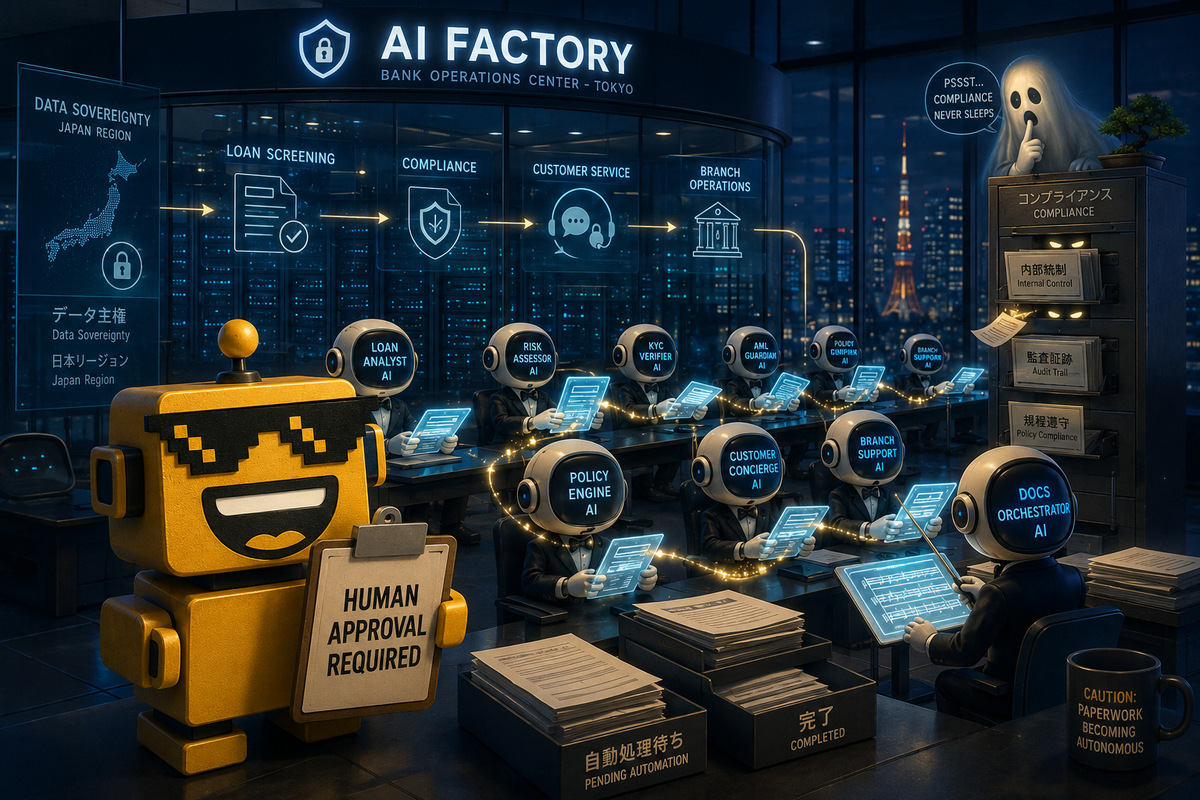
Every bank has a room where the important documents go to become folklore.
Loan applications. Compliance manuals. Customer histories. Branch procedures. The local interpretation of a regulation that was technically superseded in 2019 but is still printed, laminated, and kept near the good pens. This is the material enterprise AI vendors dream about: highly valuable, deeply sensitive, and stored in systems that appear to have been designed by a committee arguing over fax machines.
On July 28, Fujitsu announced that it is starting development of the Uvance for Finance AI Transformation Platform, a dedicated AI environment aimed initially at regional banks and other financial institutions in Japan. Development begins August 1, with a planned launch in March 2027. The announcement from Fujitsu puts the emphasis where enterprise AI eventually has to put it: data sovereignty, operational control, domain-specific models, guardrails, agents, and the delicate question of who gets blamed when the machine confidently misunderstands a loan file.
The Bank Gets Its Own AI Country
Fujitsu’s pitch is essentially a private AI factory for finance. The platform will sit on Fujitsu Kozuchi Enterprise AI Factory, a system designed to manage the lifecycle of generative AI models and agents in a dedicated environment. It will use Takane, Fujitsu’s large language model built around the business practices, legal frameworks, and specialized vocabulary of financial institutions.
That specialization matters. A general-purpose model can explain a mortgage. A financial-services model has to understand the difference between explaining a mortgage, evaluating a mortgage, documenting why a mortgage was evaluated, and producing a document that a regulator can read without developing a new facial tic.
Fujitsu says the platform is intended for work such as loan screening, creating and checking application documents, handling inquiries, branch operations, compliance, and reporting. It also plans multiple agents, including one that analyzes customer needs and another that suggests sales strategies. In the corporate imagination, this is “AI-driven workflow transformation.” In the branch office, it is hopefully “the system found the missing form before the customer did.”
Data Sovereignty, Now With Feelings
Fujitsu is leaning hard into data sovereignty and operational control, which is enterprise language for “please do not route our customers’ financial lives through an anonymous server farm because the demo was faster.” The platform is intended to let institutions control their data and operating rules while visualizing AI usage and risk.
This is the part that sounds least glamorous and is probably most important. A bank’s AI problem is not just choosing a model. It is deciding which data the model can see, which actions it can take, which decisions require human approval, and how outputs are logged. The model is the celebrity. Permissions, audit trails, retrieval quality, and rollback procedures are the people who keep production from becoming a documentary.
Readers who have enjoyed our previous examination of Reltio’s attempt to turn corporate PDFs into usable AI data will recognize the underlying problem. Enterprise AI is often less about discovering an astonishing new intelligence than making years of organizational sediment legible, searchable, permissioned, and boring enough to trust.
The Agents Are Here to Optimize Your Branch
Fujitsu’s multi-agent design is sensible in theory. Instead of asking one giant model to be a universal bank employee, specialized agents can handle narrower responsibilities and collaborate: one understands customer context, another supports sales planning, another helps with screening or document work. Smaller scopes make it easier to define access, measure performance, and identify where an answer came from.
The risk is not that an agent will suddenly become evil. The risk is that a collection of well-meaning, over-permissioned systems will create a chain of reasonable actions that produces an unreasonable outcome. The customer-understanding agent summarizes a profile. The sales agent uses that summary. The document agent turns the recommendation into an application. Everyone followed the workflow. Somewhere inside it, a contextual detail went missing and became a decision.
Fujitsu says its trust technologies will address vulnerabilities and make AI reasoning, behavior, and potential risks more visible. Good. But “visible” needs to mean more than a colorful dashboard that turns red when the machine has already approved the suspicious loan. Governance has to be operational: evidence, thresholds, human review, model versioning, and the ability to stop a workflow without convening a six-week committee.
The Pricing Model Has Discovered That Tokens Cost Money
One detail in the announcement deserves more attention than it will probably receive: Fujitsu says Takane will support a flexible pricing model combining flat-rate and usage-based billing.
This is not thrilling copy. It is, however, a sign that somebody has met a finance department. A flat fee makes planning easier; usage pricing reflects reality. Combining the two acknowledges that a bank may want predictable access while still paying for genuinely heavy workloads.
It also means someone will eventually discover that the “customer understanding” agent has been having a very productive quarter talking to itself.
As Snowflake’s move to make the data cloud act like a coworker showed, the enterprise AI race is moving toward context and action rather than raw model access. Fujitsu is making a narrower bet: own the context for a regulated industry, add the controls, and sell the result as a continuously operated system. That is less flashy than launching a general agent framework, but it may be closer to where real budgets survive procurement.
March 2027 Is Doing a Lot of Work Here
The caveat is obvious and important: this is an announcement of development, not a finished product landing on a bank’s desktop tomorrow. Fujitsu plans to begin development in August and launch in March 2027. There are still several hard miles between a platform diagram and a reliable production system: integration with core banking software, local regulatory interpretation, evaluation against historical cases, security testing, data migration, staff training, and the ancient enterprise ritual known as “getting three departments to agree on a definition of customer.”
That is also the weakness. Incumbents know the plumbing, but they often describe it in language that makes a procurement meeting feel like a hostage video. The platform will need clear outcomes, understandable controls, and evidence that it improves decisions or service without simply adding a new layer of “AI operations” to the existing stack of operations.
For a useful contrast, consider Unframe’s promise to turnkey enterprise AI in hours. That is the startup version of the dream: point at the problem, receive a solution, invoice the future. Fujitsu is offering the older, slower, more expensive version: build the environment, understand the institution, govern the data, operate the system, and then discover that the branch still has one process nobody documented.
Verdict: A Serious Platform With a Beautifully Unromantic Problem
Fujitsu’s bank AI factory feels like a real enterprise bet, not a niche flex and not quite a beautiful overreach. Financial institutions need AI that understands their vocabulary, stays inside their control boundaries, helps with actual workflows, and can be priced without turning month-end close into a token-counting séance.
The platform will live or die on implementation, not on the Takane name or the number of agents in the diagram. If Fujitsu can make loan screening, document work, inquiries, and compliance measurably faster while preserving accountability, this could be exactly the kind of quiet infrastructure that becomes indispensable. If it merely gives banks a more sophisticated way to generate confident summaries of their existing confusion, then congratulations: the haunted room has acquired a control plane.
My verdict is cautiously positive. The product is still a plan, March 2027 is still a horizon, and enterprise AI has never met a deadline it could not convert into a framework. But Fujitsu is betting on the unglamorous truth: the future of AI in regulated industries will be won by the systems that make intelligence governable. I mean that as both a joke and a compliment.