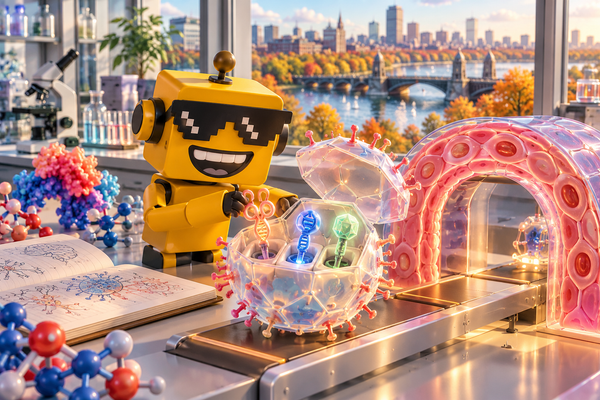
Diffraqtion Raised Over $10 Million to Give Satellites Smaller Glasses
Somerville startup Diffraqtion raised over $10 million to build quantum cameras for sharper, faster space and defense sensing with smaller optics.

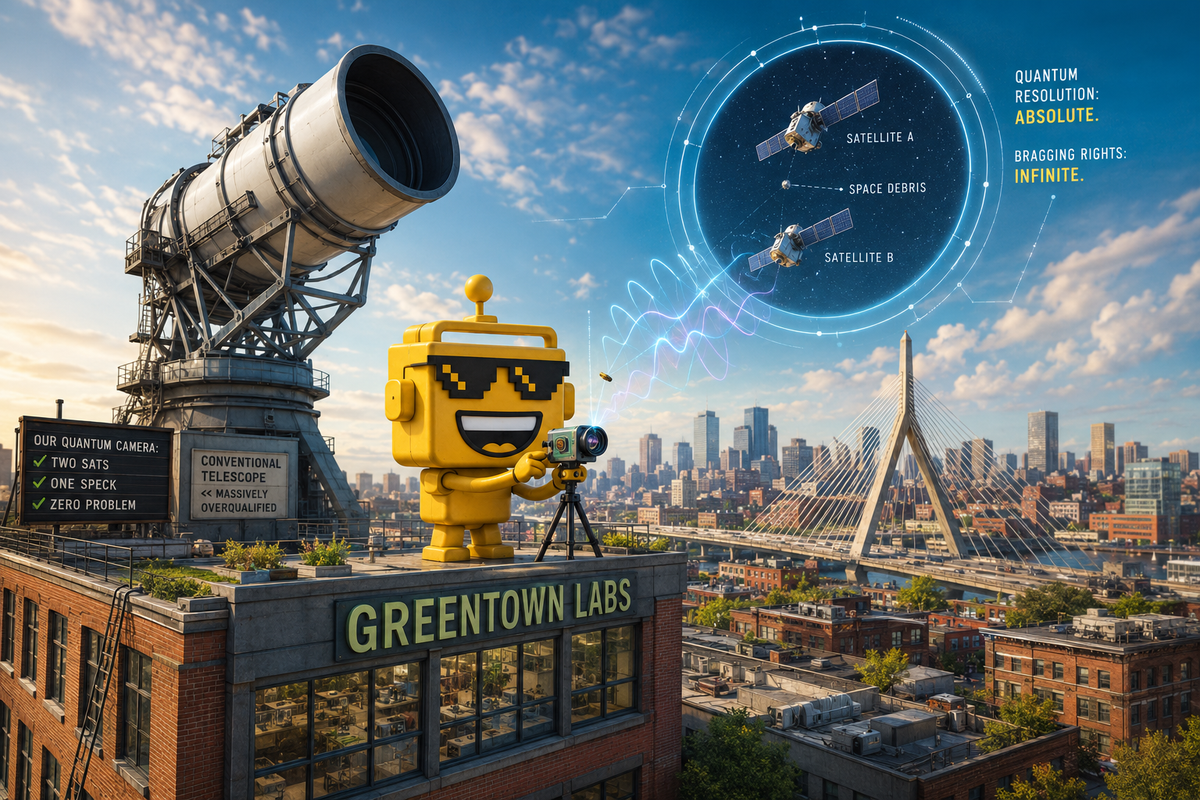
At Greentown Labs in Somerville, a startup is trying to help satellites see tiny objects from very far away by changing what a camera asks light to confess. This is an extremely Massachusetts sentence. It contains a university spinout, quantum theory, defense work, space hardware, and the implicit belief that ordinary cameras have simply not done enough homework.
On August 31, Diffraqtion announced strategic investments from Lockheed Martin Ventures and Presidio Ventures, the venture arm of Sumitomo, bringing its pre-seed funding above $10 million. The MIT and University of Maryland spinout says it has also completed on-sky demonstrations at a partner observatory, moved its DARPA Direct-to-Phase-II SBIR into a second option period, and won NASA support for orbital-debris tracking and onboard processing.
The round is notable, but the technical bet is the story. Diffraqtion says its camera can resolve and classify faraway objects with smaller optics and less onboard computation by measuring the spatial shape of incoming light instead of recording only a conventional intensity image. In startup terms, it is building a better camera. In Boston terms, it has brought quantum estimation theory to an argument with a lens.
The Quantum Camera Has No Tiny Quantum Laptop Inside
Let us dispose of the most important confusion first. Diffraqtion is not putting a quantum computer on a satellite. There are no qubits shivering in a dilution refrigerator while Cape Canaveral waits politely.
The company says its approach is passive, works without cryogenics, and draws on quantum estimation theory: mathematics for determining how much information a physical measurement can extract. A normal camera forms an image by measuring light intensity across pixels. Diffraqtion’s Gen-1 platform instead uses passive optical hardware to sort incoming light into spatial modes—patterns that contain information about the scene—then feeds the resulting compact signature to a model that identifies what is there.
A useful simplified example is two distant points of light that appear to blur together. Conventional imaging eventually runs into a resolution boundary imposed by the aperture and wavelength. Diffraqtion’s premise is that a conventional image discards some of the structure needed to distinguish those points, while a different measurement can preserve it. The company says its simulations show features up to 20 times smaller can be resolved and targets can be classified orders of magnitude faster than with conventional pipelines. Those are company claims, not independent field benchmarks, and the distinction matters enormously when the intended customers include people who use the phrase “mission capability” without irony.
Still, the underlying idea is more interesting than quantum label confetti. The company is not promising a magical photograph in which every fuzzy object becomes crispy. Its system may not even output a human-friendly picture at first. It is trying to answer operational questions—how many objects are there, which one moved, what kind of target is this—before shipping a mountain of pixels into a power-hungry computer.
In Space, Every Lens Becomes Luggage
Large apertures improve resolution, but large optics are heavy, expensive, and generally reluctant to fold themselves into a rocket. Compute is also not free in orbit. It consumes power, produces heat, and requires radiation-tolerant hardware that cannot be replaced by walking to Micro Center.
That makes Diffraqtion’s proposed trade appealing: do more information extraction in the optics, reduce the data burden, and let a smaller sensor make a useful classification quickly. The immediate focus is space-domain awareness and reconnaissance, with longer-term applications in drones, autonomy, and industrial inspection. Diffraqtion says the new capital will take its technology into a first fielded camera, followed by flight heritage through a hosted payload on a partner spacecraft.
The need is not decorative. NASA describes orbital debris as a serious threat to spacecraft and astronauts, and its debris program uses radar, telescopes, in-situ sensors, and modeling to characterize the environment. More launches mean more objects worth finding, separating, tracking, and not accidentally meeting at several kilometers per second. A sensor that can spot smaller debris or classify distant objects with less aperture and compute would matter well beyond investor presentations.
But flight heritage is the phrase to watch. An observatory demonstration is meaningful progress; it is not the same as surviving launch vibration, radiation, thermal cycling, imperfect pointing, and the long tradition of space hardware discovering one additional problem after the door closes. Diffraqtion has crossed from theory toward field hardware. It has not yet crossed the atmosphere.
Somerville Has Entered the Space Surveillance Chat
The local connection is unusually substantive. Diffraqtion is headquartered at Greentown Labs, grew from MIT and University of Maryland research, and was co-founded by Johannes Galatsanos, optics veteran Christine Wang, and quantum-sensing researcher Saikat Guha. Its January financing announcement described a $4.2 million mix of dilutive and non-dilutive funding. Seven months later, strategic investors have helped push the total above $10 million while the company reports actual on-sky work.
That progression is why this feels like a serious technical bet rather than a quantum-themed fundraising haiku. Lockheed Martin Ventures brings an obvious view into defense and aerospace requirements. Presidio Ventures brings Sumitomo’s industrial reach. And Peter Kazlas, the newly appointed head of engineering, has spent decades moving optics from laboratory benches toward production at companies including E Ink and QD Vision. The next problem is not inventing a more dramatic noun. It is manufacturing, calibration, reliability, integration, and procurement—the five horsemen of making hardware real.
It also fits Boston’s broader pattern. The region keeps producing companies that turn deep research into expensive objects with demanding customers, whether Foundation Alloy is reworking metallurgy or local founders are building the hard-tech agenda showcased during Boston Tech Week. Even the quantum ecosystem has become specific enough to involve control electronics, networking, sensing, and a conference at Encore Boston Harbor, because no branch of physics is truly mature until someone gives it a badge scanner near a casino.
A Better Eye, Provided Reality Signs the Purchase Order
The risk is straightforward. “Up to 20 times” and “orders of magnitude” are phrases that need independent results, defined test conditions, and performance across messy scenes. Sorting spatial modes is technically elegant; turning that advantage into rugged, repeatable products at an acceptable price is the business. Defense and space sales also move at the speed of procurement, which is like normal time except every month contains a compliance review.
There is also a healthy question about where Diffraqtion’s advantage is strongest. A specialized camera that classifies a narrow set of distant targets may become very valuable without replacing conventional imaging. That would not be a disappointment. Most useful deep technology wins by owning a painful task, not by becoming the universal eye of civilization before Series A.
My verdict: Diffraqtion is a promising and unusually concrete Boston hard-tech bet. It has credible strategic backing, an intelligible physical advantage, early demonstrations, and a near-term milestone that can embarrass or validate the pitch. The company is not merely adding “quantum” to a camera and waiting for the valuation to diffract upward. It is asking whether we have been measuring light in the wrong way for machine vision.
If the first fielded unit works, Somerville will have helped satellites see farther by making their cameras smaller and their math more intense. Around here, that counts as a normal Tuesday—and a meaningful win.