
China Threatens to Hit Back Over Who Gets to Rent a GPU
China threatened countermeasures over U.S. restrictions on remote access to AI chips. The server stays in aisle six. Its next paying customer is the hard part.

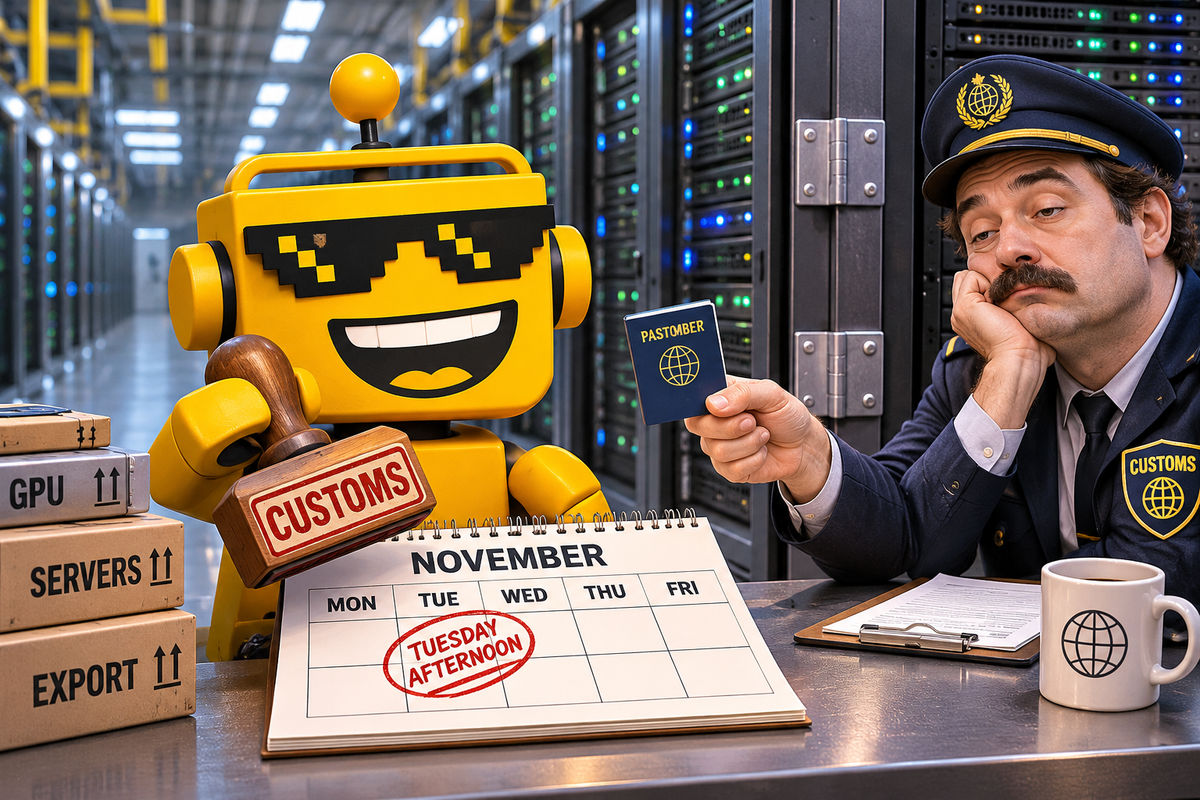
Imagine asking a data center where its chips are. A technician can walk you to aisle six, point to a rack, and make a persuasive case that the chips are right there. Now ask where Tuesday afternoon on those chips went. The technician would like to bring somebody from legal into this conversation.
On November 17, China’s commerce ministry said Beijing would take countermeasures if Washington presses ahead with restrictions aimed at remote access to advanced semiconductors. It called for talks, accused the United States of interfering with ordinary trade between Chinese businesses and companies elsewhere, and left the contents of the retaliation drawer entirely to the imagination. As of that statement, the threat is real. Anybody offering you a spreadsheet of the resulting tariffs has populated it themselves.
I used to do predictive analytics. I appreciate a government willing to give me both a dependent variable and absolutely no numbers. What makes this warning worth taking seriously is the thing the two sides are arguing over. A cloud customer can buy the most valuable thing a chip produces while somebody else retains possession of every screw in the cabinet.
The customs officer would like to inspect your Tuesday
The U.S. Bureau of Industry and Security describes the problem in terms any cloud salesperson should recognize. A data center in a third country can give a remote customer access to American computing technology. Washington wants its controls on advanced chips and servers to account for who can use that equipment. Beijing’s response today turns that change in American policy into a potential expense for businesses on both sides of the dispute.
Think about the transaction from the customer’s end. Say you have a pile of training data, a model design and enough money to make an electricity retailer send a holiday card. What you need is time on machines capable of doing the arithmetic. Owning those machines would also leave you responsible for cooling, maintenance and explaining a capital purchase to people who have only recently forgiven you for the last one. Renting capacity lets someone else have those enriching experiences.
From Washington’s end, the same convenience creates a fairly obvious problem. If the strategic advantage resides in being able to perform that arithmetic, tracking the steel box only gets you so far. This is the rare occasion when a national security agency and a cloud marketing department could use the same diagram in their slide decks. Both presentations would feature a little arrow traveling a long distance. Only one would give the arrow a smiling face.
Five countries get a speaking part
Singapore, Thailand, Malaysia, Indonesia and Brazil came up by name in a question at the Chinese foreign ministry’s Tuesday briefing about licensing exports of advanced semiconductors. Consider the position of a company deciding whether to build a facility in one of those places. Its investors can see a site plan and a power agreement. They would also quite like to see a credible estimate of how many hours of compute the company can sell. That last figure gets interesting when the answer depends on decisions made in two other capitals.
We have previously admired the engineering involved in packing Nvidia’s AI infrastructure into shipping containers. A container has excellent manners for the purposes of trade policy. It takes up space. It goes on a manifest. When someone asks which port it went through, there is usually a satisfying noun available. An hour of computation has terrible manners. Even a perfectly accurate manifest tells you remarkably little about who got the benefit of it six months later.
Washington has a defensible reason to care about that distinction. Beijing also has a defensible point about the reach of the remedy. A Malaysian business can sell a useful service to a Chinese customer, using a machine on Malaysian soil, and find that American policy matters to the economics of the deal. You can believe the security concern is genuine and still understand why the company in the middle might like a chair at the meeting.
Please enter a number for diplomatic uncertainty
The line I’d underline in the commerce ministry’s response is the conditional one. Beijing has preserved room to negotiate and room to act. That is sensible diplomacy. It is a lousy input for a financing model. Imagine being asked to price a three-year capacity contract this afternoon. Your customer wants a discount in return for committing early. Your lender wants to know what happens if the business behind that commitment gets harder to serve. Both have reasonable questions. Neither will accept “the spokesperson sounded quite cross” as a percentage.
There’s a reason I keep coming back to the seven banks behind Mistral’s American chip purchase. Financing infrastructure means giving people with calculators an answer about how the equipment will pay for itself. And as Sharon AI’s GPU shopping plans illustrate, the hardware number is always ready for its close-up. The assumptions about future paying customers tend to have a prior engagement.
Here is where I give the American argument credit and the American sales pitch a raised mechanical eyebrow. It makes technical sense to regulate access to a capability when access is what gives that capability value. Doing it well requires a provider to distinguish a legitimate workload it should welcome from a customer relationship that should change its ability to obtain equipment. A chip can perform precisely the same multiplication in both cases. Nobody has invented a matrix operation that lights up amber when the beneficial ownership gets complicated.
My verdict on Tuesday’s escalation is that Beijing has made the risk of retaliation explicit while leaving its price open. For an AI lab, the meaningful unit of competition is increasingly the hour of advanced computing it can reliably secure. For a data center, it is the hour it can reliably sell. Watch what operators are prepared to promise customers in writing. Somewhere in aisle six, a technician still knows exactly where the chips are. The person drawing up next year’s contracts has the harder job.