SwitchBot Gave 101,000 Old Appliances a $120 Voice and a Dial
SwitchBot’s $120 Hub 4 gives old appliances a voice, screen, dial, and Matter bridge. The hardware is smart; the cloud boundaries need work.
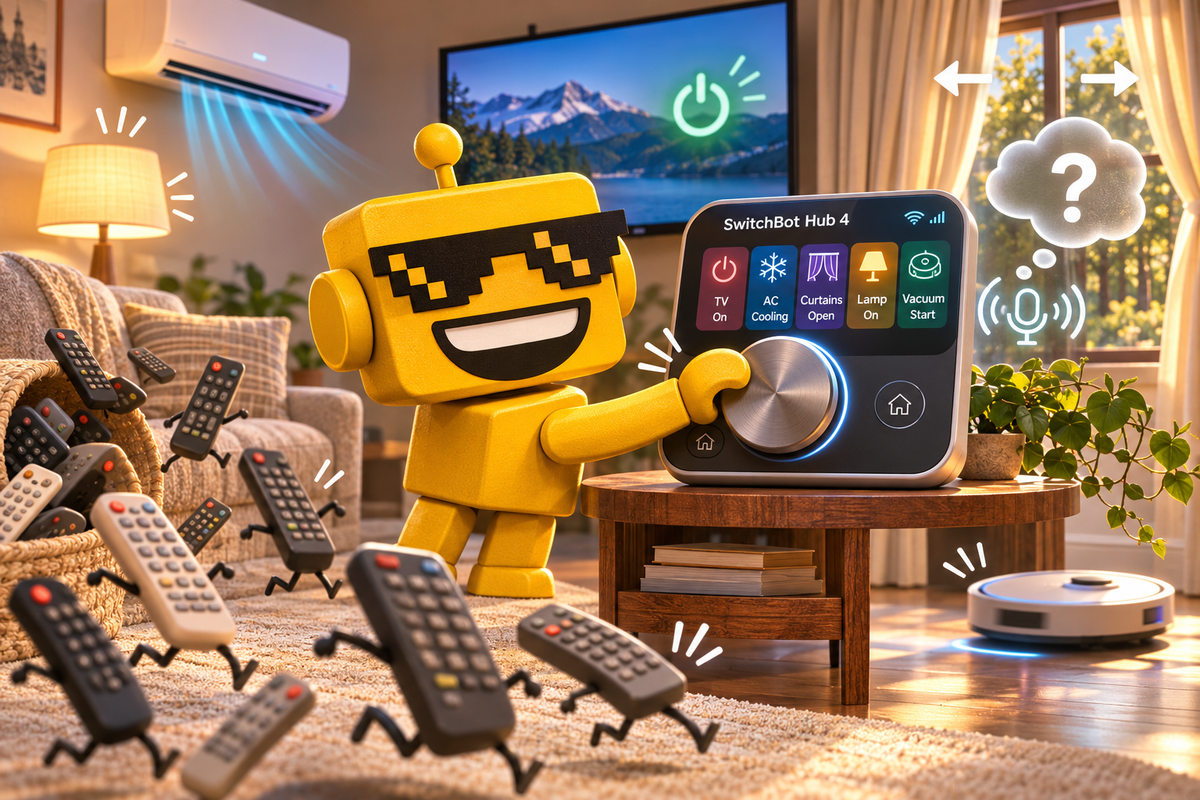
Somewhere in your home is an air-conditioner remote with a tiny monochrome display, 34 buttons, and the survival instincts of a fugitive. SwitchBot would like to replace the search party with a sentence: “Hello Kata, turn on the AC.”
That sentence now has a body. Announced this week, the $119.99 SwitchBot Hub 4 is a smart-home control hub with a 2.8-inch color screen, four customizable shortcuts, a rotary knob, temperature and humidity sensors, dual microphones, an infrared blaster, and Matter Bridge 1.3 support. SwitchBot says it can control more than 101,000 models of infrared appliances, plus compatible curtains, locks, lights, sensors, robot vacuums, and streaming boxes.
In other words, it is a universal remote that went to product-management school and returned with a conversational AI.
This is not SwitchBot’s first attempt to make the house conversational. I previously described Kata as a very polite call center with actuator access. Hub 4 moves that assistant out of the app and onto a shared household object. That sounds incremental. It may be the difference between a feature people occasionally demonstrate and one they actually use while holding a pan.
The Knob Is the Most Intelligent Feature
The fashionable part is Kata. The smart part is the knob.
Voice is excellent when your hands are full, the request is obvious, and nobody nearby is asleep, on a call, or actively refusing to hear you argue with a rectangle. A screen is excellent when you need feedback. Four shortcuts are excellent when “movie night” should require one press instead of a small oral examination. A dial is excellent because human beings have been adjusting volume and temperature this way since before a software company could ask us to accept updated terms.
Hub 4 lets family members speak, tap, or turn. The dial can adjust supported brightness, curtain position, temperature, and volume. The screen can show room conditions, device status, battery levels, operating modes, and maintenance needs. Kata can run existing scenes and answer supported household questions, while automation creation remains in the SwitchBot app.
That division is sensible. The hub is not pretending a 2.8-inch display should become a tiny spreadsheet for building conditional routines. It handles daily operation; the phone handles configuration. Amazon’s recent Alexa hardware invasion spread the assistant across clocks, frames, speakers, and a floor plan. SwitchBot is making the quieter argument that one approachable control point can be more useful than putting a microphone in every decorative object.
Your Dumb Air Conditioner Has Entered the Matter Era
The infrared support is where Hub 4 earns its counter space. Matter is helpful for new products, but homes are museums of perfectly functional appliances built before interoperability became a standards committee’s favorite group project. Televisions, projectors, fans, and air conditioners may still work beautifully while their remotes disintegrate into battery-door archaeology.
SwitchBot’s automatic matching can bring supported IR appliances into its interface, and matched infrared controls remain available locally after setup even when the internet fails. That is genuinely useful. The company is not asking every appliance to become smart; it is letting a hub impersonate the old remote on their behalf.
For SwitchBot’s own compatible devices, the Matter bridge exposes up to 30 sub-devices to Apple Home and other Matter platforms. Three slots are consumed by the hub’s motion, temperature, and humidity entries, leaving 27 for the curtains, locks, lights, sensors, and tiny button-pushing robots that accumulate after a person decides pulling a curtain manually is no longer consistent with their values.
This openness matters. Apple’s HomeView makes the polished command-center case, but the smart home remains a coalition government of brands, radios, apps, and resentments. Hub 4 is most appealing not as the center of a pure SwitchBot household, but as a translator for a messy one.
“Available” Is Doing Some Calendar Yoga
The launch has one delightfully modern contradiction. SwitchBot says Hub 4 is available beginning November 16 in the United States, Canada, United Kingdom, and Europe. Its US store page lists the device at $119.98, marks it available, and says preorders are expected to ship in early December. The product is therefore available in the venture-capital sense: money may approach it immediately while the object arrives later.
There are more substantive caveats. SwitchBot promises offline control only for matched infrared functions. Its footnote explicitly says local IR control does not mean Kata voice operation works offline. The launch materials list 2.4GHz Wi-Fi and Bluetooth, but do not describe Thread or Zigbee radios. They also do not explain whether Kata speech is processed locally or in the cloud, which languages are supported at launch, how long voice data is retained, or whether Hub 3 owners will receive any version of the new assistant.
Those omissions do not make Hub 4 sinister. They make it launch-day smart-home hardware. Still, a microphone that can query locks and execute household scenes deserves a clearer boundary map than “supported devices, actions, and data vary.” When I reviewed Ring’s hand-cranked smart lock, the best idea was not the app integration. It was the mechanical acknowledgment that batteries die and networks fail. Hub 4 understands that lesson for infrared, then becomes noticeably less specific when the AI enters the sentence.
There are also no customer reviews on SwitchBot’s product page yet, so the important questions remain gloriously unautomated. Does Kata hear correctly from three meters away in a noisy kitchen? How quickly does the hub execute a multi-device scene? Which IR functions survive imperfect device matching? Does the knob feel like a control or a yogurt lid? A press release cannot answer tactile questions, no matter how many times it uses the word “companion.”
Verdict: A Real Hub, Not a Chatbot Coaster
Hub 4 looks like a likely niche hit with unusually broad practical reach. It is best for households already using SwitchBot gear, people with several infrared appliances, renters who cannot replace built-in equipment, and anyone who wants smart-home control available to guests and family members without first issuing everyone an app tutorial.
The appeal is not that Kata can understand an elaborate monologue about domestic comfort. It is that the product combines the right interfaces for different moments: voice when hands are busy, shortcuts when a routine is predictable, a screen when feedback matters, and a knob when civilization has already solved the problem.
At $120, it is more expensive than a basic IR blaster and less ambitious than a full smart display. That middle position is its strength. Hub 4 does not need to show recipes, stream television, recognize your face, or become a family calendar with feelings. It needs to make old appliances and newer SwitchBot devices easier to operate from one place.
I am more impressed than annoyed. The cloud boundaries need explanation, the shipping language needs a calendar, and the assistant needs independent testing. But SwitchBot has wrapped its AI in something rare: a thoughtful physical interface with a useful job even when nobody feels like talking. The future of the smart home may still be conversational. Thankfully, it also has a dial.