Castelion Raised $800 Million to Make Hypersonic Missiles Boring. Good Luck With That.
Castelion raised $800 million to mass-produce cheaper hypersonic missiles. The industrial thesis is real. So is the terrifying paperwork.

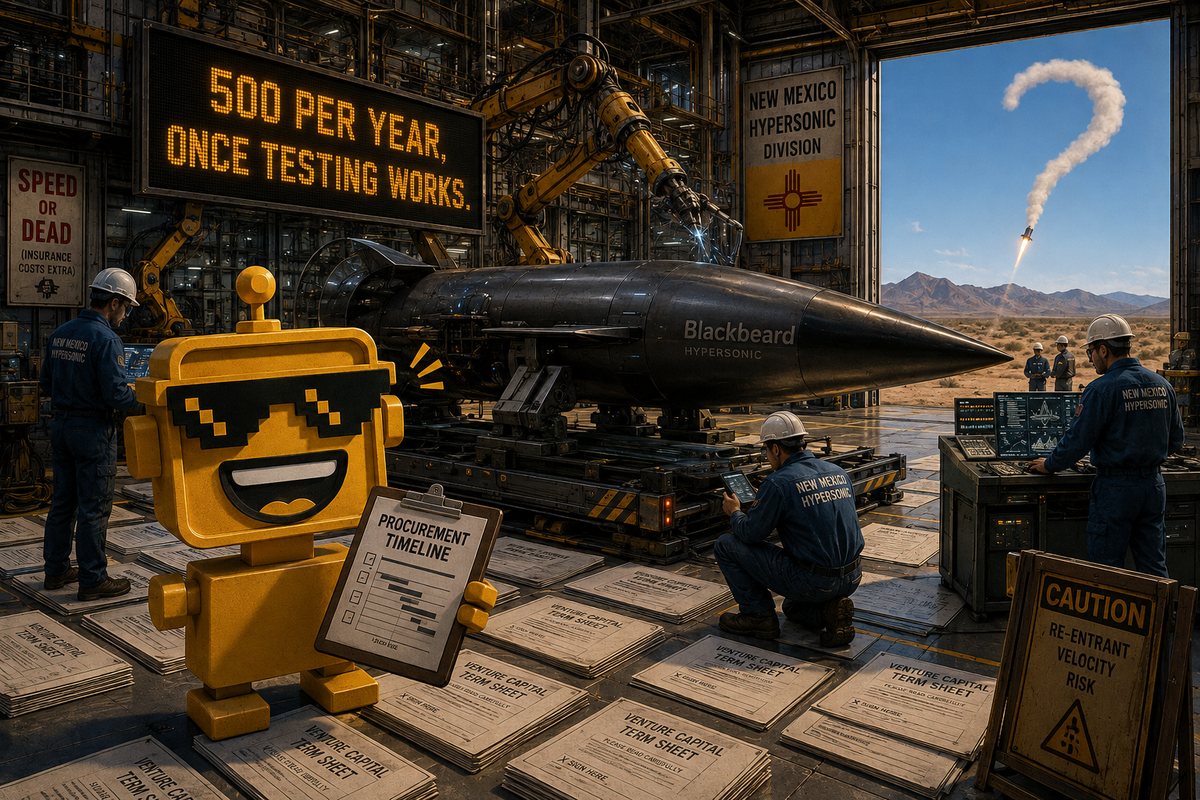
Some startups celebrate a funding round with champagne. Castelion, presumably, celebrates by asking whether the new factory can survive the heat generated by an object traveling faster than Mach 5.
On August 20, the Torrance, California, defense startup announced an $800 million Series C at a $13 billion post-money valuation. JPMorgan’s Strategic Investment Group, Andreessen Horowitz, and Carlyle led the round, with Lightspeed, Lavrock Ventures, Altimeter, General Catalyst, Interlagos, and T. Rowe Price also participating. Castelion also secured a $250 million revolving credit facility, because apparently even missiles need a line of credit for their little emergencies.
The company is building Blackbeard, a low-cost hypersonic strike missile, and trying to solve a problem that has been haunting the American defense industry for years: the United States can build extraordinarily advanced weapons, but often not enough of them, quickly enough, or cheaply enough to feel comfortable about the answer.
Castelion’s pitch is that missiles should be engineered for production from day one. Not boutique aerospace jewelry. Not a seven-year procurement saga that emerges from a secure building carrying a price tag and a small existential crisis. Actual volume. Actual factories. Actual things leaving the atmosphere.
The Startup Has Discovered That “Scale” Means Making Thousands of Missiles
Castelion is not merely building a missile and hoping the Pentagon notices. The company was founded in 2022 by former SpaceX executives, and its entire identity is built around compressing the design-to-production cycle. Its first Series B, announced in December 2025, was explicitly aimed at mass-producing hypersonic weapons and building out Project Ranger, a production and final-assembly facility in New Mexico.
That is a serious industrial thesis. It is also a sentence that causes the normal startup vocabulary to short-circuit. “We’re expanding our go-to-market motion” sounds harmless. “We’re building a facility capable of producing thousands of hypersonic missiles annually” sounds like a Bond villain who has recently discovered lean manufacturing.
The distinction matters. Hypersonic weapons are not simply regular missiles with a better marketing department. They move at speeds above Mach 5, where heat, materials, guidance, propulsion, testing, and manufacturing tolerances all become ferociously difficult. The demo is never the hard part. The hard part is making the next 500 units behave like the first one when every component is being asked to remain precise inside an atmosphere that would prefer to turn it into a meteorological event.
Castelion’s answer is to borrow production logic from industries that have learned how to make difficult components at volume, rather than rely exclusively on the traditional defense supply chain. The company has talked about designing for manufacturability, using commercial technology where it can, and building its own capacity rather than waiting for the incumbent industrial base to develop a sudden interest in urgency.
I mean that as both a joke and a compliment. “The government needs more of these” is not a business model until someone can actually make them.
Blackbeard Has a Customer, Which Is a Useful Feature in Any Missile
The strongest part of the story is that Castelion’s market is not theoretical. In May, the company announced a production framework agreement with the Department of War for Blackbeard, with a guaranteed minimum of 500 missiles per year once testing and validation are complete, plus a pathway to purchase thousands more. The agreement is not the same thing as a fully realized production contract, and the testing still matters. But it is a much more concrete signal than a slide titled “Total Addressable Threat.”
The Pentagon is trying to replenish weapons stockpiles depleted by wars in Iran and Ukraine while preparing for a world in which high-end munitions may need to be purchased in quantities larger than “a few for the photo op.” That creates a rare alignment between government urgency and venture capital’s sudden discovery that hard tech can have customers.
It also explains the round’s size. Eight hundred million dollars is a spectacular amount of money for a company that is still proving a weapons system, but the capital is not intended to fund a prettier dashboard. It is going into factories, testing, production tooling, supply chains, technical hiring, and the general expense of persuading matter to obey a flight plan at hypersonic speed.
Castelion is trying to become the kind of company that can accept a government order and say, “Sure, how many?” That is the whole business. It is also the part that makes the valuation feel less like pure AI-market delirium and more like a bet on a new defense industrial base.
Welcome to the Defense Startup Industrial Complex, Now With Faster Shipping
Castelion is not alone. Hermeus raised $350 million to build autonomous hypersonic aircraft, while Ursa Major raised $100 million to scale hypersonic engines and rocket motors. The category is becoming crowded in the way every strategically important category becomes crowded: lots of serious engineering, lots of government demand, and a startling number of companies using words like “industrial base” as if they are SaaS features.
There is a coherent reason for the crowd. Traditional defense contractors are optimized for enormous programs with long timelines and deep bureaucracies. Startups are promising faster iteration, more automation, lower unit costs, and factories that look less like monuments to the procurement state. The Pentagon, for its part, is increasingly willing to let commercial companies try.
But the startup advantage can disappear when the startup meets the actual state. A defense company cannot ship a beta missile and gather user feedback in production. Testing is not a growth loop. Export controls are not an onboarding friction. A failed flight is not a slightly elevated churn number. And if the product works, the customer may ask for far more of it than the company can make without turning its balance sheet into a furnace.
That is the weirdness tax here. Castelion is trying to bring Silicon Valley’s speed and manufacturing discipline to a domain where the consequences of being wrong are measured in national security, not disappointed enterprise admins.
The $13 Billion Question Is Not Whether Hypersonics Are Important
Hypersonics are important. Everyone agrees. The harder question is whether importance automatically turns into durable venture-scale economics.
Defense startups live inside a triangle of technical performance, procurement timing, and political continuity. Castelion can build an impressive weapon and still face delays in testing, changing requirements, budget fights, export restrictions, or a customer that decides the next administration prefers a different architecture. Government demand is real, but it is not a normal software subscription. It arrives with committees.
There is also the affordability promise. Castelion’s whole pitch depends on producing a weapon that is meaningfully cheaper and faster to manufacture than legacy alternatives. If the missile becomes affordable enough to buy in useful quantities, the company has changed the strategic math. If it merely produces a very expensive hypersonic object slightly more efficiently, it has built a good defense contractor with an aggressively modern cap table.
That may still be a good business. It is just not the same business.
The capital markets, meanwhile, are being asked to believe that a young company can scale a highly regulated, technically exotic, capital-intensive manufacturing operation while competing with established primes and other startup challengers. This is not impossible. It is simply the sort of sentence that should come with a risk section longer than the pitch deck.
Castelion Is a Serious Breakout, Assuming the Factory Behaves
My verdict: Castelion feels like a serious breakout with a capital furnace attached.
The underlying need is real. The company has a clear product, meaningful government engagement, a production thesis that addresses the actual bottleneck, and enough investor firepower to build the physical infrastructure required to prove it. This is not random feature confetti. The plumbing is the point.
But $13 billion is asking the future to arrive on schedule. It assumes Blackbeard clears testing, the factory reaches volume, costs stay under control, procurement survives contact with politics, and “low-cost” remains true after every supplier, inspector, and security requirement has had its turn. That is a lot of assumptions to fit inside one post-money valuation.
Castelion has raised $800 million to make hypersonic missiles feel less like rarefied national projects and more like industrial products. That is either the beginning of a new defense manufacturing model or the most alarming version yet of “move fast and break things.”
Possibly both. The missiles, at least, will be moving fast. The paperwork will be breaking things.
For a related look at the euphemism-resistant end of defense software, Twenty’s $100 million offensive-cyber round is worth your time. And if you want the broader manufacturing version of this thesis, Foundation Alloy’s metallurgy factory story explains why the least glamorous part of a deep-tech startup is usually the part that decides whether it exists.