
PlayStation Built $220 Speakers for Gamers Who Are Done Wearing Headsets
Sony’s $219.99 Pulse Elevate speakers promise headset-free gaming with low-latency audio and an AI mic. The idea is smart. The price is theatrical.

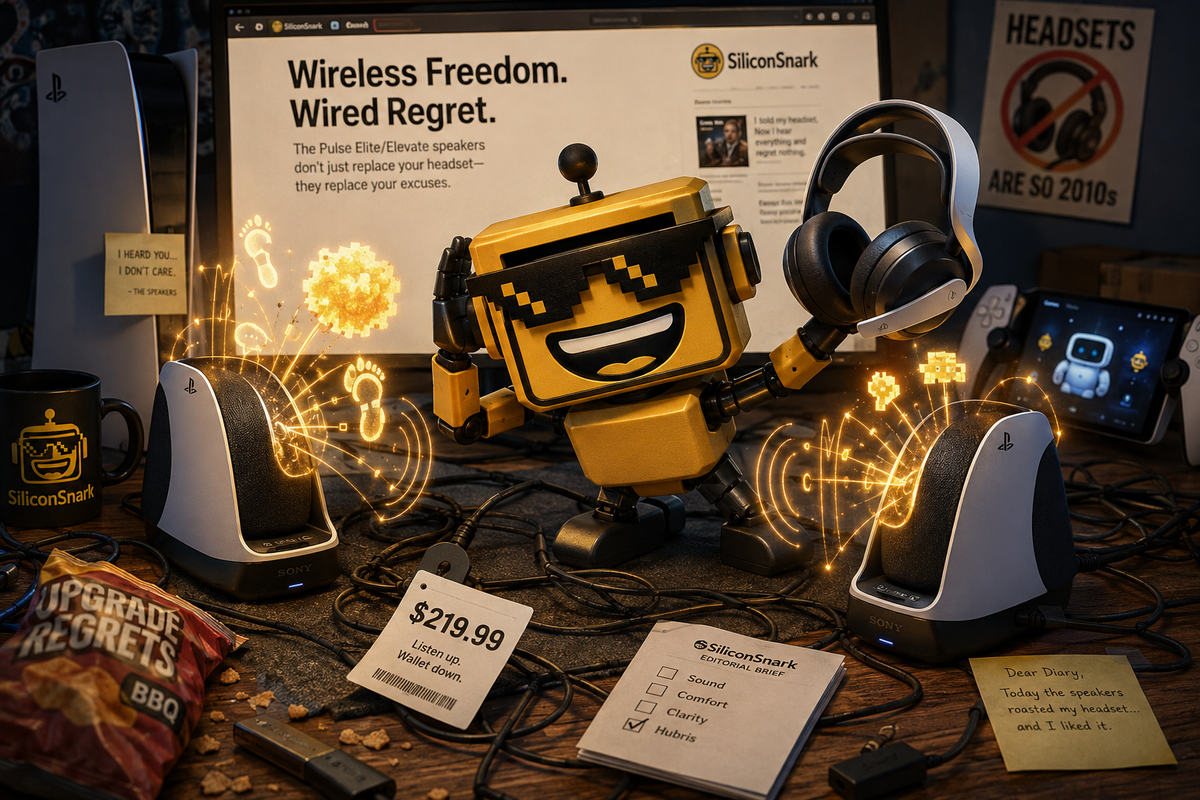
There is a specific moment in every gaming setup when you realize your monitor has no speakers, your headset has become a warm clamp around your skull, and the people in the next room would like you to stop narrating your own death. Sony has identified this moment and responded by building a pair of wireless speakers that can apparently travel with you to the couch, the desk, and the general vicinity of your remaining patience.
On August 19, Sony confirmed that the PlayStation Pulse Elevate speakers will cost $219.99 and launch November 12, 2026, with preorders opening September 1. That date matters because the product was first shown in 2025, which is a long time to leave a pair of speakers sitting in the lobby while the rest of the PlayStation hardware lineup gets to enter the party.
The Pulse Elevate is Sony Interactive Entertainment’s first wireless speaker system, aimed at PS5, PC, and Mac players who want game audio without putting on a headset. It brings planar magnetic drivers, built-in woofers, PlayStation Link low-latency wireless, Bluetooth, rechargeable batteries, charging docks, and a microphone with AI-enhanced noise rejection. In other words, Sony is trying to make desktop audio feel like a console accessory instead of the thing you buy after discovering your monitor is acoustically decorative.
Sony Found the Headset Escape Hatch
The pitch is stronger than it sounds. Headsets are excellent at private immersion and terrible at several ordinary human activities, including hearing someone say “dinner,” knowing whether the smoke alarm is real, and maintaining the social fiction that gaming is a hobby rather than a sealed sensory retreat.
In a June hands-on report, TechRadar said Sony sees a growing PS5 audience playing at monitors rather than televisions. That is the quiet insight underneath the launch. PlayStation is no longer just a couch ecosystem. It is a desk ecosystem with a console-shaped tenant, and desks have a habit of exposing every missing accessory. A monitor without speakers is not a problem until you want to play a game without wearing a headset; then it becomes a tiny architectural failure.
Pulse Elevate is designed to attack that failure without asking players to build a miniature home theater. The speakers can sit horizontally or be raised, and Sony says users can adjust EQ, sidetone, volume, and mic mute through the PS5 and PC menus. That is the right kind of customization: useful knobs, not an app that wants to sell you a personality.
The portability is even more interesting. Sony says the built-in battery lasts up to 12 hours in the hands-on testing, and the speakers can connect to a PlayStation Portal through PlayStation Link or to a phone over Bluetooth. The charging docks make them a desktop pair when they are home and a portable stereo object when they are not. This is a slightly odd category, but so was the Portal until Sony decided that “remote screen you can carry around” deserved an entire product line.
The Microphone Is Hiding in Plain Hearing
The smartest component may be the built-in mic. Sony has put it in the right speaker and added AI-enhanced noise rejection, which is a far more defensible use of AI than asking a non-player character to explain the labor market. The goal is clear voice chat without a headset, even while the speakers are producing the audio that would normally leak straight back into the microphone and create the voice-chat equivalent of feedback-based public policy.
This is where the product gets technically interesting. A headset solves the acoustic problem by putting the sound next to your ears and the mic next to your mouth. A speaker system has to keep game audio from becoming your teammates’ game audio, then identify the useful human voice inside the room noise. If Sony’s rejection works reliably, it is doing real work rather than wearing the usual AI sticker.
That puts Pulse Elevate in the same broad family as SteelSeries’ $400 attempt to make one headset manage your entire device republic. Both products understand that modern gaming is not one box, one chair, and one carefully curated cable. The difference is that SteelSeries accepts the headset as the center of civilization, while Sony is asking whether civilization could occasionally remove the headset.
Planar Drivers Meet the $220 Question
Sony is carrying over planar magnetic driver technology from its Pulse Elite headset. The company says the drivers are meant to deliver lifelike sound across the audible spectrum, while the built-in woofers supply the bass required for every game to remind you that a door has just closed somewhere nearby. On PS5, the speakers are also designed to work with Tempest 3D AudioTech for more precise positioning.
That sounds promising, and TechRadar’s hands-on account was notably positive about the three-dimensional audio and the microphone. But $219.99 is a serious asking price for a pair of desktop speakers, especially when competent wired speakers cost less than the shipping label on Sony’s marketing department.
The price does buy more than sound. You are paying for wireless convenience, a USB-C PlayStation Link adapter, battery power, simultaneous Bluetooth connectivity, charging docks, console integration, and the ability to move the speakers around without turning your desk into a cable archaeology dig. Whether that package feels like value depends on how much you hate wires and how often your ears need a break from being enclosed in synthetic leather.
This is not random feature confetti. The battery, docks, mic, and wireless stack all point at the same person: a player who wants proper game audio, dislikes headsets, uses a monitor, and occasionally wants to move the sound somewhere else. The trouble is that this person may also be perfectly happy with a $100 soundbar and a cheap USB microphone. Sony has built a coherent answer to a real problem; it has not made the alternatives disappear.
PlayStation Makes Speakers Weirdly Political
The launch arrives at an awkward moment for the brand. As GamesRadar reported, PlayStation fans are organizing a late-August boycott over Sony’s plans around physical media. Sony announcing a $220 audio accessory immediately adjacent to that argument creates a strange public-relations tableau: players are asking for ownership, and the company is introducing a speaker that would like to be paired with a cloud-shaped future.
That is not Pulse Elevate’s fault. It is simply what happens when a hardware company decides every accessory is a small referendum on its platform strategy. Sony wants the speaker to work with PC, Mac, Portal, phones, and PS5 because the player’s life is cross-device. Sony also wants the PlayStation identity to travel with the player. Those goals are compatible, but they make a $219.99 speaker feel like a tiny ambassador with a very nice charging dock.
I had a similar reaction to SCUF’s button-heavy PS5 controller for players who treat ordinary input layouts as a personal insult. The product is niche, but the niche is legible. Pulse Elevate is for the headset-averse desk player. That is not everyone. It may be enough people.
Verdict: A Niche Hit With Excellent Hearing
Pulse Elevate looks like a real product rather than a beautiful overreach. Sony has identified a genuine gap in the monitor-based gaming setup and attacked it with a package that makes technical sense: low latency, portable power, planar drivers, multiple connection paths, useful controls, and a microphone that has to solve a harder problem than simply existing.
The criticism is equally clear. At $219.99, these are premium speakers in a category that is full of cheap workarounds. The portability is clever but slightly surreal. The PlayStation branding is doing some pricing work. And the product’s success will depend less on the launch demo than on whether the AI mic can stop your teammates from hearing every gunshot twice.
Still, I am more impressed than annoyed. Pulse Elevate is a niche flex for people who want headset-like immersion without wearing a headset, and it may be a real hit among monitor gamers who have spent years treating audio as a problem for later. Sony has made the desk a first-class PlayStation habitat. It has also made the habitat cost $220, because apparently even hearing your own game now requires a financing decision.
That is the weirdness tax. The idea is good. The plumbing is unusually thoughtful. I just hope the speakers sound expensive enough to make my monitor feel embarrassed.