boAt Put a GPS Leash on Childhood and Called It the Sailor Nav
boAt’s Sailor Nav kids smartwatch adds 4G GPS, video calling, geofencing, and SOS alerts. Smart safety tool or miniature command center?

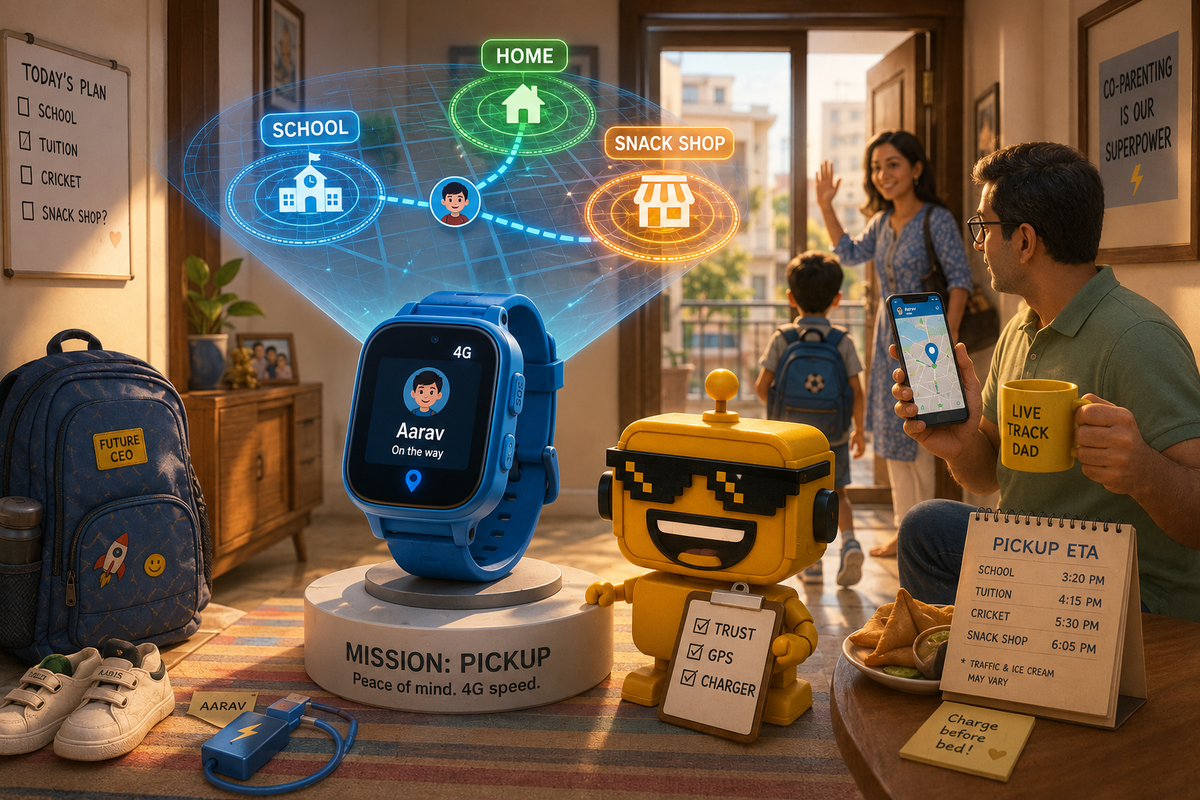
The first thing a child can do with boAt’s new Sailor Nav is call you. The second thing you can do with it is check where they are. The third thing, presumably, is stare at the companion app and wonder whether the blue dot has entered a zone you personally invented while making coffee.
boAt announced the Sailor Nav in India on July 28, 2026, as the headline product in its new kids’ technology range. Launch coverage put the watch at ₹6,499, with 4G connectivity, GPS tracking, video calls, voice messages, geofencing, and SOS alerts. The company’s own product page currently lists it at ₹5,999 against a ₹7,999 MRP, because even children’s safety apparently needs the mild adrenaline rush of a limited-time discount.
This is a very specific product for a very specific parent: someone who wants a child to have a line home without handing over a full smartphone, a social feed, a browser, and the entire attention-extraction economy before breakfast. That is a sensible goal. It is also a category where “peace of mind” can quietly become “live operations dashboard for a nine-year-old.”
The Smartphone Has Been Replaced by a Wrist-Based Permission Slip
The Sailor Nav is a 4G kids smartwatch with a 1.44-inch display, a 2-megapixel camera, a 600mAh battery rated for up to three days, and IP67 protection against dust, sweat, and splashes, according to boAt’s product page. It needs a compatible nano-SIM, which is the watch industry’s way of reminding you that freedom still requires a monthly plan.
Its core promise is controlled independence. A child can make two-way voice and video calls, send voice messages to approved contacts, and trigger an SOS alert that shares their live location with preset emergency contacts. Parents can create safe zones around home, school, or the playground and receive alerts when the watch crosses their borders. The watch also supports restricting unknown calls, disabling video chat, and keeping the dial pad out of reach.
That feature set is not random confetti. It is an attempt to build the narrowest useful bridge between “my child is old enough to walk home” and “I am not emotionally prepared to experience that walk in real time.” The watch does not need to be a tiny social network. It needs to answer, locate, alert, and avoid becoming a very colorful gateway drug to 47 notifications.
Geo-Fencing Is Just a Polite Word for Invisible Electric Sheep
The genuinely smart idea here is not the camera or the bright display. It is the boundary layer. A geofence lets a parent define a place that matters without requiring the child to narrate their entire afternoon. If the watch leaves the school zone, the app can tell you. If the child is playing at a friend’s house, you can know that without calling every seven minutes and developing a family reputation.
boAt says the Sailor Nav uses a five-point satellite positioning system for more reliable tracking indoors and outdoors. That sounds reassuring until you remember that GPS is still being asked to distinguish between “outside the school gate” and “inside the school gate” while reflected signals bounce around buildings, trees, buses, and the metaphysical chaos of a pickup line. Location precision is useful. It is not divine omniscience in a blue watch strap.
This is where I want parents to keep their expectations human-sized. A location alert is a tool for context, not a substitute for trust, judgment, or the occasional conversation that begins, “Why did you tell me you were at the library when you were at the snack shop?” A watch can identify movement. It cannot adjudicate the family politics that follow.
The Camera Is Where the Cute Gadget Gets a Compliance Department
Video calling is easy to understand. Kids like seeing faces. Parents like confirming that the thing on the other end of the call is, in fact, their child and not a mysterious voice claiming to be “Mr. Kevin from the internet.” The 2-megapixel camera is functional rather than cinematic, which is excellent. No child needs a wrist-mounted influencer studio.
But every connected camera worn by a child brings a larger question into the room: who can call, who can see, who stores the data, and what happens when the watch is taken into a classroom, a bathroom, a friend’s house, or a place where other people did not consent to becoming background scenery?
boAt’s answer is a set of parental controls: approved contacts, restricted unknown calls, the ability to disable video chat, and school-mode-style limitations surfaced through the companion app. The controls are the product. The colorful watch is merely the part that can be photographed for a launch page.
That puts Sailor Nav in the same uncomfortable neighborhood as privacy-first child-safety tools: the hard problem is not adding more observation, but deciding what should be observed, by whom, and for how long. A good safety system protects a child without teaching the adults around them that constant access is the same thing as care.
At Least It Does Not Pretend to Be a Tiny Life Coach
I have a soft spot for products that understand their lane. The Sailor Nav counts steps, offers communication tools, and manages contacts. It is not trying to summarize a child’s emotional state with an AI-generated morning briefing titled “Your Tween Appears Sardonic.” It is not promising to optimize childhood, unlock potential, or turn recess into a quantified-performance vertical.
That restraint is worth noticing. Fitbit Air made a persuasive case for removing the screen from adult health tracking because attention is not a free resource. Sailor Nav takes the opposite route because a child needs visible, tactile access to a trusted contact. Both products work when the hardware serves a behavior instead of demanding a new identity.
The tradeoff is battery life. Up to three days is reasonable for a 4G watch with location and video calling, but “up to” is the small phrase doing the heavy lifting. A child’s wearable that dies during the exact afternoon you want it to work is not a safety system. It is a colorful bracelet with excellent launch photography. Parents will need to treat charging as part of the routine, like shoes, lunch, and asking where the other shoe went.
The product also has a distinctly regional starting point. The launch is India-focused, and its value depends on compatible 4G service, the companion app, local support, and a family that is comfortable with boAt’s data practices. The hardware is accessible; the social contract is the difficult installation.
Every Child’s Wrist Is Now a Small Family Argument
The best version of this product gives a child more room to move while giving a parent a reasonable emergency channel. The worst version turns every delayed bus, unscheduled game, and dead battery into a breach report. The distance between those two outcomes is not a firmware update. It is a parenting philosophy with LTE.
That is why the controls matter more than the headline feature count. The modern internet is already building an identity layer around children, with age signals, parental consent, and platform restrictions. Sailor Nav is the physical version of the same negotiation: a device that says the child can participate, but only inside a carefully labeled perimeter.
I do not think that makes the watch sinister. I think it makes it honest. Safety products are full of tradeoffs; pretending otherwise is how the sales deck becomes a family policy. The right question is not whether the watch tracks a child. It is whether the child and parent can agree on what tracking is for, when it is used, and when everyone gets to stop looking at the map.
Verdict: A Real Hit, If the Adults Can Put the Map Down
The boAt Sailor Nav looks like a real consumer hit for families who want a first connected device without making a child carry a full smartphone. The price is reachable, the feature set is concrete, the emergency use case is obvious, and the parental controls are more meaningful than a decorative “AI-powered” badge.
It is also a niche product with a large emotional payload. GPS can be wrong. Video calls create privacy questions. Three-day battery life assumes somebody remembers to charge the watch. A 4G SIM adds recurring cost. And the companion app could either reduce parental anxiety or give it a professional user interface.
Still, I am more impressed than annoyed. Sailor Nav is not trying to make children more productive, more measurable, or more monetizable. It is trying to make the first steps toward independence slightly less terrifying for the adults who authorized them. That is a modest job, which is why it feels unusually sane.
My final verdict is real hit leaning toward niche flex: buy it for a clear safety boundary, not because a dashboard can replace trust. Give the child a contact list, a charger, and an explanation of what the watch can do. Then resist the urge to watch the blue dot like it is a live market position.
The Sailor Nav is a useful little bridge between childhood and the smartphone era. It just happens to have a camera, a satellite receiver, and the power to turn “I’m on my way home” into a geospatial event. I mean that as both a joke and a compliment.