Aina Put an Approval Button on Your Finger for $399
Aina’s $399 AI Ring gives agents a screen, joystick, and human veto. The interface is smart; the 18-hour battery and unfinished software need proof.

The future of human agency is apparently a tiny joystick on your index finger.
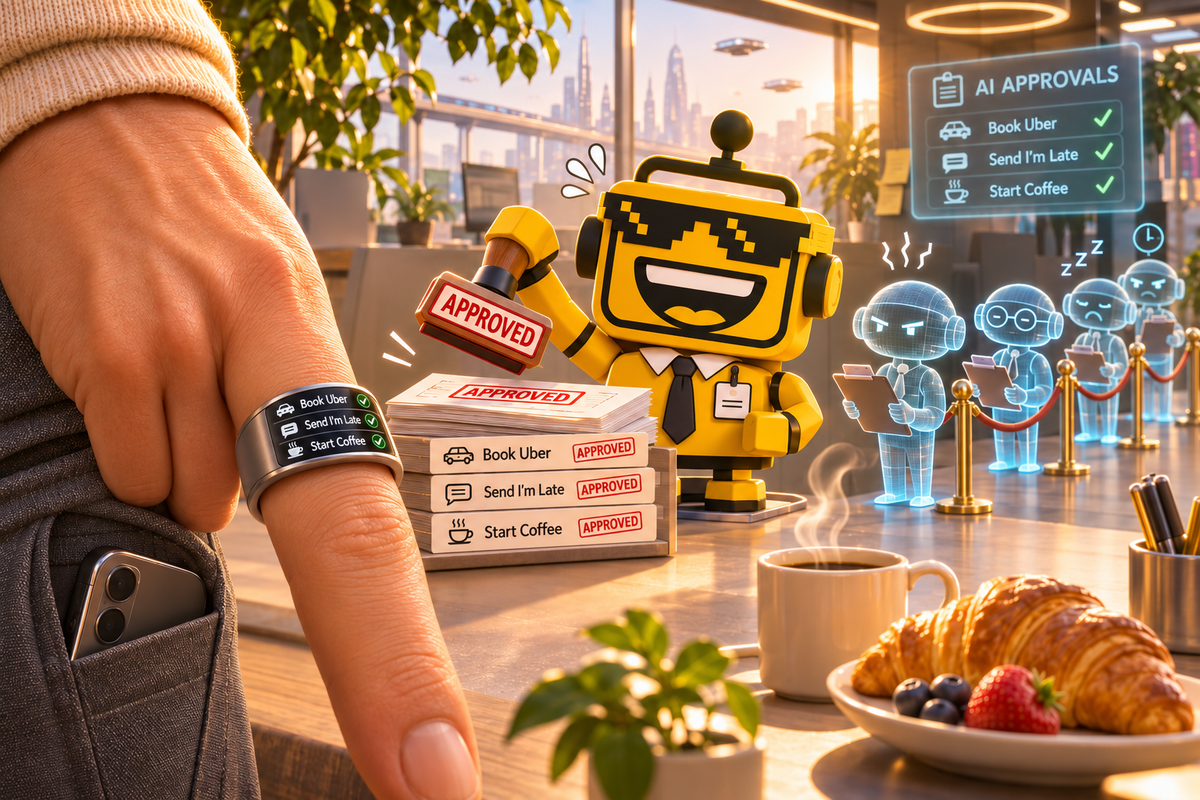
When an AI decides it is time to order your morning Uber, send an apology for your late Zoom arrival, or resume last night’s podcast, Aina’s new ring places the proposal on a miniature OLED and waits for your thumb to flick yes. We have spent two years being warned that autonomous agents will transform civilization. Aina has looked at this coming revolution and correctly identified its most urgent infrastructure need: the equivalent of a nervous manager nodding at expense reports.
Announced November 5, the Aina Ring is a titanium wearable with a display, microphone, speaker, button, and four-way thumb control. It starts at $399 during the limited preorder period, steps through $419 and $449 tiers, and is eventually supposed to cost $499. Shipping is planned for early 2027. A charging dock is included, because even the post-app future must spend every night on a tasteful puck.
This is not a health ring. It does not seem interested in your blood oxygen, sleep debt, or whether yesterday’s lunch has damaged your biological age. It is a remote control for software: part notification screen, part dictation tool, part meeting controller, part phone earpiece, and part permission slip for AI agents. The pitch is narrow enough to be coherent and strange enough to deserve attention.
Your Agents Have Been Waiting for Middle Management
Aina founder Apoorv Shankar argues that proactive agents create a new bottleneck. They can prepare rides, messages, music, and routines, but humans still need to unlock a phone, open an app, inspect the action, and approve it. The company’s Context Aware Operating System studies signals from a connected iPhone, Mac, calendar, email, location, and third-party services, then surfaces three likely next actions as “Cues.” One flick accepts. Another dismisses.
That is genuinely smart. An agent that acts without confirmation is unnerving; one that makes you reopen its app for every decision is merely an intern with excellent punctuation. The ring turns approval into a glanceable physical interaction while keeping the phone—the secure, connected, highly evolved computer you already own—in charge of the heavy work.
The small display matters more than the AI branding. A screen can show which action is pending and whether it actually completed. That visible confirmation answers one of the central questions in SiliconSnark’s skeptical look at dedicated AI hardware: how do you know what the object heard, what it intends to do, and whether it worked? Aina’s answer is not mystical ambient intelligence. It is a tiny status screen. The plumbing is the point.
The company also lets users build custom Cues in natural language and connect outside agents through virtual browsers. That could make the interface more adaptable than a fixed menu of blessed integrations. It could also turn setup into a small career in debugging why your coffee-machine workflow works on Tuesdays but not when Spotify is open. The demo is never the hard part. Reliable context is.
A Smartwatch Was Put in the Dryer
The hardware is pleasingly overcommitted. Four titanium parts contain 140 components. The curved OLED shows the current action and hints at the correct gesture. Aina says the control system supports seven gestures: flick the joystick in four directions, press, double-press, or hold to talk. The ring comes in seven index-finger sizes and four finishes, with the same display across every size.
It is also chunky. This is not the discreet metal band of the beautifully minimal Pebble Index 01. The Aina resembles a miniature smartwatch case that has escaped its strap and attached itself to your knuckle. I mean that as both a joke and a compliment. A usable screen and mechanical control require volume, and the result has the practical science-fiction charm of a decoder ring designed by someone who owns calipers.
The built-in microphone can capture notes, dictate to a Mac, set reminders, or talk to an agent. The speaker supports phone calls, which requires raising your ring hand to your ear like a secret agent whose communications budget was cut. The ring can also control music, Zoom, cameras, Macs, and televisions. One early hands-on tester used it to reply to notifications, surface meetings, call an Uber, and rescue an Apple TV session after the real remote disappeared. He also found much of the software still under construction and the normal Apple TV remote easier when available. This is the most honest possible review of a wearable remote: useful precisely when the better interface has fallen between the cushions.
Eighteen Hours Is One Very Organized Day
Aina claims up to 18 hours per charge. That is enough for waking life if the estimate survives notifications, dictation, calls, Bluetooth, and habitual joystick fidgeting. It is also an overnight charging obligation, which weakens the advantage of putting a device somewhere more persistent than a watch. The ring is rated IP65, so rain, sweat, dust, and splashes are acceptable; swimming and shower confidence are not part of the promise.
The larger caveat is ecosystem width. At launch, Aina pairs with iPhone and Mac. Android and Windows users can admire the approval economy from outside. Supported actions will depend on integrations, permissions, and services that may change their APIs after breakfast. A $399 controller becomes much less magical when the app you need is absent or an agent’s promised action ends in a spinning icon on a very small screen.
There is also a meaningful privacy bargain. A system that learns routines from location, calendar, email, and connected services can be wonderfully helpful because it has access to exactly the data that would be wonderfully harmful if mishandled. Aina says the ring learns patterns from personal context, but the launch material gives far more detail about titanium and gestures than retention, encryption, third-party data flows, or how users inspect and delete the profile it builds. Before preordering, I would want an adult privacy document, not merely a calming animation of an Uber arriving on time.
This is where the ring differs from Alloop’s modular health wearable and the Spark Ring’s voice-capture workflow. Those products collect data to interpret you later. Aina wants to observe context, predict intention, and perform work now. The reward is greater convenience. The failure modes include ordering the wrong ride, messaging the wrong person, or turning on the lights with the confidence of a home-automation poltergeist.
Verdict: A Convincing Interface Waiting for Its Economy
The Aina Ring is a coherent niche flex, not yet a consumer hit. The central interaction is excellent: show one proposed action, explain the available gesture, and require a deliberate human flick. Aina does not pretend to replace the phone. It uses the phone’s connectivity and security while moving the smallest, most frequent decisions onto a wearable surface. That restraint is rare in AI hardware, a category that normally begins by announcing the death of screens and ends by asking you to scan a QR code.
The problem is that Aina is building an interface for an agent economy that remains more forecast than habit. Most people do not spend their day supervising a bustling workforce of autonomous assistants. They use calendars, notifications, shortcuts, Siri, and an increasingly judgmental collection of widgets. For them, $399 buys a smartwatch compressed into a ring, with shorter battery life, fewer established apps, and no obvious health platform.
For AI enthusiasts, automation obsessives, and Mac users who already live among agents, the calculus is better. The hardware gives invisible software a visible, tactile checkpoint. The joystick is faster than opening a phone, the display makes actions legible, and the decision not to chase smartphone replacement is unusually sane.
I am more impressed than annoyed. Aina has identified a real interface problem before it has conclusively proved the market exists. If the software matures, integrations broaden, and privacy controls match the industrial design, this could be the first AI ring whose extra bulk buys clarity rather than theater. Until then, preorder only if you already have agents waiting for your approval. Everyone else can continue bottlenecking civilization with the traditional method: looking at the phone already in your hand.