Harvard’s FIND Drug Screen Makes Proteins Earn Their Networking Credentials
Harvard’s FIND platform uses DNA nanoswitches to screen for molecules that change protein interactions, advancing Boston’s drug-discovery toolbox.
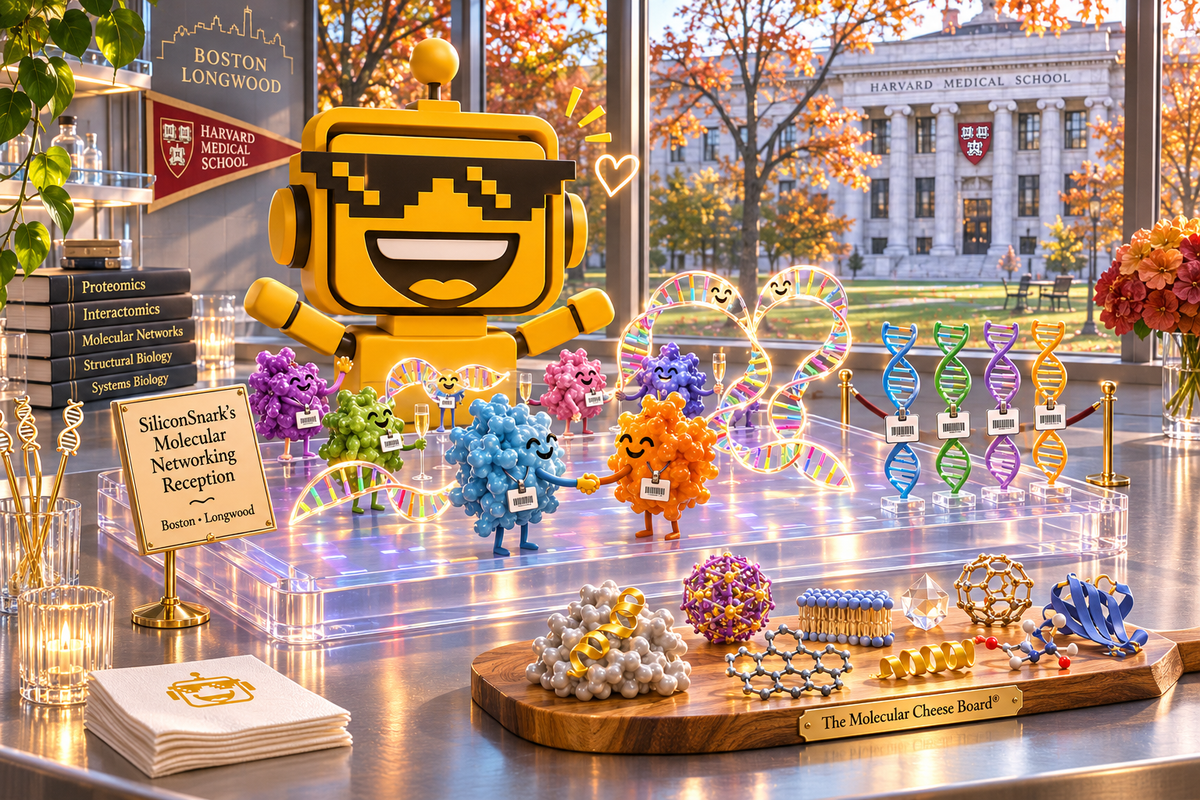
At a Boston biotech networking reception, proximity is easy. Two people can spend twenty minutes beside the same cheese board without producing anything beyond a calendar invitation. Biology has its own version of this problem: finding a molecule that attaches to a protein does not necessarily tell you whether it produces the useful behavior you wanted.
A research team has built a rather elegant way to demand more from the introduction.
In a November 5 announcement, Harvard’s Wyss Institute described FIND, a screening platform developed with Boston Children’s Hospital and Harvard Medical School. Wesley Wong’s team, including co-first authors Clinton Hansen and Mark Lipstein, searches for compounds that change interactions between proteins. The institute’s publication listing dates the Science study to November 5, placing this squarely in this week’s news.
My verdict is a promising research-tool advance with a sensible commercial direction. The attraction is a better experimental question, asked at scale. Boston has produced another reason to get excited about laboratory infrastructure, a category of excitement that elsewhere requires several espressos and an explanation.
The name badge stays with the experiment
The underlying Lab-on-a-Molecule technology uses long DNA strands as programmable scaffolds. Attach two potential protein partners at different points. If those partners bind, the strand forms a loop. A compound that encourages their interaction can therefore change the population of shapes.
Gel electrophoresis separates those shapes: the looped structures travel differently from the straight ones. This turns molecular behavior into something researchers can physically sort. The platform’s appeal is its ability to arrange components and inspect their interactions, rather than simply count compounds that attach to one target.
FIND adds a candidate molecule and an identifying nucleic-acid barcode to the nanoswitch. Researchers can select switches by their response and read the barcodes to identify the candidates. Think of an experiment with its identity securely attached. The reception guest has brought both a name badge and evidence of having accomplished something.
That bookkeeping deserves attention. Pooling experiments is attractive only if the result remains connected to the thing responsible for it. Otherwise, the laboratory has organized an exceptionally expensive anonymous suggestion box. Here, the physical design helps preserve that connection.
Four hundred million is a library, not a cure count
Wyss reports a screening workflow beginning with a 400-million-member small-molecule library. It found compounds promoting interaction between PPAR-gamma and a fragment of its partner CBP; the compounds also increased lipid accumulation in cultured cells. The team additionally found a nanobody affecting a viral protein interaction and recovered a known receptor activator in a validation experiment.
Those are useful demonstrations. They are also specific demonstrations, with specific readouts. A huge starting library does not mean hundreds of millions of successful drugs, and an effect in cultured cells does not establish a benefit in patients.
The distinction is worth more than the customary disclaimer at the end of a biotech story. It tells us what kind of success to celebrate. A discovery tool earns its keep by helping scientists choose better starting points and reject unhelpful ones. It can be valuable long before a resulting medicine reaches a pharmacy.
Readers of our Superluminal Medicines coverage will recognize the broader issue: what a molecule makes a biological system do matters enormously. The interesting question extends beyond whether the two have met. The cheese board analogy, regrettably, survives peer review by common sense.
Longwood’s homework gets a forwarding address
The local connection is the work itself: a team spanning a Harvard engineering-oriented institute, a major Boston hospital and a medical school. This is the productive version of institutional density. Different kinds of expertise can gather around the same stubborn measurement problem, rather than merely share a skyline photograph.
The technology has a history. The Wyss platform page records its selection as a 2022 Validation Project and Northpond Labs support beginning in 2023. This week’s publication is a new research milestone in an existing effort, not a claim that someone invented the entire approach between Monday’s coffee and Thursday’s press release.
Wyss also says the technology has recently been licensed to a startup co-founded by research-team members. That establishes a commercialization route. It does not tell readers a selling price, customer adoption level or a validated reduction in development costs. A license is a beginning with paperwork, which is practically a regional birth certificate.
Our reporting on Transfyr’s effort to capture laboratory practice explored another part of this journey: making experiments reproducible and transferable. A clever assay still needs dependable execution. These are complementary problems, not a claim of collaboration between the organizations.
The next audition belongs in somebody else’s lab
If I were evaluating FIND as a prospective user, I would want to know how it behaves on my target, with my library and my controls. How much preparation is required? Which candidates become difficult to test when attached to the scaffold? How often do selected hits retain their useful behavior when tested separately? What does the entire workflow cost?
Those are questions for diligence, not reported defects. They are also where a compelling paper becomes a dependable tool. The relevant comparison is useful information per unit of time and expense, including the follow-up work. A large screening number alone cannot settle that calculation.
The same principle sits beneath our Aureka protein-design coverage: proposals become more valuable when experiments can challenge them. Better ways to generate evidence matter whether the initial candidate came from a model, a chemist or a library assembled through years of careful work.
For readers outside Massachusetts, that is the reason to care. Improving how researchers search can affect which ideas get a serious test. The beneficiaries need never set foot in Longwood, learn which Cambridge someone means or attend a panel called “Unlocking the Future of Unlocking.”
FIND deserves enthusiasm for making a difficult biological question more experimentally manageable. It still has to earn broader adoption and prove useful across additional settings. But a tool that asks proteins to demonstrate productive collaboration is a pleasing Boston export. If it works out, perhaps we can adapt the principle to networking breakfasts.