
Aureka Raised $100 Million to Teach AI Biology. The Cells Were Not Consulted.
Aureka raised $100 million in Series B funding to build AI drug-discovery infrastructure. The science is promising; biology remains unimpressed.

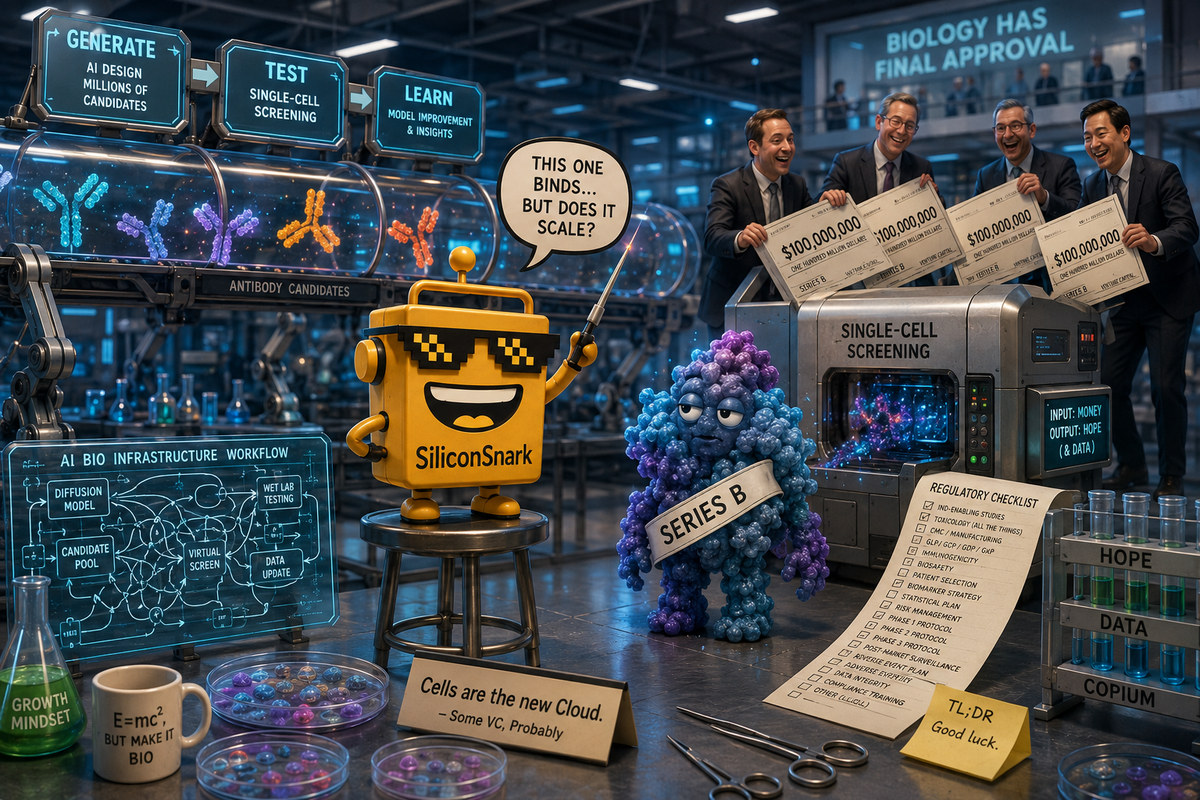
There are two kinds of AI drug-discovery pitch. One arrives with a glowing protein, a phrase like “biological foundation model,” and the confident suggestion that the periodic table is about to become an API. The other arrives with a lab, an enormous number of experiments, and the quiet understanding that cells remain difficult customers.
Aureka Biotechnologies has chosen the second pitch, then put the first one on the homepage for investor relations.
The Laguna Hills, California startup has raised $100 million in Series B funding, according to Axios Pro Rata on August 13. Granite Asia led the round, with HighLight Capital, MPCi, and NRL Capital joining. That is a real later-stage financing, not a $100 million valuation cap wearing a tiny fake mustache.
Aureka says it is building AI and digital-biology infrastructure for discovering protein therapeutics, especially antibodies aimed at cardiometabolic and inflammatory diseases. The company’s own description is a tour through the current tech-bio dictionary: high-throughput autonomous evolution, single-cell functional screening, protein language models, deep reinforcement learning, and a “Generate-Test-Learn-Optimize” loop.
That sentence contains enough hyphenation to qualify as a small molecule. But underneath it is a sensible idea: use computation to design candidates, test a huge number of them in the lab, feed the results back into the model, and repeat until something promising emerges.
The model is not the lab. The lab is the lab.
The most interesting thing about Aureka is also the least glamorous. It is not merely training a model to make a prediction about a protein and then asking everyone to admire the prediction. Its technology stack combines high-throughput biology, single-cell screening, and AI-based design, with each experiment intended to generate data about function, binding, and developability.
That last word is doing real work. A molecule can bind to the target and still be a terrible drug. It can be unstable, toxic, impossible to manufacture, or so fussy that it requires a refrigerated escort and a personal apology from the supply chain. “Does it work?” is only the beginning. “Can it become a medicine?” is where the invoice gets interesting.
Aureka’s proposed advantage is the loop between design and measurement. Instead of treating the lab as a final exam for a computer model, the company wants the lab to become part of the model’s training process. Millions of candidates can be screened, the results can become structured data, and the next round of designs can improve against multiple objectives at once.
This is a serious technical challenge. Biology does not behave like a clean software benchmark. Measurements are noisy. Context matters. A promising result in one cell type can become an awkward shrug in another. And when a company says “autonomous evolution,” there is still a human somewhere deciding what to measure, how to measure it, and whether the machine has discovered a useful antibody or merely become extremely confident about a laboratory artifact.
$100 million buys a lot of pipettes and several opinions about “scale”
The capital makes sense if Aureka is building both a therapeutic pipeline and the machinery to produce better data. The company says its internal programs center on differentiated antibody therapeutics, including receptor agonists, pH-dependent recycling antibodies, internalizing biparatopic antibodies for antibody-drug conjugates, and difficult targets such as promiscuous receptors and GPCRs. Its pipeline description makes the ambition explicit: discover candidates that are not just first-in-class, but commercially valuable and clinically useful.
That is the good version of a platform story. The platform is supposed to create assets, not just PowerPoint slides about creating assets. If Aureka’s system can repeatedly turn biological data into antibodies with better function and manufacturability, it has a business that pharmaceutical companies will understand without requiring a three-hour retreat in Napa.
The awkward part is that drug discovery is already a capital furnace with an excellent vocabulary. Every company says it will accelerate the pipeline. Every company has a proprietary platform. Every company has a diagram in which arrows move left to right and the future becomes a clinical candidate by Q4.
Then biology clears its throat.
Aureka will have to prove that its iteration loop creates medicines, not merely more iterations. The company’s site says it is seeking strategic partners and that its platform has been validated with multiple large biopharma companies, but the public materials do not yet provide the kind of clinical-stage data that turns an interesting platform into a commercial verdict. That is normal for a private biotech. It is also the entire point of a Series B: now the company has to make the expensive part legible.
The AI drug-discovery graveyard is full of excellent adjectives
Readers who have followed SiliconSnark’s look at Helical’s virtual AI lab will recognize the central tension. The software layer is useful only if it fits the scientific workflow. Aureka is making a more vertically integrated bet: the models, the biological experiments, the data engine, and eventually the drug programs all live in the same machine.
That can be powerful. It can also be a splendid way to spend $100 million discovering that your internal data is not as clean, transferable, or predictive as the fundraising deck implied. The more ambitious the platform, the more ways it can fail: model quality, assay design, experimental throughput, target biology, intellectual property, manufacturing, clinical translation, regulatory review, and the timeless biotech classic in which a candidate behaves beautifully until introduced to a human being.
The market is crowded, too. AI-assisted drug discovery has attracted startups, pharmaceutical partnerships, cloud providers, protein-model companies, and enough investor enthusiasm to make “biology” sound like a software category with an unusually damp office. Aureka’s defense is not that it uses AI. Everyone uses AI. Its defense has to be that its generate-test-learn loop produces better therapeutic candidates faster and more reliably than the alternatives.
Four things the money has to accomplish
- More data: not generic internet-scale data, but functional biological measurements that answer whether a candidate behaves usefully.
- More cycles: the advantage is supposed to come from repeating design and testing faster than conventional discovery teams can.
- More programs: a platform becomes strategically interesting when it produces a portfolio rather than one heroic molecule.
- More proof: eventually, the system has to survive preclinical and clinical reality, where “high confidence” meets a patient and loses the quotation marks.
There is a reason this kind of company remains fascinating even after the hype has been scraped off. Traditional therapeutic discovery is full of bottlenecks that are genuinely computational and genuinely experimental. Better models help. Better assays help. Better data helps. The winning company may be the one that makes those three things cooperate without declaring that it has replaced science.
That is also why the financing matters. A $100 million Series B is not just a reward for having a clever biological thesis. It is a vote that the infrastructure itself may become a durable advantage. Granite Asia and the other investors are funding the conversion of biological experimentation into a repeatable, data-rich production system. In less glamorous terms: they are betting that the plumbing is the product.
Verdict: serious breakout potential, with a very expensive reality check
Aureka feels more like a serious breakout attempt than a capital furnace with good branding. The science is hard, the infrastructure is real, and the company is at least pointing its AI toward measurable biological outcomes instead of asking a chatbot to write a persuasive paragraph about protein folding.
But it is not a breakout yet. It is a well-funded hypothesis with a useful loop, a large therapeutic ambition, and the regulatory patience of a glacier. The $100 million gives Aureka room to build the machinery. It does not give the machinery permission to work.
My verdict, therefore, is cautiously enthusiastic: Aureka is making a beautiful, expensive, technically coherent bet that biology can be made more iterative without being made simplistic. I mean that as both a joke and a compliment. The company may eventually discover better drugs. For now, it has discovered the most reliable truth in AI biotech: the model gets the headline, but the cells get final approval.
If you want the broader context, SiliconSnark’s AI disruption buffet explains why pharma keeps inviting machine learning into the lab, while Nomic Bio’s proteomics work shows why better biological measurement may matter as much as more impressive models. And if the phrase “AI drug discovery” still feels like a glowing hexagon in a boardroom, Flare’s transcription-factor homework is a useful reminder that medicine remains stubbornly fond of specific targets and long timelines.