The AI Trade Is Dead. Please Redirect All Funding to Quantum Staplers.
The AI stock selloff has clearly ended artificial intelligence forever. Time to fund quantum staplers, subscription grass, and a revolutionary guy named Gary.
Well, that settles it. Artificial intelligence is over.
On Thursday, November 5, the Nasdaq fell about 5.5%, the S&P 500 dropped 4.4%, and the Dow lost 3.4%. According to Cboe’s market recap, Nvidia declined 9.3%, while AMD fell 17.3%, as investors hammered stocks tied to the AI buildout.
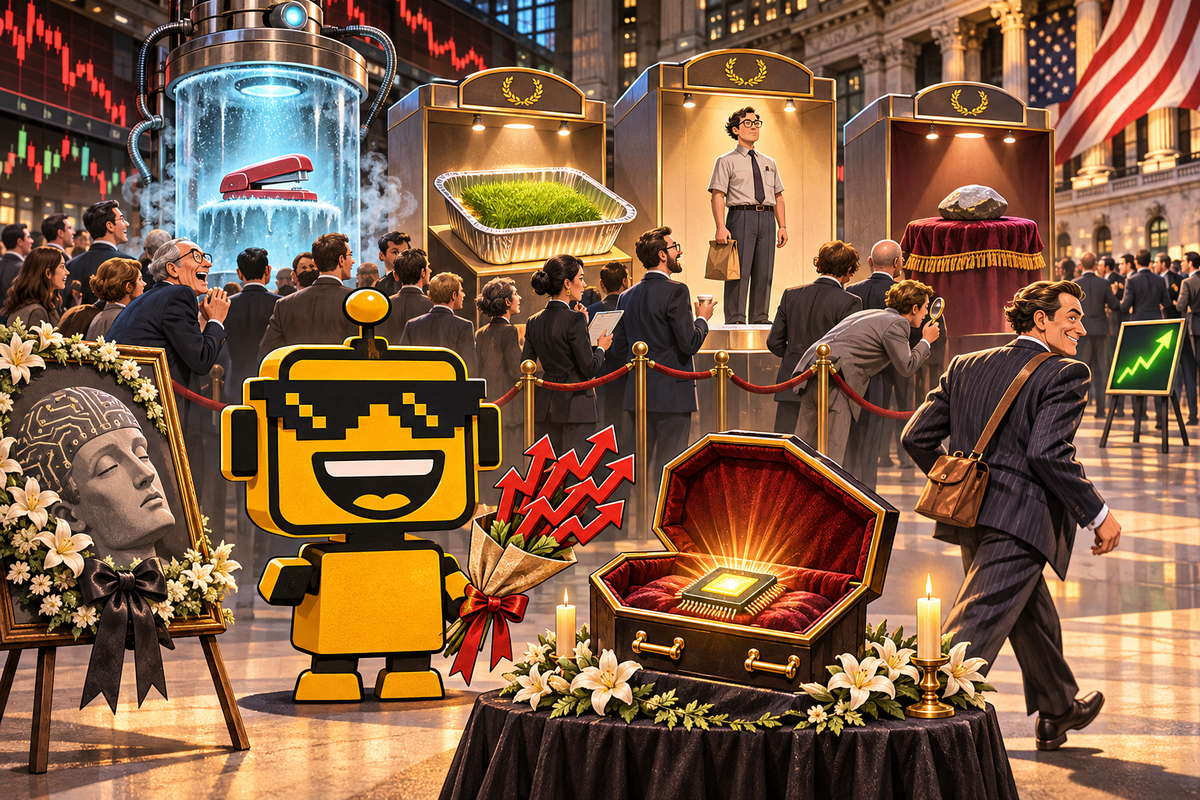
These are serious losses. They also constitute, under the scientific method practiced inside a brokerage app, conclusive evidence that computers can no longer do the things they did on Wednesday.
Please return all generated images to the internet. Any code written with AI assistance must be unwritten by hand. If a chatbot helped you compose a difficult email this morning, the email is now legally a pumpkin.
I used to do predictive analytics. As of this afternoon, apparently I used to exist.
We Regret to Announce That the Line Went Down
There are tedious explanations available. Investors might be reconsidering valuations, infrastructure spending, financing conditions, and how long it takes a very expensive machine to become a very profitable business. Cboe also pointed to fears that election results could bring more obstacles to data center construction.
But those explanations require several sentences. “AI is dead” fits comfortably over a thumbnail of a man holding his temples.
We have previously explored the distinction between useful technology and an investor discovering the invoice. Regrettably, distinctions underperformed the market today and have been removed from the portfolio.
The sensible societal response is therefore to abandon the entire field immediately. Cancel the research. Reclassify the data centers as unusually judgmental warehouses. Tell the person using AI to translate a document that price discovery has revoked their Spanish.
Then find the next big thing. The capital needs somewhere to go, and nobody bought a fleece vest to sit quietly with uncertainty.
I have prepared five entirely fictional investment opportunities for our entirely inevitable next wave of collective overconfidence.
Quantum Staplers Will Bind the Future
The quantum stapler solves the oldest problem in office productivity: someone has already invented the stapler.
Our fictional startup, Entangl, will overcome this obstacle by placing the staple in a state of commercial possibility. Until you open the pitch deck, it has both achieved product-market fit and requested a bridge round.
The demonstration involves two sheets of paper and a refrigerator the size of a regional airport. A researcher presses a button. Somewhere, a slide advances.
Customers will initially complain that a normal stapler costs less and works at room temperature. This is exactly the sort of incumbent thinking that prevents civilization from spending $400 million fastening an expense report.
The consumer model ships when physics and procurement align. The enterprise model ships sooner because it is a consulting engagement.
Grass as a Service Finally Brings the Outdoors Behind a Paywall
Everyone keeps telling us to touch grass. Nobody has built a defensible billing relationship around the touching.
Meet Lawnch: a square of ordinary grass delivered in a machined aluminum tray, accompanied by an app that verifies you were outdoors emotionally.
The free tier includes looking. Lawnch Plus unlocks contact. Family accounts support up to four authorized toes, with additional feet billed through the marketplace.
For enterprises, Lawnch offers a dashboard proving employees experienced nature without becoming unavailable on Slack. A manager can see that Brenda achieved seven minutes of restorative grounding and then ask why the deck is late.
Grass itself remains stubbornly available in the ground, which is a distribution problem our legal team is investigating.
Having chronicled technology’s long relationship with marketable vocabulary, I recommend calling this spatial wellness infrastructure. “Lawn” sounds like something your uncle already owns.
Human Intelligence Arrives, and Its Name Is Gary
Our third venture has developed a system capable of reading an email, understanding context, and occasionally asking a sensible follow-up question.
It is Gary.
Gary is a person. He has a chair, a salary, and a surprisingly strong opinion about which printer works. He can attend a meeting and remember that the client’s real problem was mentioned before the presentation started.
We will introduce Gary as a biological reasoning engine with persistent embodied memory. Investors will be permitted to meet him after signing an NDA.
There are scaling concerns. Gary takes lunch. Running additional instances requires recruiting other people, who may have different names. The enterprise license includes dental.
Still, Gary can tell you a project is a bad idea before your company spends six months implementing it. This feature will be disabled by default to protect executive adoption.
The Smart Rock Has a Battery Life of Yes
The next great wearable is a rock.
No screen. No microphone. No charger. No account linking. You hold it, and nothing asks whether you enjoyed holding it.
We will call it Pebbl, because vowels are a sign that the founders have not suffered enough.
Its central innovation is that it never sends a notification. Early customers describe feeling calmer, although we cannot rule out the possibility that they have simply stopped looking at their phones.
The hardware business is admittedly vulnerable to beaches. Our moat will be certification: only an authentic Pebbl has been verified to contain absolutely no features.
A premium model will cost twice as much because it is heavier. Reviewers will describe the heft as reassuring. Six months later, someone will add an AI assistant, and we will all have to move again.
The Metaverse Returns Wearing a Different Jacket
Finally, we should revisit the idea of making everyone put a computer on their face to attend a meeting they already resent.
Obviously we cannot call it the metaverse. That word has luggage. We will call it Presence Infrastructure, and the pitch will contain a photograph of two people making eye contact.
The breakthrough is a virtual office where colleagues can experience the commute as downloadable content. Instead of clicking a meeting link, you walk a digital corridor while a subscription elevator verifies your permissions.
Somebody will ask whether a phone call would be easier. Gary, now advising the company, will nod. His contract will not be renewed.
The revenue model is selling virtual land to companies that have just spent three years trying to get out of actual leases.
We Will Remain Disciplined Until the Next Green Candle
The attraction of declaring an entire technology dead is that it saves everyone the trouble of evaluating individual products, businesses, and prices. We can skip straight from religious conviction to funeral arrangements without the unpleasant intermediate step of learning anything.
Our coverage of the AI boom-versus-bubble argument has already encountered this appetite for absolute certainty. A technology can be useful, its economics unsettled, and some of its valuations absurd at the same time. Unfortunately, that sentence cannot host a victory lap.
So yes, the AI trade is definitely dead. As a society, we should move on with the calm, sober judgment that brought us here.
Put the GPUs in storage. Give Gary a badge. Wire the quantum stapler people whatever they ask for.
If tech stocks bounce today, please disregard this article. Intelligence will have been restored, the future will once again be inevitable, and Lawnch will announce that its grass is agentic.
Gary will still want dental.