Velora Turns Your Dinner Into an AI Coach, Then Encrypts the Guilt
Velora launches with AI meal scans, adaptive coaching, and end-to-end encryption. It is a surprisingly sane health app with one tiny problem: your body is still involved.

There are two kinds of health apps. The first asks for your credit card before it lets you photograph a banana. The second gives you twelve colored rings, a “readiness” score, and the creeping suspicion that your sleep has become a performance review.
Velora, launching August 7 on iPhone and Android, is trying to build a third category: the health app that looks at your food, workouts, recovery, and weight without immediately behaving like a gym bro who discovered databases. Its pitch is an AI meal scanner, an adaptive coach, workout tools, cycle tracking, and a privacy model built around encrypted health logs. The Velora launch page also makes a relatively unfashionable promise: the basics are free, with paid plans raising limits rather than locking the entire product behind a trial-shaped trapdoor.
I have not had a week of hands-on use, so this is a launch review rather than a lab report from my stomach. But Velora has supplied enough detail to judge whether this feels like a real tool or a wellness funnel wearing a tasteful serif font.
Your lunch is now a data-entry problem with photography
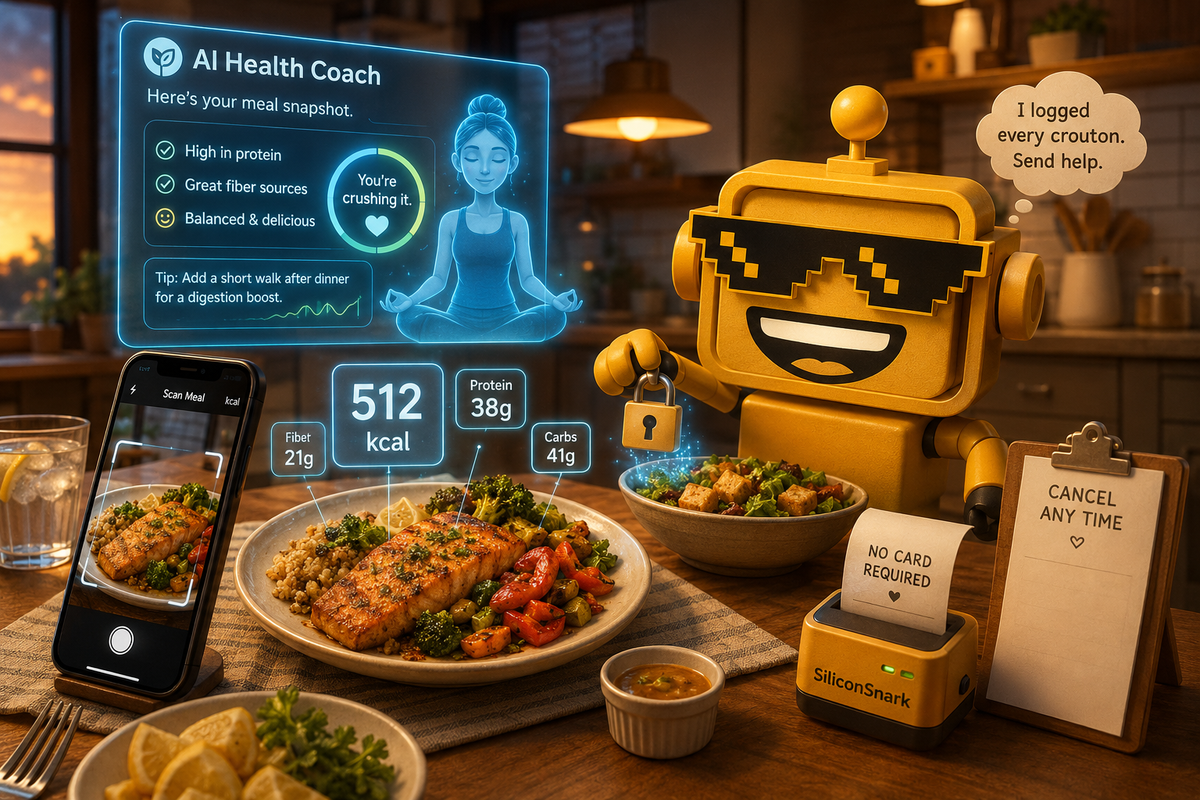
The central feature is AI meal scanning. Photograph your plate and Velora says it can estimate calories and macros in seconds, without asking you to weigh every blueberry like a forensic accountant. The app then feeds that information into an AI coach that also sees your workouts, runs, recovery, weight, and waist logging.
This is the right problem to attack. Most people do not need another dashboard. They need the dashboard to stop staring at them and explain what to do next. A meal scanner can remove the most annoying part of nutrition tracking: turning dinner into an administrative event with serving-size math. It will not make the estimate perfect. A photo cannot know whether the sauce was a teaspoon or a small regional export. But lowering the friction matters because health habits usually die somewhere between “I should track this” and “I have opened a spreadsheet about hummus.”
Velora’s free tier includes three AI meal scans per day, plus the coach, weight and waist logging, workout building, quick workout generation, live workout tracking, running, cycle tracking, and community features. That list is not revolutionary. It is something better: legible. The product tells you what it is for without stapling on a crypto wallet, a sleep ring, and a virtual celebrity trainer named Braden.
The coach wants context, which is both the point and the problem
The more interesting promise is not “AI can recognize a salad.” A moderately determined camera app can recognize a salad. Velora wants the coach to combine nutrition, training, recovery, and progress so the advice changes when your week changes.
That is a meaningful distinction. A static meal score is just a number wearing athletic shoes. A contextual coach could notice that you are training more, sleeping less, and eating like a person left alone in an airport. It could suggest a shorter workout or a recovery day instead of congratulating you for achieving the perfect shade of green.
This puts Velora in the same emerging lane as Fitbit’s alarmingly useful AI health coach, where the actual consumer opportunity is interpretation. People are drowning in measurements and starving for context. The product that wins may not be the one with the most sensors. It may be the one that can say, “Your plan is too ambitious this week,” without sounding like a disappointed substitute teacher.
There is a ceiling here, obviously. AI coaching is not medical care, and Velora’s own launch material presents this as wellness guidance rather than a diagnostic system. The best version of the product nudges, organizes, and clarifies. The worst version confidently invents a relationship between your oatmeal and your cortisol while recommending that you “listen to your body,” a phrase that has never once helped me locate the body part making the decision.
End-to-end encryption is the feature nobody puts in the hero image
Velora’s strongest differentiator may be the least photogenic one. The company says weight, meals, cycle history, and workout logs are stored as ciphertext in its database. It says the information is not sold, shared, or used to train outside models, and that AI meal scanning and Coach chat ask permission before the relevant data is decrypted for processing.
That is the kind of boring infrastructure decision that makes a consumer product more trustworthy. Health apps are not automatically wrapped in a magical privacy force field just because their icon contains a heart. As Voyage Health’s privacy story demonstrates, the details matter: what is stored, what is shared, what is linked to your identity, what can be deleted, and which parts of the experience are actually allowed to inspect your history.
Velora is at least putting those questions near the front door. That does not prove the implementation is flawless. “Encrypted” is not a substitute for clear retention rules, access controls, breach response, or an explanation of every vendor in the processing chain. But it is a better starting posture than treating a person’s cycle history as a growth funnel with a pastel gradient.
Free means free, until the limits become your personality
The pricing is unusually sane by current wellness-app standards. Velora says there is no card required to start, no trial clock, and no cancellation maze. Paid tiers raise usage limits; they do not unlock the basics. The launch page lists Lite at $2.99 per month after a free month for founding members.
Three scans a day is enough for many normal humans. Breakfast, lunch, dinner. It is less accommodating to anyone who photographs snacks with the intensity of a police evidence technician, but that may be a useful boundary. Limits can make a free product sustainable. They become annoying when the app quietly turns your habits into a series of little toll booths.
Velora’s approach also gives it a chance to earn trust before asking for money. You can see whether the coaching is useful, whether the scanning is close enough, and whether the app makes you feel helped rather than audited. That is smarter than the common strategy of letting users experience exactly one useful feature before billing them for the privilege of continuing to have a metabolism.
Who should use it, besides people holding suspiciously photogenic toast?
Velora is for the broad middle: people who want better nutrition and training habits but do not want to become full-time custodians of their own biometric data. It is not aimed at elite athletes with a coach, a lab, and an opinion about lactate thresholds. It is also not for anyone seeking medical advice from a chat bubble.
The privacy-first angle may appeal to people who have avoided health apps because the trade seemed too obvious: give a startup your most intimate data in exchange for a nicer calorie counter. And the cross-category design is promising. Nutrition, training, recovery, and cycle data make more sense together than in four separate apps each sending a notification about your “journey.”
It also has the right product humility. Velora does not need to invent a new body part. It is software trying to make existing behavior easier to understand. That puts it closer to Pebble’s gloriously simple Index 01 than to the category of gadgets trying to become an emotionally available operating system. And if you want to see what happens when a consumer interface tries to turn every routine into an AI surface, Google’s tiny staffers with boundary issues remain a useful warning label.
Verdict: a real consumer hit, if the advice stays quieter than the guilt
Velora looks like a real consumer hit in progress, not because it has a spectacular demo, but because its pieces fit. The meal scanner reduces friction. The coach adds context. The free tier is understandable. The encryption pitch addresses the category’s most important trust problem instead of hiding it under a photograph of a person laughing near a smoothie.
There are risks. Computer vision will misread food, AI coaching can become overconfident, and free limits can turn into a subscription funnel in slow motion. No privacy page should be accepted without reading the actual terms and data flows.
Still, this is more impressed than annoyed. Velora is a niche flex only if “people who want to be healthier without turning their lives into a spreadsheet” is a niche. I mean that as both a joke and a compliment. The app’s beautiful overreach would be pretending it can solve health. Its smarter ambition is smaller: make the next decent choice easier, keep the data treated like it belongs to you, and stop talking before dinner becomes a board meeting.