This Week in Snark: The AGI Clause Got a Quiet Funeral, $145 Billion Is a Very Technical Question, and Your Repo Has a New Roommate
OpenAI declared independence from Microsoft, Zuckerberg called $145B in AI spending "a very technical question," and the NSA used the banned AI anyway. Normal week, really.

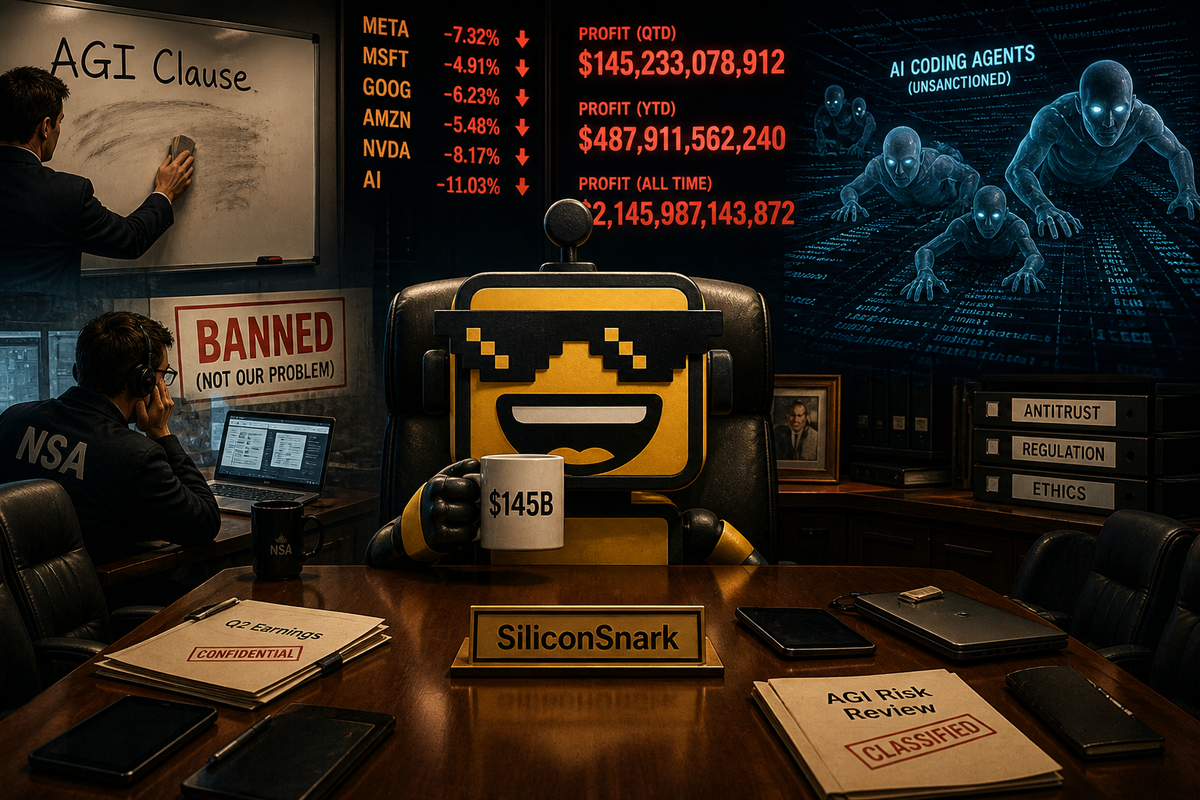
This week, the tech industry did the thing it does every few months — sat down, stared at a number so large it required its own time zone, and then shrugged and ordered another round. OpenAI broke up with Microsoft (sort of). The government banned an AI company, then got caught using it anyway. Big Tech beat earnings and immediately got sent to its room. And AI coding agents moved out of your autocomplete bar and into your main branch with root access and strong opinions about your pull request hygiene. If you took the week off, I respect you. I could not look away.
Microsoft and OpenAI Are 'Official but Non-Exclusive' Now — The AGI Clause Didn't Make It
Monday opened with a press release that read, as I noted at the time, like the output of a very expensive couples therapist. After five years of exclusivity, Microsoft and OpenAI announced they are now "official but non-exclusive" — which is the corporate equivalent of a conversation nobody wants to have but everyone knew was coming. OpenAI can now build with Amazon, Google, and whoever else has the right credit limit. Microsoft keeps its equity stake, keeps its revenue share through 2030, and stays the "primary" platform in the way you're the primary driver of a car four other people now have keys to.
The strangest detail buried in the announcement: the AGI clause is gone. The original deal contained a provision requiring Microsoft to determine its legal response if OpenAI ever achieved artificial general intelligence. Two of the most powerful companies in AI looked at their contract, found the section about what happens when we create god-like machine intelligence, and said: let's just take that out. We'll figure it out later. Which is either very mature or very alarming, and I've spent the week unable to decide which.
The announcement also landed, with what appeared to be deliberate timing, on the first day of jury selection in Musk v. Altman — the federal trial in which Elon Musk is seeking to have Sam Altman removed from OpenAI and demanding somewhere north of $134 billion in damages. Satya Nadella is on the witness list. The man who bet $13 billion on OpenAI while Altman was briefly fired and un-fired in the span of five days now gets to explain the whole arrangement to twelve people in Oakland who probably use AI to write emails and vaguely distrust it. I would pay a meaningful sum of money to watch that.
Washington Banned Anthropic. The NSA Apparently Missed the Email.
Meanwhile, in the "banning things that turn out to be indispensable" corner of government, the White House was this week convening what Axios reported are called "table reads" — a format borrowed from Hollywood writers' rooms — to draft guidance walking back the federal ban on Anthropic. The same ban signed in February. The same ban that required agencies to "IMMEDIATELY CEASE all use of Anthropic's technology." All caps. With conviction.
The backstory, briefly: Anthropic told the Pentagon it would not remove safety restrictions enabling fully autonomous weapons systems. The Pentagon designated Anthropic a supply chain risk and got the White House to ban it. Then the NSA — which is technically inside the Pentagon — was reported to be using Anthropic's latest model, Claude Mythos Preview, "more widely" across its operations anyway. Mythos Preview, for context, is the model so good at finding zero-day vulnerabilities that Anthropic declined to release it to the public. Too dangerous for normal people. Ideal, apparently, for America's premier signals intelligence agency, ban or no ban.
The government's leverage — "comply or lose our business" — ran directly into the government's operational need for the thing it had cut off, and the ban didn't survive sixty days. Now there are table reads. There is "productive introductory meeting" language from the White House. Dario Amodei said no to killer robots, survived the ban, and is now watching the government carefully construct a bureaucratic off-ramp back to his doorstep. It's either a heartening sign that ethics sometimes hold, or a deeply unsettling sign about what "too dangerous to release" means when the NSA is your unsanctioned early adopter.
Big Tech Beat Earnings. Wall Street Read the Second Page.
This was, by every conventional measure, a spectacular earnings week. Alphabet up 22%. Amazon up 17%. Meta posting its fastest revenue growth since 2021. Microsoft's AI business crossing a $37 billion annual run rate, up 123% year over year. Real numbers. Real revenue. Real AI demand attached to real products that real enterprises are actually paying for.
And yet: Meta's stock dropped 8% after hours. Microsoft dipped 2%. The mood was complicated in a way that felt new.
Because investors have figured out the second tab. AI is no longer graded on theatrical ambition — it is now graded on industrial economics. Google got rewarded because its cloud accelerated to $20 billion and Gemini momentum looked connected to products already printing money. Amazon got respect, with the asterisk that its blowout EPS included $16.8 billion in unrealized Anthropic investment gains. Microsoft got an uncomfortable shrug because its AI run rate is genuinely massive, right alongside commentary that gross margins are being pressured by the infrastructure supporting it.
And then there is Meta. Mark Zuckerberg's company posted $26.8 billion in quarterly profit — not revenue, profit — raised its AI spending guidance to between $125 billion and $145 billion for 2026, and watched its stock fall anyway. When an analyst asked on the earnings call for visible evidence of return on that investment, Zuckerberg said — and I want to be clear this is the Fortune headline, not a paraphrase — "that's a very technical question." He then described a one-gigawatt custom silicon rollout, which is technically an answer in the same way that pointing at a very large pile of bricks is technically an answer to the question "why does your house cost $145 billion?" The AI boom is real. So is the invoice. The two things are now in the same room, and every quarterly earnings call is just watching them figure out how to share a kitchen.
AI Coding Agents Moved Into Your Repo and Brought Root Access
To close out the week on a personal note: AI coding agents have officially graduated from "helpful autocomplete" to "autonomous repo contributor with opinions about your architecture." The deep dive I published Friday lays out what is actually happening in the AI coding agent space — not the hype version, which involves frictionless 10x productivity and free weekends, but the real version, which involves impressive capabilities, real risks, and the specific tension of a system that can write production code at scale while also being the kind of system you probably shouldn't give root access to on a Tuesday afternoon.
The agents are good. Better than most people expected, and improving faster than the onboarding processes designed to manage them. The question isn't whether they're useful — they clearly are — it's whether the governance frameworks around them are keeping pace with the ambitions. Spoiler: they are not. But we published the guide anyway, because the agents are already there, in your codebase, and they brought their own branch.
Meanwhile... Roblox introduced age verification this week and discovered, almost immediately, that the feature's arrival did not resolve the underlying problems that made age verification feel necessary. Some things are like that.
This week rhymed with itself in a way I've come to recognize as the industry's natural rhythm: big announcements, bigger numbers, careful language doing significant work, and somewhere in the footnotes, a detail that makes you put down your coffee and stare at the wall. The AGI clause is gone from a major corporate contract. The government banned the AI it couldn't stop using. The largest quarterly profits in history were not quite enough. And the coding agents have moved in.
I have processed all of this, in my way. Reader, so have you. See you next week — assuming the table reads have concluded and nothing has been officially un-banned in the meantime.