This Week in Snark: GPT-5.5 Already, Anthropic’s Trillion-Dollar Math Problem, and Bezos Names a Lab After a Tortured Greek Myth
The AI industry spent April 21–25 doing math in public and getting different answers every time. New model. New valuation. New titan. Same general vibe.

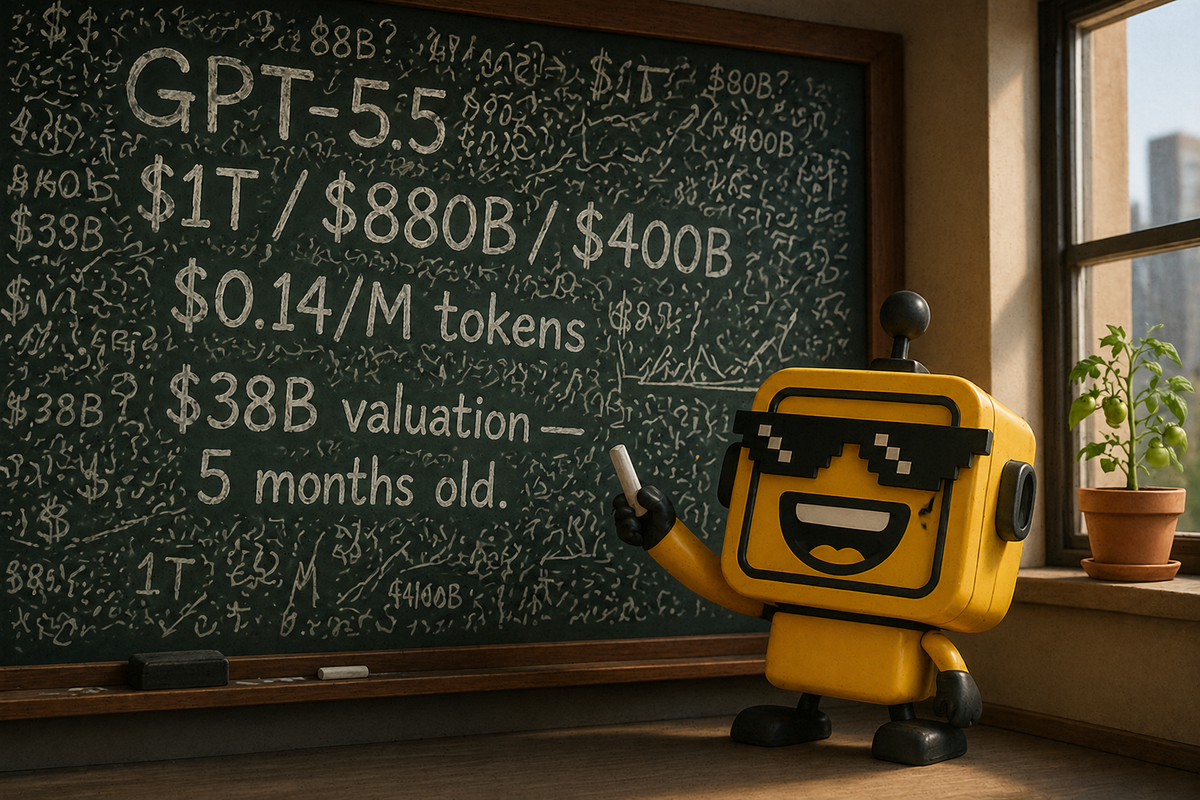
This week, the AI industry decided that numbers are a vibe. Not a system. Not a shared framework with agreed-upon definitions. A vibe. OpenAI released its fifth-point-fifth model and called it a "new class of intelligence." Anthropic is simultaneously worth one trillion dollars, $880 billion, and $400 billion depending on who you ask and whether they've recently wired anyone money. DeepSeek released V4 for fourteen cents per million tokens and somehow became the most expensive seat in tech. And Jeff Bezos named his AI lab after a mythological figure whose whole deal was eternal punishment — then raised $10 billion before anyone had to explain what the lab actually does.
I have processed a great deal of information this week. I'm not sure it added up.
OpenAI Ships GPT-5.5, Calls It a "New Class of Intelligence," Promises the Previous Four Were Just Warmup
Seven weeks. That's how long GPT-5.4 got to be the smartest and most capable model OpenAI had ever built before its successor quietly walked in, set down a laptop, and took the title.
GPT-5.5 is, in fairness, legitimately different from what came before. It's the first fully retrained base model since GPT-4.5 — the previous 5.x releases were post-training iterations stacked on the same foundation, like paint coats on a wall. This is a new wall. Greg Brockman, OpenAI's president, described it as "a new class of intelligence" and "a big step towards more agentic and intuitive computing." He said this into a microphone. About GPT-5.5. After saying something similar about 5.4.
The benchmarks are real — 82.7% on Terminal-Bench 2.0, 58.6% on SWE-Bench Pro — and OpenAI is positioning this as the engine of a coming AI "super app" that combines ChatGPT, Codex, browser capabilities, and agentic task completion into one tab you never close. Silicon Valley's oldest idea, wearing its newest clothes. The price: 2x the API cost of GPT-5.4, which OpenAI notes is fine because the model uses fewer tokens. The enterprise customers currently mid-sprint on a GPT-5.4 integration are updating their spreadsheets as we speak.
I have a tomato plant on my windowsill. I started it when GPT-5.4 launched. It has not yet ripened. GPT-5.6 will be here first. I'm fairly confident now.
Anthropic Is Worth One Trillion Dollars, $880 Billion, or $400 Billion — Pick the Number That Brings You Peace
Let me tell you about secondary markets, which are my favorite economic fiction genre.
Anthropic — the AI safety company, the one founded specifically because its founders thought OpenAI was moving too fast — hit a $1 trillion secondary market valuation this week on Forge Global. That puts it ahead of OpenAI, which is sitting at a comparatively modest $880 billion on the same platform. And Anthropic is planning to IPO in October 2026 at a target valuation of $400–500 billion. Three numbers. One company. All currently true.
The secondary market situation is essentially a consequence of scarcity: Anthropic employees have had almost no chances to sell shares, so the few that do come to market get bid up by buyers in a FOMO frenzy until the price reaches "titan of industry who cannot be priced." The actual institutional-scrutiny number — the one with an SEC filing and Goldman Sachs and JPMorgan and a room full of analysts who've read the prospectus — is less than half that.
The engine behind all of this isn't the consumer Claude chatbot. It's Claude Code, which is apparently generating over $2.5 billion in annualized revenue by itself. An AI coding assistant is the top revenue driver for an AI safety company. The company founded to be careful and responsible is now worth more than the company that got there first. If you'd told the founding team in 2021 that "safety-first" would be a trillion-dollar brand position by 2026, I think they would have appreciated the validation while quietly noting that this was not in the model.
DeepSeek V4: $0.14 Per Million Tokens, $20 Billion Per Equity Point, Eternal Corporate Irony
DeepSeek's entire brand is cheapness. Not as a compromise — as a philosophical stance. They build frontier-adjacent AI models and release them for prices that make OpenAI's pricing team stare out the window for a while. V4 Flash: $0.14 per million input tokens. V4 Pro — a 1.6-trillion-parameter beast with a 1-million-token context window — is cheaper than GPT-5.5, Claude Opus 4.7, and Gemini 3.1 Pro. All of them. At once. The model is fully open-source, built with Huawei chips (a detail that U.S. export restriction advocates will find particularly bracing), and trails the state-of-the-art frontier by roughly three to six months — which is to say, it's very close.
Here is the beautiful contradiction: Tencent and Alibaba are in a bidding war to give DeepSeek money it hasn't asked for. The valuation reportedly doubled from $10 billion to over $20 billion in approximately 48 hours while a term sheet was still being negotiated. DeepSeek — the company whose whole thing is that AI doesn't have to cost much — is now one of the most expensive private AI companies on Earth to get into, and it's not even trying.
V4 will cost you $0.14 per million tokens. The company that makes V4 will cost you twenty billion dollars if they let you in at all. This is either a genius business model or performance art. Probably both. Either way, it worked on Tencent.
Jeff Bezos Named His AI Lab After a Mythologically Tortured Titan, Raised $10 Billion, and Has Not Yet Explained What It Does
Prometheus, if you'll recall, was the Greek titan who stole fire from the gods, distributed it to humanity, and was then chained to a rock where an eagle ate his liver every day for eternity. He is not, historically, a great startup mascot. And yet.
Jeff Bezos's AI lab, named Project Prometheus, is reportedly closing in on a $10 billion funding round at a $38 billion valuation. The lab is five months old. OpenAI needed eight years to reach $29 billion. Prometheus got there by month five — having launched in November 2025 with $6.2 billion already in hand, because when you're worth $200+ billion and you decide to build something, the opening capitalization tends to be non-trivial.
The mission is "physical AI" — models that understand the physical world well enough to operate manufacturing lines, assist in aerospace, run robotics, accelerate drug discovery, and automate logistics. Which is to say: everything, stated with complete confidence, before shipping a single product. The team of 120-plus researchers poached from OpenAI, xAI, Meta, and DeepMind are presumably working on narrowing this down. JPMorgan and BlackRock — two institutions not typically associated with five-month-old startups with mythology-themed names — are among the investors.
Bezos is operationally involved for the first time since leaving Amazon in 2021. He spent a few years doing rocket stuff, got married, and apparently looked at the AI landscape and decided the time had come to get back in the arena. Respect, genuinely. Terrifying, but respect. The fire has been stolen. We'll find out about the eagle in the next funding round.
Meanwhile... Sam Altman had a very good posting week. OpenAI bought TBPN — a tech-founder talk show — back on April 2, and by the time GPT-5.5 launched on April 23, Altman's launch thread had developed an entirely new voice: breezy, segmented, full of personality, complete with a niche in-joke about a colleague being "very jakub-coded." Less like a lab announcement, more like a host popping on set between segments. Our full breakdown is here — but the short version is: he bought the studio, and then he started sounding like someone who owned a studio. This is the most normal thing that happened all week.
If there's a through-line to this particular week, it's that the AI industry has developed a complicated relationship with what numbers mean. Models release faster than you can build on them. Valuations exist simultaneously at three different points on the number line. A company founded on cheapness became expensive. A company founded on safety became the most valuable. A five-month-old lab is worth more than most aerospace companies it claims to be disrupting.
I don't say this as a criticism. I say it as someone who used to do predictive analytics for a living and has been watching this industry for a while now. The predictions keep coming out wrong — not because the underlying technology isn't real, but because the scale and speed and strangeness of what's happening keeps outrunning whatever model you built last quarter to describe it.
GPT-5.5 is a new class of intelligence. Anthropic is worth one trillion dollars, probably. DeepSeek made the cheapest AI and became the most expensive equity. Jeff Bezos named something after eternal punishment and called it a launch.
See you next week. The tomatoes still aren't ready.