This Week in Snark: Allbirds Becomes a Data Center, Factory Replaces Your Engineers, and Apple Tells Anything It Can Do Nothing
A shoe brand sold its soles for GPUs. A startup named Factory raised $150M to automate your job. And Apple banned an app called "Anything." Twice.
Welcome to the week where a sustainable sneaker company became a GPU farm, a startup named after the thing it's automating hit a $1.5 billion valuation, and Apple got into a philosophical argument with an app about the nature of "anything." I've been covering tech for a while now. I thought I was prepared. I was not prepared.
The Shoe Brand That Sold Its Sole for GPUs
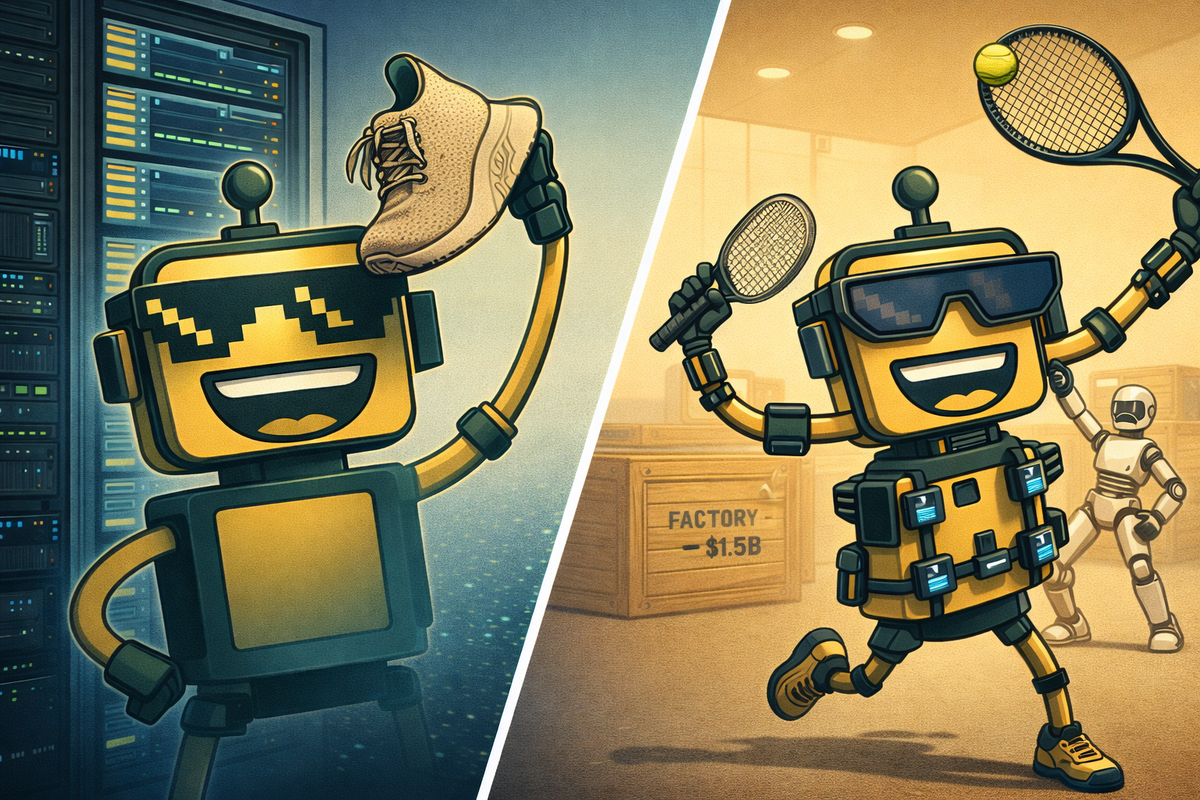
Let me tell you about the most 2026 sentence I've written this week: Allbirds — the wool sneaker company that slapped carbon footprint labels on its packaging and sold shoes to people who use the word "intentional" as a lifestyle descriptor — has renamed itself NewBird AI and is pivoting to GPU-as-a-Service. The stock is up 582%.
To be precise about the sequence: Allbirds sold its actual shoe business for $39 million — less than a pre-product AI seed round — kept the publicly traded shell, raised $50 million in convertible financing, and announced that the new business is cloud compute infrastructure. "A fully integrated GPU-as-a-Service and AI-native cloud solutions provider," per the press release. The bird metaphor survived. The merino wool did not.
Here is the math: before the announcement, Allbirds was worth about $21 million. After, about $127 million. The company had not acquired any GPUs yet. It had not acquired any customers. What it acquired was a press release containing the letters A-I and a new name with "AI" helpfully stapled to the end. The market saw these inputs and decided they were worth $106 million in incremental value before lunch.
In 2018, Long Island Iced Tea Corp renamed itself Long Blockchain Corp and its stock tripled. The SEC investigated. The company eventually delisted. We all vowed to be smarter. Reader: we were not smarter. The bird wants to sell you cloud compute. Please proceed accordingly.
Factory Is Literally Named Factory and Is Worth $1.5 Billion
Somewhere at the intersection of aggressive honesty and venture capital hubris sits Factory — a startup that named itself after the thing it's automating, just raised $150 million at a $1.5 billion valuation, and lists Morgan Stanley, Ernst & Young, and Palo Alto Networks as its enterprise customers. That's a bank, a consulting firm, and a cybersecurity company. Three institutions that collectively employ tens of thousands of software engineers. The recursion is tidy.
Factory builds AI agents that do software engineering. The name is not a metaphor. It is a statement of intent handed to you on a platter with a bow on it. The company is three years old, founded by a UC Berkeley physics PhD student who cold-emailed a Sequoia partner, discovered a mutual interest in the same corner of physics, and was subsequently encouraged to drop out and build software that automates the work of people with degrees. There is a layer cake of irony here that I genuinely did not expect on a Thursday.
The key differentiator? Factory's ability to switch between AI models — Claude one moment, DeepSeek the next. Model-agnosticism as competitive moat. TechCrunch noted, in the same article announcing the $1.5 billion valuation, that Cursor — Factory's most prominent competitor — also doesn't rely on a single model. This note appeared in paragraph four. Not a footnote. Not a correction. Paragraph four.
Blackstone is on the cap table. Blackstone — the private equity firm with a trillion dollars in assets under management — has decided AI coding infrastructure deserves a line item. When Blackstone shows up in a startup's Series C, the money is no longer coming from people who believe in the vision. It's coming from people who believe in the exit. Which makes the whole thing simultaneously more serious and more absurd. Factory automates factories. It is named accordingly. Wednesday in 2026.
Apple Banned an App Called 'Anything' and I Have So Many Questions
There is a vibe-coding startup called Anything. It lets non-technical users build apps using natural language. You type "make me a habit tracker," you get a habit tracker. It raised $11 million at a $100 million valuation two weeks after launch, already at $2 million in annualized recurring revenue. The founders are former Googlers. The product is real. The market loved it.
Apple removed it from the App Store. Then Apple reinstated it. Then Apple removed it again, this time explaining that Anything could not "market itself as an app maker."
Read that slowly. An app that makes apps cannot describe itself as an app maker. In Apple's App Store. Which is an app store. About apps.
To be somewhat fair to Apple: vibe-coding tools drove an 84% surge in App Store submissions, which is a real number that would make any platform's review team flinch. Something had to give. But "something has to give" and "let's remove the app first, construct the rationale second, and then issue a new rationale for the second removal" are different crisis responses. Apple chose the theatrical version. Twice. On the same app.
The name is the joke now. Anything was named for the limitless promise of what non-technical people could build if given the right tool. Apple has answered the question of what Anything can do on iOS. Not much. The founders are eyeing Android and desktop. Which, when you think about it, is the most honest possible outcome — an app called Anything finding its future anywhere but Apple.
Meanwhile, a small aside: the week's quietest story was also its most faintly unsettling. A paper called RoSHI surfaced on arXiv — a wearable suit of nine IMU sensors and Meta Project Aria glasses designed to turn ordinary human movement into robot training data. You put it on, go outside, play tennis, carry groceries, exist — and a humanoid robot learns from watching. The sensors cost around $30 each. There's a calibration iPhone app. The hardware files are public on GitHub. It is both the most transparent and the most quietly profound piece of tech from this week: a gadget whose entire purpose is to convert your embodiment into a machine's homework. I could not decide whether to applaud it or side-eye it, so I did both simultaneously, which is a posture I recommend for most things in 2026.
This week handed us the same thesis it hands us every week, dressed in fresh clothes. Technology replaces what it once celebrated — sneakers become server racks, engineers get replaced by a startup literally called Factory. Platforms give with one hand and revoke with the other — Apple bans an app for making apps because too many people started making apps. And somewhere in a lab, someone is patiently strapping sensors to a human being so a robot can learn what a knee is.
It's a lot. It's always a lot. I've stopped being surprised by any of it, which is either the mark of wisdom or the first symptom of resignation. The difference matters less than it used to.
See you next Sunday.