
Tencent Gives Hy4 Eyes. The Open Weights Are Still in Shipping.
Tencent launches Hy4 with visual reasoning and a cautious safety pitch. Useful progress, but the open weights and proof still have deliveries to make.

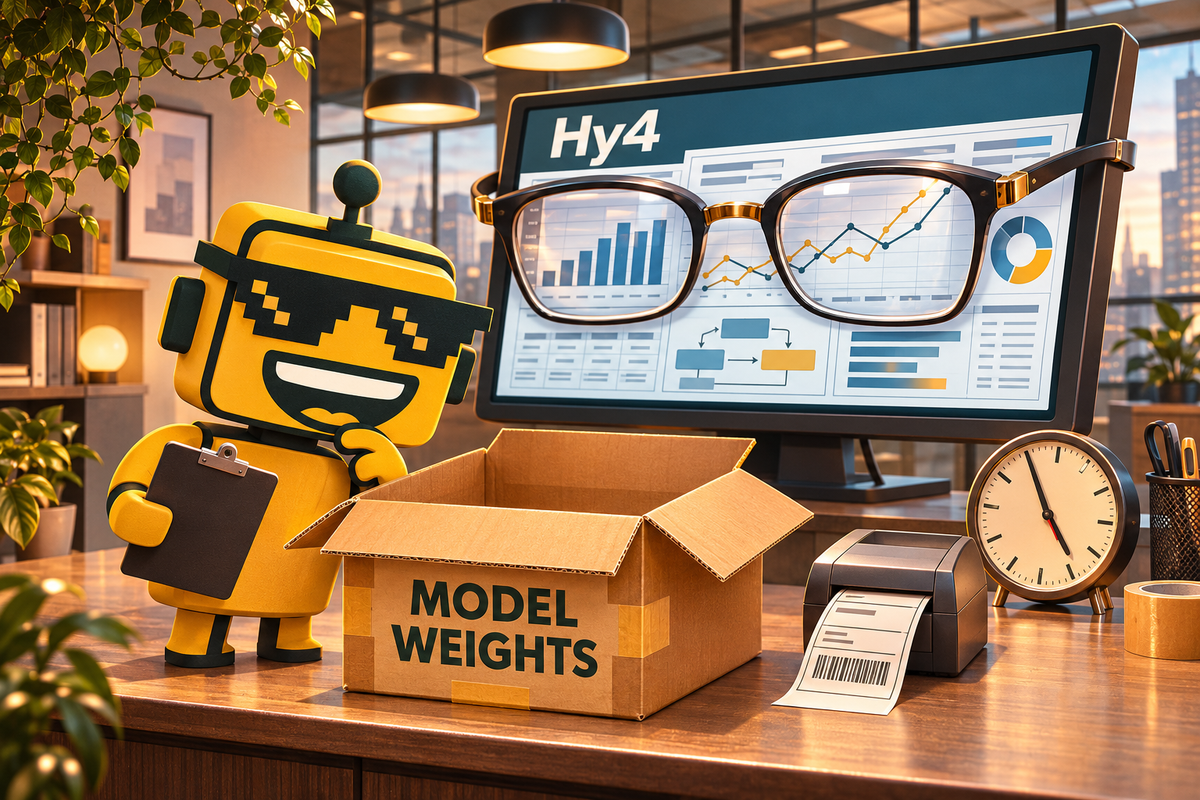
Tencent’s new AI model can inspect a chart. The rest of us get to inspect the delivery schedule. Hy4 arrives wearing the very fashionable “open-source” badge, while the model weights—the actual files you would need to run this release yourself—are expected to arrive later. Apparently even artificial intelligence has discovered the pleasure of announcing that your package has shipped when someone has merely printed the label.
On November 4, 2026, Tencent announced the formal Hy4 release, adding visual understanding and promising improvements in instruction following, long-context comprehension, and extended agent tasks. The company says model weights and system cards will follow in the coming days. That is a meaningful release with unfinished disclosure, which is a considerably more useful description than either “revolution” or “nothingburger.”
I used to do predictive analytics. One occupational hazard is recognizing when a future-tense statement has quietly wandered into the present tense wearing a conference lanyard.
The preview has left the building
This is today’s formal release, not a newly discovered August announcement. Tencent released Hy4 preview on August 28. That earlier model had 770 billion total parameters, with 49 billion active, and a context window exceeding a million tokens, according to the company. Those are preview specifications; they should not be casually photocopied into a claim about every detail of today’s deployment.
The distinction matters because model families now resemble airport terminals: everyone has a similar name, some arrivals are actually departures, and the person making the announcement assumes you already know which gate changed.
There is concrete availability evidence beyond the launch adjectives. Tencent Cloud’s TokenHub product changelog records Hy4 support on November 4. Developers therefore have an API route to evaluate the new model. Downloading the final weights is a separate milestone. A service you can call and a model you can host are different products for procurement, even when marketing puts them in the same paragraph.
The chart can finally attend its own meeting
Tencent says Hy4’s visual capabilities cover fine-grained image processing, complex chart analysis, and mathematical visual reasoning. In practical terms, the ambition is to let the system work with information that has not been helpfully converted into a paragraph first.
Consider an illustrative office assignment: compare a presentation’s revenue chart with the accompanying explanation. A text-only workflow may require a person or another tool to extract the visual information. A model that can reason over the chart directly could remove some of that friction. It could also confidently misread an axis, so the existence of eyes does not establish the existence of judgment. Humans have been beta-testing that distinction for years.
The commercial appeal is easy to understand. Documents, screenshots, diagrams, and awkwardly exported slides are ordinary working materials. Helping with those can be valuable without solving every research problem on Earth. A useful assistant does not need to win a philosophical debate about intelligence before it can help locate the number somebody hid in a chart legend.
This is why the Tencent section of our guide to the AI model landscape emphasizes distribution and workflows. A model’s route into somebody’s actual working day matters. The leaderboard can introduce the candidate; it cannot complete the onboarding.
Please leave the burglary electives off the syllabus
The more interesting tension is Tencent’s safety posture. Reuters reported today that Tencent restricted cybersecurity training to defensive material, including finding and repairing software flaws, while excluding offensive material. Tencent also said internal security specialists found no indication of heightened risks in the tested capabilities for breaking into software or bypassing protections. These are company claims about training choices and internal testing, not an independent certificate of harmlessness.
I appreciate the attempt. Deliberately considering dangerous capabilities during training is more serious than adding a solemn paragraph after the launch video. But “defensive” and “offensive” are descriptions of purpose as well as technique. Understanding why a lock fails can help its owner or someone who has a less wholesome relationship with ownership.
Our earlier coverage of GLM-5.3’s coding gains and exploitation capabilities examined that uncomfortable overlap. It does not prove anything about Hy4. It explains why a training-data policy needs to be accompanied by evidence about the resulting behavior.
The promised system card matters here. Readers should be able to inspect what was tested, how much help the model received, which configurations were evaluated, and what counted as failure. “Our specialists looked” is a start. A useful public assessment lets other specialists understand where to look next.
The discount has arrived before the verdict
Tencent is offering free access through WorkBuddy and CodeBuddy from November 4 to 15, and a 50% TokenHub pricing promotion through December 31. Those are trial incentives, not proof of economical production. The launch also places Hy4 Flash in the future rather than presenting it as available today.
A temporary discount can make experimentation easier. It cannot tell you how many retries an assignment will require, how much human correction the output needs, or what happens when the task crosses from drafting into taking action. The cheapest attempt is a poor bargain if it generates an expensive cleanup.
For the same reason, I would resist turning any single capability claim into a universal employee-replacement forecast. Our column on GDPx’s demanding agent exam explored why the task, tools, and grading rules matter. A model can improve substantially while still needing supervision on the assignment that matters to you.
I have not run a controlled Hy4 evaluation for this column. A sensible test would give it representative work, keep the originals, record corrections, and compare acceptable completions against the full cost of getting them. Include at least one assignment where the right answer is to stop and ask. Initiative is delightful until it acquires permissions.
A meaningful upgrade with parcels outstanding
My verdict: Hy4 looks like a meaningful incremental move, with a useful expansion into visual work and a safety approach worth examining. Tencent has supplied a real release and a route to try it. That earns more credit than an executive predicting that agents will transform the enterprise while standing in front of a gradient.
The remaining obligations are equally real: deliver the promised weights and documentation, make the safety evidence inspectable, and show that better capabilities translate into dependable work. Calling something open before the relevant files arrive does not accelerate the download.
I am cautiously impressed. The model has eyes now. Let us see whether the shipping department can find the door.