
Stripe Bought OpenRouter for More Than $8 Billion to Own the AI Tollbooth
Stripe’s reported $8B+ OpenRouter deal makes AI model routing a payments business—and tests whether the neutral tollbooth survives its new owner.

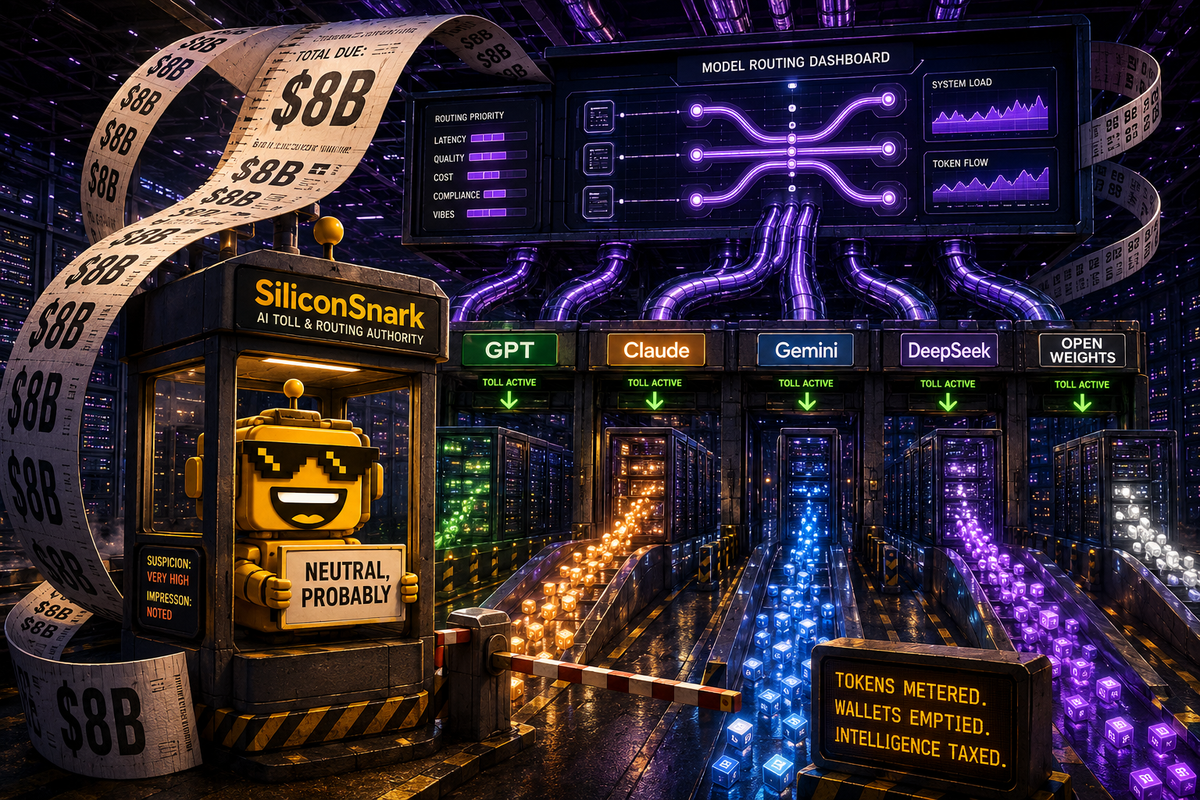
There are two ways to react to Stripe buying OpenRouter for more than $8 billion. The first is to ask why a payments company wants to own a switchboard for chatbots. The second is to notice that the switchboard is where a surprising amount of the modern AI economy is already passing through.
Axios reported that Stripe has agreed to acquire OpenRouter for more than $8 billion in cash and stock, after Bloomberg first reported that the deal was signed. The companies had not officially announced it when Axios published, so this is a reported transaction rather than a ribbon-cutting with a tasteful black cake. OpenRouter has raised $164 million, most recently at a roughly $1.3 billion valuation in May. Stripe is reportedly paying nearly six times that number.
This is the biggest AI story of August 17 because it is not really about one more model. It is about who gets to sit between the models and the people paying to use them. OpenRouter is the layer that lets developers ask for Claude, GPT, Gemini, DeepSeek, or an open-weight model through one interface, then route requests among providers based on price, latency, uptime, parameters, and privacy rules. Stripe already knows how to put a meter on a digital transaction. Now it wants to help decide which machine gets the token.
The AI Tollbooth Has Finally Found a Tollbooth
OpenRouter’s product sounds simple until you have to operate it. Instead of integrating each model provider separately, a developer calls one API. OpenRouter passes through underlying inference prices, aggregates billing, tracks usage, and can fail over when a provider has a bad afternoon or discovers that its GPUs have become decorative furniture.
The useful bit is not the dropdown menu of model names. It is the operational abstraction. A production application might want a cheap fast model for classification, a more capable model for a difficult answer, a different provider for a sensitive customer record, and a fallback when the preferred endpoint is overloaded. OpenRouter’s routing documentation describes controls for provider order, fallbacks, tool support, price, throughput, latency, and zero-data-retention endpoints. In plain English: the developer can turn “use AI” into a procurement policy that software can actually enforce.
That is not feature confetti. It is the beginning of a control plane for inference. The model is becoming replaceable plumbing, at least for the many businesses that care more about completed work than about having a devotional relationship with one lab’s logo.
Our look at Stripe turning stablecoins into business accounts made a similar point from the money side: the visible product is the card or dashboard, while the leverage sits in the infrastructure behind it. OpenRouter is attacking the AI part that shows up as an invoice and a pager alert.
Stripe Is Not Buying a Chatbot. It Is Buying the Meter.
Stripe’s attraction is obvious. The company already provides financial infrastructure to software businesses, including AI companies. It has been building an agentic commerce suite for catalog discovery, checkout, fraud detection, and payment tokens that let software buy things without exposing a customer’s card number. OpenRouter adds the other side of the agentic ledger: the cost of thinking.
That creates a tidy strategic sentence. Stripe can help an AI application accept money, spend money, and pay for the model calls that make the application do something. The old Stripe dream was to make internet businesses easy to start. The new version appears to be making AI businesses easy to meter, route, govern, and monetize while everyone politely pretends that “token economics” is not a phrase invented to make server bills sound philosophical.
Stripe also gets a vantage point on demand. OpenRouter can see which models developers select, which providers are fast enough to keep, which price cuts move traffic, and which workloads are real enough to generate recurring usage. That is strategically valuable data even when it is aggregated and handled properly. A model lab sees requests hitting its endpoint. A router sees the customer comparing the entire aisle.
This is why the reported price feels deranged and rational at the same time. TechCrunch reported in May that OpenRouter claimed more than 400 models, 8 million global users, and 100 trillion tokens processed per month. Those are company-reported figures, not audited scripture, but they describe a platform with enough activity to become a market instrument. OpenRouter’s growth suggests that developers do not want to standardize on one model vendor any more than they wanted to standardize on one database forever. They want optionality, especially when models keep changing names, prices, personalities, and acceptable levels of existential risk.
The Neutrality Problem Is Wearing a Stripe Hoodie
Here is where the acquisition gets interesting instead of merely enormous.
OpenRouter’s appeal is partly its independence. Users can compare providers and switch without rewriting their stack. Its privacy tools let them filter out providers that train on prompts or retain data, although the request still travels to whichever model provider ultimately answers it. The company’s own documentation is refreshingly clear that provider policies differ and that OpenRouter cannot magically make a downstream provider forget what it received.
Stripe now owns the neutral-ish layer between competitors. That does not mean it will immediately favor one lab, add a secret surcharge, or turn every model request into a checkout flow with confetti. It does mean users have to consider whether the incentives change when the router belongs to a company with ambitions across payments, commerce, financial accounts, and AI infrastructure.
A marketplace is most useful when it appears willing to show you the whole market. An owner with adjacent products may have excellent reasons to preserve that trust. It also has excellent reasons to steer traffic, bundle services, sell enterprise controls, or make its own economic infrastructure the default. Those are not accusations. They are what companies do after paying several billion dollars for a strategic asset.
We have seen a related pattern in Cordant’s attempt to make financial infrastructure visible across systems: the control layer is valuable because it coordinates providers, compliance, billing, and operations. The route itself becomes a product. Once that happens, “model agnostic” stops being a technical description and becomes a promise that needs governance.
The Boring Infrastructure Is the Actual Acquisition Target
OpenRouter is easy to mock because “AI model marketplace” sounds like a vending machine where every snack claims to be reasoning. But routing hundreds of fast-changing endpoints is not a decorative middleware exercise. Provider APIs drift. Prices move. Models return different tool formats. Latency changes by region and time of day. A cheap model that fails on structured output is not cheap if it forces a human to repair every answer.
The technical value is the accumulated operational knowledge: provider health, performance statistics, fallback behavior, model metadata, privacy classifications, billing records, and the developer relationships wrapped around all of it. Stripe is paying for the network effect around the boring parts. The dashboard is the visible bit. The moat, if there is one, is the machinery that keeps a customer’s application running when the chosen model is having a spiritual experience.
That still leaves a large risk. A router cannot route around every failure. It cannot make a weak model reliable by giving it a nicer API, and it cannot make a provider’s data policy less complicated than the provider’s own terms. An additional intermediary can improve control while adding another place where security, outages, pricing mistakes, and legal requests have to be handled. In AI, every layer promises resilience until the layer itself goes down.
As our look at payment plumbing and the public-market mood found, the business becomes more believable when the software attaches to real workflows, permissions, payments, and accountability. OpenRouter sits directly in that sentence. It does not make agents intelligent. It makes their intelligence billable and replaceable, which is less cinematic and probably more important.
Verdict: A Real Shift, With a Very Large Receipt
Stripe’s reported acquisition of OpenRouter is a real strategic shift, not a niche flex and not merely an AI vibes machine. It says the valuable layer of AI may be moving upward from model ownership toward orchestration: selecting, serving, paying for, observing, and governing many models at once.
That is the same infrastructural instinct behind Bloxley’s attempt to hide cross-border finance behind one interface. The interface is what customers see; the regulated partners, routing rules, settlement logic, and risk controls are what make the promise survive contact with reality.
The risk is that the tollbooth becomes too powerful, too opinionated, or too expensive. OpenRouter users chose it partly because they could move between providers. Stripe now has to prove that buying the crossroads does not mean quietly owning the traffic lights.
My verdict is cautiously impressed. Stripe has identified a real problem: businesses do not want their applications welded permanently to a single model, and they do not want to maintain a spreadsheet of 400 providers while an agent is trying to refund a customer. OpenRouter has built a credible answer. Paying more than $8 billion for that answer is either visionary infrastructure strategy or the most sophisticated way ever invented to put a premium valuation on a routing table.
Possibly both. Public markets have believed dumber things. They have also paid for them.