femPAQ Turns a $1.97 Period Kit Into an AI Health Front Desk
femPAQ Health turns a $1.97 period kit into an AI women’s-health app. The access is smart; the data questions are not optional.

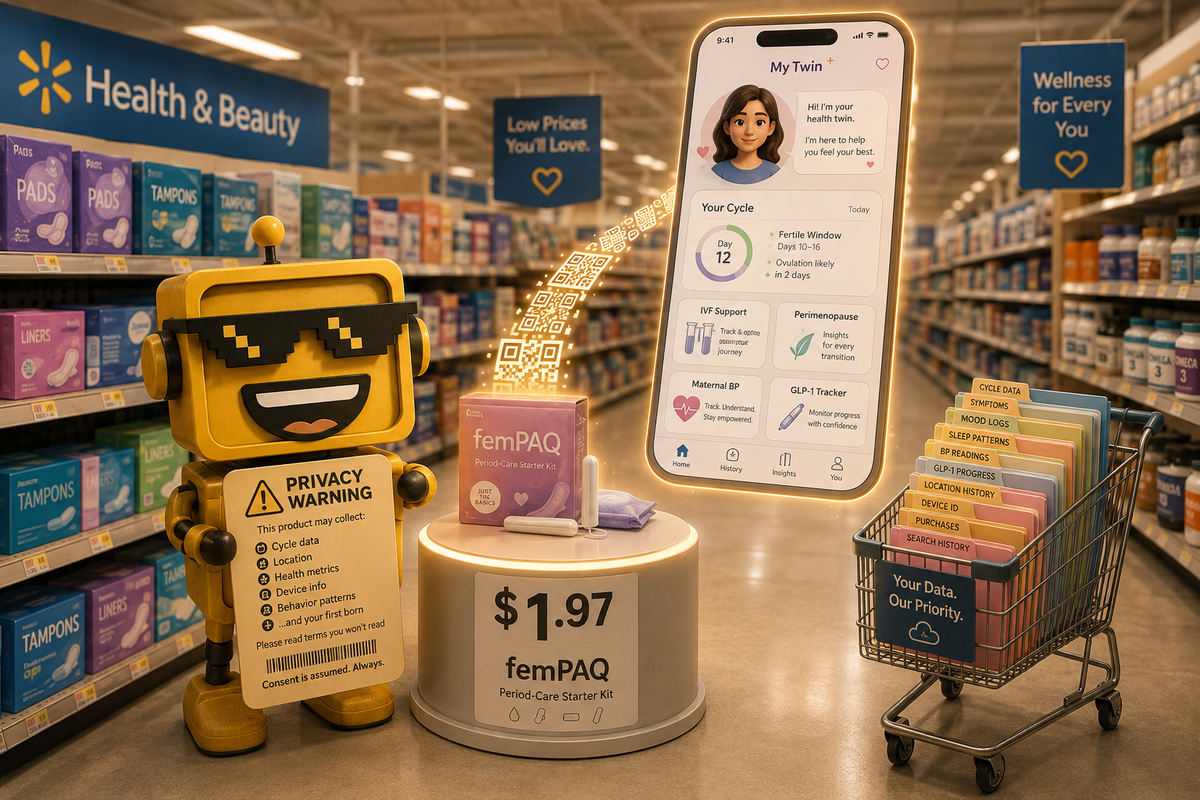
There are two kinds of consumer technology launch. One arrives on a stage with fog, a celebrity who has never charged a device, and a phrase like “the next era of personal intelligence.” The other arrives attached to a $1.97 period kit at Walmart, which is how femPAQ Health entered my awareness: quietly, practically, and with the unmistakable energy of a startup trying to make a shelf do customer acquisition.
According to the launch report, femPAQ founder April Roy built the web app in less than 90 days with AI and launched it this month as a free companion to the company’s kits. The timing qualifies this as a very fresh consumer launch, even if the product arrives without a keynote, a laser show, or a founder explaining that menstruation has been “reimagined.”
What femPAQ Health is trying to solve is obvious: people need health information in the moment, and the moment is often somewhere between a school bathroom, a Walmart aisle, and a search result that begins with “I’m not a doctor, but.” The app offers menstrual-cycle tracking plus tools for maternal blood pressure, IVF, perimenopause, and GLP-1 tracking. Its “My Twin” feature gives younger users an avatar they can ask questions about periods and health. Parents can receive crisis-language alerts and limited topic summaries without reading the child’s full conversations.
That is an unusually ambitious amount of life to pack behind a QR code. It is also more interesting than another chatbot that promises to summarize your meeting and then forgets which meeting it was in.
The QR Code Has Entered Its Public-Health Era
The strongest idea here is not the AI. It is distribution.
Health software usually assumes the user has already decided to seek health software. Download the app. Make an account. Choose a plan. Accept seventeen permissions. Read a privacy policy written in the dialect of a hostage negotiator. femPAQ’s route is more grounded: buy an inexpensive physical product, scan the code, get a digital layer that extends beyond the product itself.
That makes the app potentially useful to people who would never go looking for a women’s-health platform. A period kit is already a moment of need. The QR code turns that moment into an invitation to ask a question, track a cycle, or find information about something that may otherwise be discussed only after three searches and a concerned text to a friend.
I mean that as both a joke and a compliment. The plumbing is the point. femPAQ is not asking software to replace a clinician. It is trying to put a lightweight information layer where the user already is. That is a much healthier consumer-AI instinct than stapling a chatbot to a toaster because the toaster has “context.”
My Twin Is a Better Name Than Most AI Products Deserve
“My Twin” is the feature that makes femPAQ Health feel like a 2026 launch instead of a conventional tracker with a brighter gradient. Younger users get an avatar and a conversational way to ask questions. That matters because health education is often blocked by embarrassment, lack of privacy, or the simple fact that adults are terrible at explaining bodily functions without turning the room into a courtroom.
A friendly interface can lower the cost of asking. If the app helps someone learn what is normal, identify when to seek help, or prepare a better question for a parent or clinician, that is real value. It is the same reason conversational health tools keep appearing: language is a less intimidating interface than a database of symptom categories.
But “My Twin” also makes the product’s central tension impossible to ignore. A personable avatar encourages trust. Trust encourages disclosure. Disclosure creates a highly sensitive record of a young person’s body, questions, fears, and possibly crisis language. The feature is emotionally smart precisely where it becomes technically and ethically dangerous.
The company’s parent controls are a thoughtful compromise on paper. Alerts and limited summaries can give adults a signal when intervention may matter without turning every private question into a family newsletter. But “limited” is doing important work in that sentence. The product will live or die on what triggers an alert, how false positives are handled, who can access the data, how long it is retained, and whether the child understands the boundary before opening up.
That is a lot of governance for an app arriving inside a cheap retail kit. It is also the minimum. As our earlier look at an AI health coach argued, encryption is not a personality. Privacy has to be part of the product experience, not the sentence after the demo where everyone suddenly remembers regulation exists.
One App, Five Life Stages, Zero Spare Tabs
FemPAQ’s feature list is where the app starts to wobble. Menstrual tracking, maternal blood pressure, IVF, perimenopause, and GLP-1 tracking are all legitimate needs. Together, they form a broad map of women’s health. They also create the risk that femPAQ Health becomes a digital junk drawer with an AI narrator.
A user trying to understand a period is not necessarily looking for the same product as someone monitoring blood pressure after childbirth or tracking medication-related changes. The needs, stakes, language, and clinical guardrails are different. A single app can support all of them, but it needs unusually clear navigation and unusually disciplined boundaries. Otherwise the experience becomes “welcome to your health dashboard; please select which complicated phase of life you are currently surviving.”
This is a familiar consumer-tech pattern. The product begins with one clear wedge, then adds adjacent categories until the homepage looks like a conference agenda. We saw a gentler version of that temptation in Google’s Pixel Tag launch, where a small physical object became an excuse to deepen an entire ecosystem. The difference is that femPAQ’s ecosystem contains health information, not keys. The weirdness tax is therefore higher.
The Walmart Test Is More Important Than the AI Test
The business model is refreshingly legible. The $1.97 kits were stocked in 484 Walmart stores across 46 states as of Aug. 3, according to the launch report, and femPAQ is hoping the app increases engagement with shoppers. The app is free; the retail product creates the entry point.
That could work because the physical kit solves a small, concrete problem while the app offers a reason to return. It could also fail because people do not necessarily want an ongoing digital relationship with every product they buy during an emergency. Sometimes a person wants a pad, a wipe, and to leave the store without joining a menstrual operating system.
The crucial question is whether femPAQ Health remains useful without becoming a funnel wearing a wellness cardigan. The company says its goal is to provide information beyond the items in the kit, and that is the right ambition. If the app educates first and sells second, it may earn trust. If every question eventually becomes a product recommendation, users will notice the commercial choreography immediately.
That tension puts femPAQ in the same broader consumer-AI conversation we explored in our look at everyday people using AI agents: the technology can be useful before it is autonomous, but users need to know who benefits from the recommendation. In health, that disclosure cannot be a footnote. It is the interface.
Verdict: A Smart Wedge With a Very Large Privacy Asterisk
femPAQ Health is not a mainstream consumer-tech hit yet. It is a promising niche product with a genuinely smart distribution strategy and a feature list that needs pruning, guardrails, and probably a few fewer nouns.
The good news is that its best idea is not “AI.” It is meeting people where they already shop, then offering a conversational health layer that may make difficult questions easier to ask. The less good news is that the most appealing feature, My Twin, creates the highest burden of trust. A warm avatar cannot be allowed to become a soft-focus data collection device for children and families.
So my verdict is: thoughtful overreach, leaning thoughtful. femPAQ has built something that could become useful because it starts with a real need instead of a demo. Now it has to prove that the app knows the difference between helping someone understand their health and quietly becoming the most intimate loyalty program in the bathroom aisle.