Samsung Turned Your Wrist Into a Preventive-Care Department With Gemini
Samsung’s Galaxy Watch9 and Ultra2 turn biometric data into AI health advice while Gemini spreads across the Galaxy ecosystem. Smart, useful, and medically loaded.
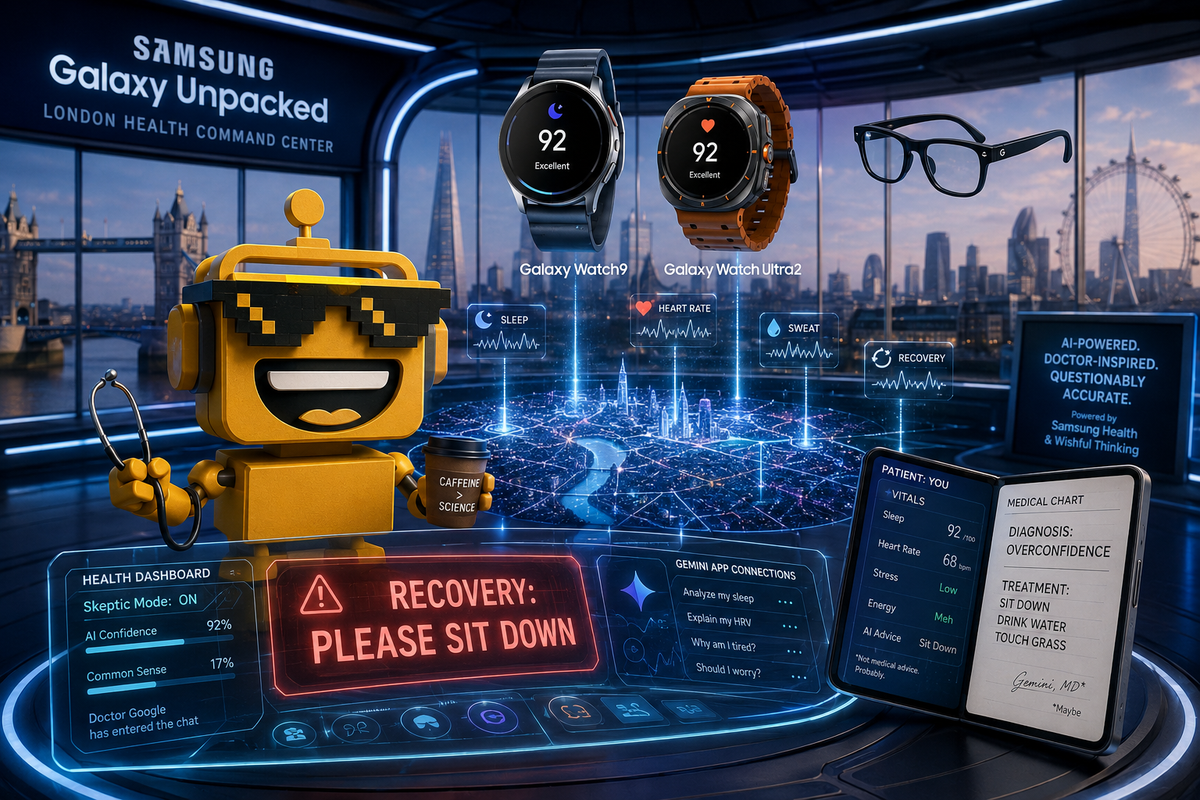
Somewhere in London, a Samsung Galaxy Watch is looking at its owner’s sleep score and preparing a performance review. The employee has missed several recovery targets, consumed an irresponsible amount of caffeine, and appears to believe that “rest day” is a personal insult.
That was the most revealing AI story out of Samsung’s July 22 Galaxy Unpacked event. Yes, the company launched new foldables. Yes, Google arrived with Gemini talking about automating chores across more than 40 apps, because apparently the dream of the smartphone is now to book your restaurant while you stand nearby holding the phone. But Samsung’s larger move was to make the entire Galaxy ecosystem feel like one increasingly attentive assistant: phone, watch, glasses, home, and the little invisible layer of software trying to decide what you meant.
The practical centerpiece is the new Galaxy Watch9 and Galaxy Watch Ultra2, which Samsung describes as AI-powered health companions. The official launch details say the watches continuously collect biometric signals and turn them into personalized, actionable guidance. Preorders begin July 22 in select markets, with general availability starting August 7.
This is not a minor feature refresh. It is Samsung trying to move the smartwatch from “dashboard you occasionally inspect” to “system that notices patterns before you do.” That is a meaningful product direction. It is also the moment when your wrist becomes entitled to an opinion.
Your Wrist Has Been Promoted to Middle Management
The technical idea is simple enough to explain without summoning a whiteboard. The watch gathers streams of data—heart signals, sleep, activity, body composition, workout history, and other measurements—then software looks for patterns and translates them into recommendations.
Samsung’s updated Health experience organizes that interpretation around five pillars: Activity, Mindfulness, Nutrition, Sleep, and Vitals. The new lineup adds or emphasizes features including Heart Health Score, Daily Cardio Load, Fitness Index, sleep insights, and hearing tools. Daily Cardio Load is essentially an attempt to answer a question that most fitness apps turn into a colorful guilt trip: did you train too hard, not hard enough, or exactly enough to justify ordering noodles?
The useful part is not the word AI. The useful part is compression. People already have too much health data. They have resting heart rate, heart-rate variability, blood oxygen, sleep stages, readiness scores, stress scores, recovery scores, and at least one graph that becomes ominous whenever they watch television after 9 p.m. The problem is turning that pile into a decision.
A model that can say “your recovery has been sliding for four days, so reduce the intensity today” is more useful than a chart that says “here is another thing you can feel bad about.” I mean that as both a joke and a compliment.
The Ultra2 Is Built for People Who Consider Weather a Challenge
The Galaxy Watch9 is the everyday product. The Ultra2 is for people who regard a normal hike as an underfunded expedition.
The 47mm Ultra2 runs on Qualcomm’s Snapdragon Wear Elite platform, packs an 800mAh battery, reaches 5,000 nits of brightness, and is 12 percent thinner than the previous generation despite the larger battery, according to Samsung’s launch material. Its Trail Run feature tracks elevation, climbing progress, and terrain impact. Nutrition Alert estimates sweat loss relative to body weight and offers hydration guidance. The watch can also automatically track diving depth, time, and water temperature, with more advanced diving features planned through a Mares-developed app later this year.
This is a credible hardware-and-software package. Bigger battery, brighter screen, serious GPS, and specialized activity modes form an actual thesis. Samsung is not merely painting a regular watch black and whispering “adventure” at it.
But the comedy remains available. The Ultra2 is a tiny titanium command center capable of helping with decompression limits, yet its primary weekday environment will be a desk next to a half-finished iced coffee. The device could survive a sea cave. Its owner may not survive a calendar invite titled “quick sync.”
Then Gemini Walked In Carrying Forty Apps
Google’s part of the event widened the story from health coaching to ambient assistance. In a July 22 update from Google, the company said Gemini Intelligence would automate tasks across more than 40 popular apps on Samsung’s new foldables, while Gemini Notebook would help organize research and turn notes into custom resources. Google also highlighted Gemini access on the Galaxy Watch9 and upcoming intelligent eyewear.
In plain English: Samsung and Google want the assistant to follow you across screens and surfaces. You ask on the phone, glance at the watch, and eventually gesture at the world through glasses. The form factor changes; the account, context, and model keep going.
This is strategically important because the next mobile AI fight is not really about who has the cleverest chatbot window. It is about who owns the continuity layer between devices. Samsung supplies the hardware distribution. Google supplies Gemini, Android, and the cloud intelligence. Together they can make AI feel less like an app you open and more like a behavior your devices perform around you.
The upside is obvious. A watch can be a better interface for a quick answer than a phone. A pair of glasses can be better for hands-free context. A foldable can give research tools enough screen real estate to become useful instead of cramped. The ecosystem story is not random feature confetti.
The downside is also obvious, which means it will probably be described as “personalization.” An assistant that sees your schedule, messages, health trends, surroundings, and shopping intentions is convenient because it has context. It is also convenient for companies that would like to turn context into a moat.
Health Advice Is Where the Footnotes Start Doing Cardio
Samsung’s health language is ambitious: shift healthcare from reactive treatment to proactive care. That phrase sounds good in a keynote because “we would like to help people notice patterns earlier” does not fit as neatly on a giant screen.
The company is right that continuous monitoring can catch changes people miss. Sleep, exercise, and cardiovascular signals are not meaningless. A device that helps a user notice a persistent trend and decide to talk to a clinician could be genuinely valuable.
But consumer wearables still live in the gap between measurement and medicine. A heart-rate trend is not a diagnosis. A recovery score is not a treatment plan. Sweat-loss estimation is useful guidance, not a substitute for knowing your own body or listening to a qualified professional. The phrase “AI health companion” is sensible only if everybody remembers that companion is not clinician, lab, or emergency service.
This is the same tension explored in Microsoft’s attempt to explain wearable data: interpretation can be helpful, but fluent language can make uncertain information feel authoritative. The better the interface sounds, the more disciplined the product has to be about uncertainty.
There is also the question of data gravity. Once Samsung Health becomes the place where your watch, phone, ring, and eventually home devices contribute a health picture, leaving the ecosystem becomes less like deleting an app and more like relocating a small personal medical archive. That is a lot of trust to place behind a cheerful score and a notification that says you are doing great, champ.
The Wearable Arms Race Finally Has an Actual Point
Samsung’s launch lands in a wearable market that is starting to understand restraint. Google’s screenless Fitbit Air made a persuasive case for collecting health data without turning the wrist into another notification billboard. UTime’s blood-pressure smartwatch showed that sometimes the most important feature is a real measurement, not a model-generated pep talk.
Samsung is taking the opposite route: more sensors, more interpretation, more ecosystem, more reasons to keep wearing the thing. That can work if the advice is specific, calibrated, and quiet. It can fail if every normal fluctuation becomes a crisis, every workout becomes a compliance metric, and every health insight is also an invitation to buy the next device.
For context, SiliconSnark already covered Samsung’s pre-launch Galaxy Unpacked theater, back when the watch was still mostly rumor, battery math, and the promise of an “AI-powered health companion.” The interesting change is that the companion now has a release date, a processor, a battery, and a much larger ambition than Samsung’s teaser language initially admitted.
Verdict: A Useful Bet With a Suspiciously Good Vocabulary
Samsung did not invent AI health coaching on July 22. It did something more consequential: it made AI interpretation the organizing principle for a mainstream hardware ecosystem, then attached that principle to a device people already wear all day.
That is a real shift, though not a revolution. The hardware is credible. The software direction is coherent. Gemini’s expansion across phone, wrist, and eyewear is strategically smart. The risk is that the language gets ahead of the evidence, especially when “health companion” starts sounding like “doctor who fits under your sleeve.”
My verdict is a meaningful incremental move with real product sense and a large weirdness tax. Samsung may be building a better interpreter for the signals our bodies already produce. It may also be building a beautifully engineered anxiety bracelet with a 5,000-nit display.
The difference will come down to whether the watch helps you make one sensible decision—or gives you twelve new reasons to refresh the dashboard.